By Eric Andrew Kristof, RN, CAHIMS | Healthcare IT Professional | HIMSS Arkansas Chapter Member
About This Series: The HIMSS Word of The Day is a running blog series drawing from the HIMSS Dictionary of Health Information and Technology Terms, Acronyms, and Organizations, 6th Edition (2025) — the authoritative reference for healthcare IT professionals and the primary study resource for CAHIMS and CPHIMS certification. Each post paraphrases the term in plain language, grounds it in real-world healthcare IT context, and adds a bedside nursing perspective you won’t find in a textbook.
📖 The Term: AMIA (American Medical Informatics Association)
Source: HIMSS Dictionary of Health Information and Technology Terms, Acronyms, and Organizations, 6th Edition (2025)
🔍 Plain-Language Definition
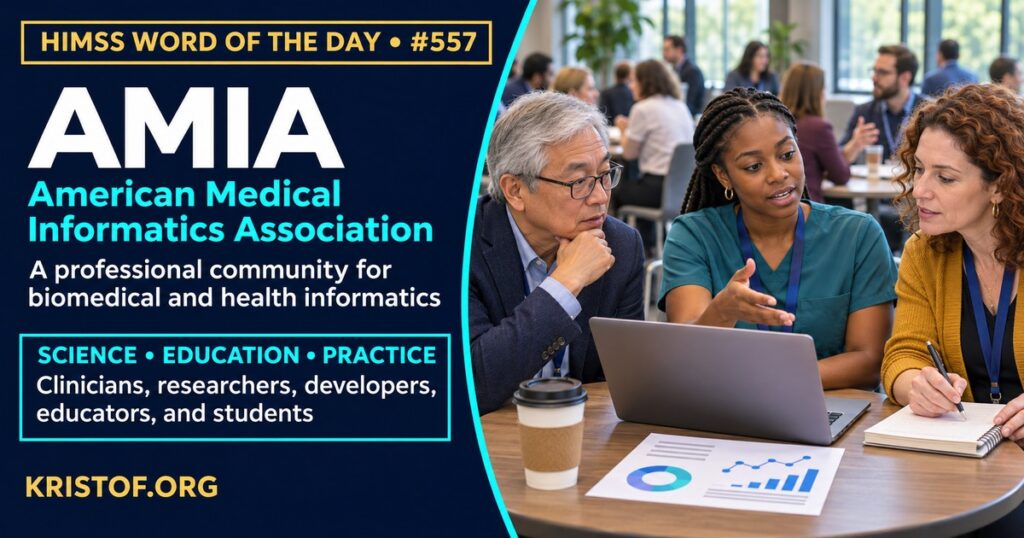
The HIMSS Dictionary lists AMIA (American Medical Informatics Association) in its organizations appendix as a membership association for people interested in biomedical and health informatics, with a stated aim of changing health care through reliable science, education, and informatics practice.
AMIA describes itself on its own site as the professional home for informaticians, with more than 5,600 members, including clinicians, researchers and educators, librarians, students, developers and data scientists, policymakers, and consultants. That figure is AMIA’s own, so it is best read as the association’s description of its community. Its mission page says AMIA aims to lead health care transformation through trusted science, education, and informatics practice, and it lists core purposes such as advancing the science of informatics, promoting informatics education, and advancing the profession.
On history, AMIA’s mission-and-history page says the association was formed in 1988 by merging three organizations: the American Association for Medical Systems and Informatics, the American College of Medical Informatics, and the Symposium on Computer Applications in Medical Care. AMIA’s page is the only source for that date checked for this post, so treat it as AMIA’s statement. The page refers to the American College of Medical Informatics as AMIA’s honorary college.
| Item | Detail |
|---|---|
| Type | Membership association for informatics (AMIA’s description) |
| Formed | 1988, from three predecessor organizations, per AMIA |
| Focus | Biomedical and health informatics science, education, and practice |
| Education | Conferences, e-learning, webinars, and the AMIA 10×10 program |
| Certification | AMIA Health Informatics Certification (ACHIP credential) |
| Relation to HIMSS | Separate organization; HIMSS offers CAHIMS and CPHIMS |
⚠️ Exam Alert: AMIA is an association for biomedical and health informatics and is the home of the ACHIP credential. HIMSS is a separate organization that offers CAHIMS and CPHIMS. Do not confuse AMIA with AHIMA, which serves health information management professionals, or with ANCC, which offers nursing certifications. The physician clinical informatics subspecialty is a board certification administered through the medical boards, not by AMIA.
🌐 Why It Matters: Real-World Healthcare IT Context
Because AMIA is an organization, this section draws on its own pages, read directly for this post, plus two sources that are not AMIA’s marketing. The AMIA pages show what the association says it does. They are not independent evaluations.
Education and community. AMIA’s about page says the association is accredited by the Accreditation Council for Continuing Medical Education (ACCME) and often offers continuing education credit. It lists annual conferences, live and e-learning programs, webinars, a career center, and the AMIA 10×10 distance-learning program offered with academic partners. It also describes a Clinical Informatics Board Review Course for physicians preparing for certification. These are AMIA’s descriptions of its programs.
The health informatics certification. AMIA’s news page on its first diplomates says the AMIA Certified Health Informatics Professional (ACHIP) credential is meant for interprofessional informatics practitioners and aims to standardize expectations for skills, knowledge, and experience. It says the Health Informatics Certification Commission, which AMIA created, administers the program, that the first exam period ran from October 2021 to January 2022, and that 96 professionals were the first to earn the designation. A separate AMIA page on eligibility says candidates need a graduate degree in health informatics or a related field plus qualifying health informatics experience, with the amount of experience depending on the degree type, and offers a free eligibility check. That page carries no date, so current requirements should be confirmed with AMIA.
How the certification came about. Gadd and colleagues, in the Journal of the American Medical Informatics Association (2016), wrote an AMIA Board white paper describing the effort. They report that in 2005 AMIA leaders and members concluded that certifying advanced informatics professionals would have value, that AMIA first led the effort to create the clinical informatics subspecialty for physicians certified by American Board of Medical Specialties boards, and that since 2012 it had worked toward certification open to all health informatics practitioners. In November 2015 the AMIA board endorsed proposed eligibility requirements. Because the authors write for AMIA, this is AMIA’s account of its own work, and it reports status as of 2016.
An independent view of the subspecialty. The American Board of Preventive Medicine describes clinical informatics physicians as professionals who work with health care and IT colleagues to design, implement, and evaluate information systems. Its page lists the requirements: an unrestricted medical license, a medical degree, current primary specialty certification, and, for the main pathway, at least 24 months in an accredited clinical informatics fellowship. The page does not mention AMIA’s role.
Status check. AMIA’s pages were reachable and described current programs when read in November 2026. The mission page shows no date, and the history in this post rests on that page.
AMIA’s pages describe a membership association that combines education, an informatics community, and a certification system, while the subspecialty for physicians is overseen by medical boards.
Common AMIA mix-ups:
- Treating AMIA and HIMSS as the same organization
- Thinking CAHIMS or CPHIMS comes from AMIA
- Assuming AMIA membership is limited to physicians
- Mixing up the ACHIP credential with the physician clinical informatics subspecialty
- Relying on an undated eligibility page instead of checking current requirements
- Quoting AMIA’s membership figure as an independent count
What AMIA offers:
- A professional community for informatics practitioners and students
- Annual conferences, webinars, and e-learning
- The AMIA 10×10 distance-learning program with academic partners
- A board review course for physicians preparing for subspecialty certification
- The ACHIP credential for interprofessional health informatics practitioners
- A career center
🏥 The Nurse’s Perspective: Clinical, Bedside, & Workflow
Nurses who work in informatics often move between nursing bodies, HIMSS, and AMIA, and each plays a different role.
At the Bedside
Nurses are not required to join anything to benefit from informatics work, but the community around it shapes the tools they use. AMIA brings together clinicians, researchers, and developers, so a bedside idea, such as a clearer alert or a simpler handoff screen, can find an audience beyond one hospital.
In Clinical Workflow
AMIA says its certification was developed for a range of professions, including nursing, medicine, pharmacy, dentistry, nutrition, and public health. For nurse informaticists, this offers one more credential path alongside nursing-specific certifications and HIMSS credentials. The right choice depends on the person’s background and goals, and AMIA’s eligibility requirements should be read in full before applying.
In EHR Implementation (Go-Live Perspective)
During an Epic Go-Live, analysts and nurse informaticists with different credentials work side by side. The shared language of informatics, which AMIA and HIMSS both promote, helps them describe a problem in the same terms and hand it to the build team. Education in that language is one reason professional associations matter at go-live.
🎓 CAHIMS / CPHIMS & HIMSS Perspective
CAHIMS Exam Domain Mapping
AMIA connects professional identity, education, and credentials:
| CAHIMS Domain | How AMIA Appears |
|---|---|
| Healthcare & Technology Environments | Professional associations and the informatics community |
| Clinical Informatics | The field AMIA supports and the clinical informatics subspecialty |
| Healthcare Information & Systems Management | Informatics competencies and education for system work |
| Management & Leadership | Credentials, professional development, and workforce planning |
Key Terms to Know Alongside AMIA
- Biomedical informatics — interdisciplinary field that studies how data, information, and knowledge improve health
- Clinical informatics — application of informatics and technology to deliver health care services
- Nursing informatics — specialty that integrates nursing science with information management
- Health informatics — field that applies information science to health and health care
- CMIO (Chief Medical Information Officer/ Chief Medical Informatics Officer) — physician leader for clinical information systems
- Informatics competencies — knowledge, skills, and attitudes expected of informatics professionals
HIMSS Organizational Position
HIMSS offers education and research on health information and technology topics through its Resource Center. Members can find related information on the HIMSS Resource Center page.
🧭 More HIMSS Word of The Day Terms
Related terms in the Clinical Informatics series:
- Usability
- TIGER Initiative (Technology Informatics Guiding Education Reform)
- Patient Classification (PCS)
- UI (User Interface)
Browse all Clinical Informatics terms or the A–Z glossary.
🔗 Explore Further: External References
- AMIA — Mission and History https://amia.org/about-amia/mission-and-history
- AMIA — About AMIA https://amia.org/about-amia
- AMIA — AMIA Announces Inaugural Class of ACHIP Diplomates https://amia.org/news-publications/amia-announces-inaugural-class-achip-diplomates
- AMIA — Health Informatics Certification: Eligibility Criteria and Program Details https://amia.org/news-publications/amia-health-informatics-certification-eligibility-criteria-and-program-details
- Gadd et al. (2016), Journal of the American Medical Informatics Association : JAMIA — Creating advanced health informatics certification https://pubmed.ncbi.nlm.nih.gov/27358327/
- American Board of Preventive Medicine — Clinical Informatics https://www.theabpm.org/become-certified/subspecialties/clinical-informatics/
- HIMSS — Resource Center https://www.himss.org/resource-center
Term source: HIMSS Dictionary of Health Information and Technology Terms, Acronyms, and Organizations, 6th Edition (2025). All definitions in this series are paraphrased for editorial purposes. Readers are encouraged to consult the primary source for exact language.
Eric Andrew Kristof, RN, CAHIMS is a Healthcare IT professional and HIMSS Arkansas Chapter member based in Hot Springs Village, AR, with hands-on Epic Go-Live experience and a diverse healthcare and IT background. He writes at kristof.org at the intersection of clinical care and healthcare technology.
Leave a Reply