By Eric Andrew Kristof, RN, CAHIMS | Healthcare IT Professional | HIMSS Arkansas Chapter Member
About This Series: The HIMSS Word of The Day is a running blog series drawing from the HIMSS Dictionary of Health Information and Technology Terms, Acronyms, and Organizations, 6th Edition (2025) — the authoritative reference for healthcare IT professionals and the primary study resource for CAHIMS and CPHIMS certification. Each post paraphrases the term in plain language, grounds it in real-world healthcare IT context, and adds a bedside nursing perspective you won’t find in a textbook.
📖 The Term: Biomedical Informatics
Source: HIMSS Dictionary of Health Information and Technology Terms, Acronyms, and Organizations, 6th Edition (2025)
🔍 Plain-Language Definition
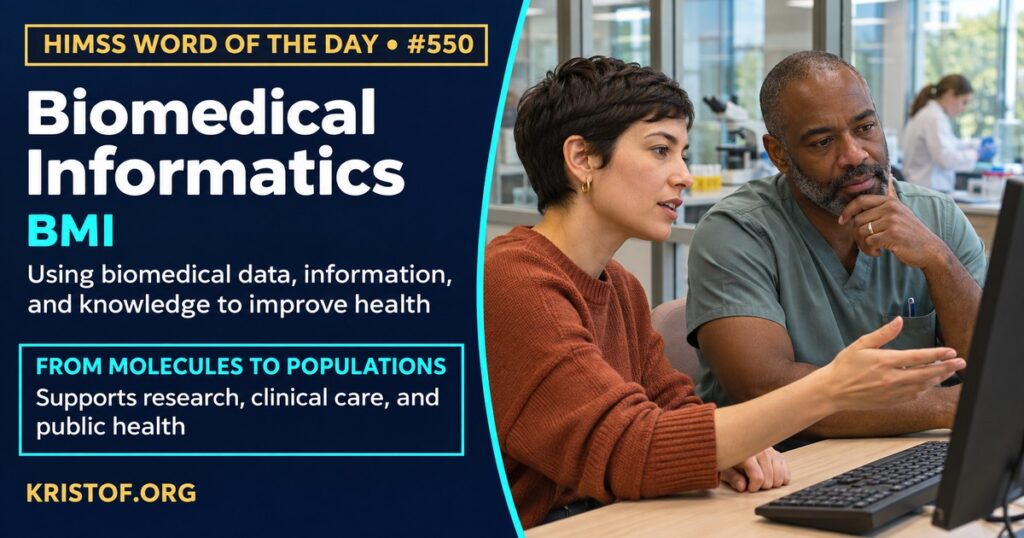
The HIMSS Dictionary defines biomedical informatics (BMI) as a field that draws on many disciplines to study how biomedical data, information, and knowledge can be used well in research, problem solving, and decisions, with the goal of improving human health. The Dictionary’s definition matches the core definition that the American Medical Informatics Association (AMIA) adopted, as quoted in an AMIA Board white paper by Kulikowski and colleagues (2012).
AMIA’s own website adds four statements about what BMI does. It develops, studies, and applies theories, methods, and processes for generating, storing, retrieving, using, and sharing biomedical data, information, and knowledge. It builds on computing, communication, and information sciences and their use in biomedicine. It supports reasoning, modeling, simulation, experimentation, and translation from molecules to populations, bridging basic and clinical research, practice, and the health care enterprise. And, because people are the ultimate users of biomedical information, it draws on the social and behavioral sciences to guide the design and evaluation of technical solutions. AMIA also says health IT is part of informatics but is only one component of the field.
AMIA lists several areas of practice. These are the areas the association names, not a complete map of the field.
| AMIA practice area | AMIA’s description, in brief |
|---|---|
| Translational bioinformatics | Methods to turn large volumes of biomedical and genomic data into predictive, preventive, and participatory health |
| Clinical research informatics | Informatics for discovering and managing new knowledge, including trials and secondary use of clinical data |
| Clinical informatics | Applying informatics and information technology to deliver health care services |
| Consumer health informatics | Informatics from patient and consumer viewpoints, such as health literacy and personal health records |
| Public health informatics | Informatics for surveillance, prevention, preparedness, and health promotion |
For health IT professionals, the useful idea is that BMI is the umbrella science, while jobs and credentials are usually tied to one of its practice areas. A nurse informaticist, a health information exchange analyst, and a clinical research data manager all work within it.
⚠️ Exam Alert: Biomedical informatics is the broad scientific field that includes bioinformatics, clinical informatics, public health informatics, and other areas. Bioinformatics, in the Dictionary, applies computer science, statistics, and algorithms to biological data. Clinical informatics is the part of the field that applies informatics and technology to delivering care. Do not confuse BMI with health IT, which is one component of informatics, or with AMIA, the association that promotes the field. HIMSS offers CAHIMS and CPHIMS.
🌐 Why It Matters: Real-World Healthcare IT Context
The question “what is informatics?” sounds academic, but the answer shapes curricula, job descriptions, and certifications. The sources below look at how the field has been defined, taught, and credentialed. Each was checked against its published abstract or page, and the type of source is noted. Several are position papers or board documents rather than studies.
AMIA’s description. The AMIA page “What is Informatics?” presents the definition, the four statements above, and the practice areas. It is the association’s own statement, not an independent review.
The definition and core competencies. Kulikowski and colleagues, in the Journal of the American Medical Informatics Association (2012), wrote an AMIA Board white paper that sets out the adopted definition and the core competencies for graduate education in BMI. They describe BMI as the core scientific discipline under the field’s research, practice, and education, with application areas from bioinformatics to clinical and public health informatics that span molecular to population levels. The shared competencies draw on many informatics subdisciplines and are meant to guide curriculum design. This is a consensus document from a professional association, not a test of whether the competencies work.
A philosophical argument. Bernstam and colleagues, in the Journal of Biomedical Informatics (2010), argued that BMI lacked a clear, theoretically grounded definition. Drawing on the philosophy of information, they define informatics as the science of information, where information is data plus meaning, and BMI as that science applied to biomedicine. They suggest that informatics problems become harder when meaning has to be captured, and that informatics work should focus on biomedical information as data plus meaning, not only on computer applications. It is a conceptual paper, and other definitions remain in use.
Master’s-level competencies. Valenta and colleagues, in the Journal of the American Medical Informatics Association (2018), described the AMIA 2017 core competencies for applied health informatics education at the master’s level. The AMIA Accreditation Committee refined earlier work to establish 10 foundational domains, each with example statements of knowledge, skills, and attitudes, intended for curriculum development and accreditation quality assessment. The domains cover all AMIA subdisciplines, and the committee plans periodic updates. This is another board white paper.
Gaps between competencies and courses. Ritko and Odlum, in the AMIA Annual Symposium Proceedings (2013), used AMIA’s BMI core competencies as a framework to label course offerings in graduate programs. Their qualitative analysis found gaps between the defined competencies and curricula. Topics missing from existing graduate curricula included community health, translational and clinical research, knowledge representation, data mining, communication, and evidence-based practice. The study dates from 2013, so programs may have changed.
Certification. Gadd and colleagues, in the Journal of the American Medical Informatics Association (2016), described AMIA’s effort to establish advanced health informatics certification. The effort began with the clinical informatics subspecialty for physicians certified by the American Board of Medical Specialties. Since 2012, AMIA had worked toward advanced certification for all health informatics practitioners regardless of primary discipline, and in November 2015 its board endorsed proposed eligibility requirements. The paper reports status as of 2016, so current details should be checked with AMIA.
Taken together, the sources show a field with a settled core definition, active debate about its foundations, a competency framework used to guide education, and growing formal certification. They also show gaps between the competency lists and what programs teach.
Common biomedical informatics problems:
- Treating informatics as a synonym for information technology
- Using bioinformatics, clinical informatics, and health informatics interchangeably
- Assuming certification and degree paths are the same across the field’s practice areas
- Confusing AMIA with HIMSS, or assuming one credential covers the other
- Expecting every graduate program to cover the same competencies
- Relying on older papers without checking what has changed
What supports a strong informatics foundation:
- A clear working definition shared across teams
- Competency frameworks used to design training and job roles
- Attention to meaning and workflow, not only to software
- Education that covers data, knowledge representation, and evidence-based practice
- Clinicians and technologists who can work in each other’s vocabulary
- Awareness of the credentials offered by AMIA, HIMSS, and other bodies
🏥 The Nurse’s Perspective: Clinical, Bedside, & Workflow
Nursing informatics is one part of the larger field of biomedical informatics, and nurses often learn its ideas through practice.
At the Bedside
Nurses already work with data, information, and knowledge: a pain score is data, the trend with context is information, and the care decision based on it draws on knowledge. The idea that information is data plus meaning explains why a number without context can mislead, and why documentation that captures meaning helps the next clinician.
In Clinical Workflow
Nurse informaticists connect bedside work to the tools that support it. A competency framework offers a common language for describing what informatics staff need to know, from data and knowledge representation to evidence-based practice and communication. The gap analysis suggests that some of these topics need extra attention in training, which is a prompt for local development plans.
In EHR Implementation (Go-Live Perspective)
During an Epic Go-Live, analysts at the elbow use informatics thinking without naming it: they decide what the data in a field means, who needs it, and what a screen should show at the moment of a task. Writing down these observations turns individual experience into material for design changes and training.
🎓 CAHIMS / CPHIMS & HIMSS Perspective
CAHIMS Exam Domain Mapping
Biomedical informatics provides the scientific base for the exam’s domains:
| CAHIMS Domain | How Biomedical Informatics Appears |
|---|---|
| Healthcare & Technology Environments | The field, its practice areas, and professional associations |
| Clinical Informatics | Using data, information, and knowledge to support care and decisions |
| Healthcare Information & Systems Management | Data management, knowledge representation, and the role of health IT |
| Management & Leadership | Competency planning, education, and credentials for informatics staff |
Key Terms to Know Alongside Biomedical Informatics
- Clinical Informatics — application of informatics and information technology to deliver health care services
- Bioinformatics — use of computing, statistics, and algorithms to understand biological data
- Public Health Informatics — informatics for surveillance, prevention, and preparedness
- Consumer Health Informatics — informatics from the viewpoint of patients and consumers
- Informatics Competencies — knowledge, skills, and attitudes expected of informatics professionals
- AMIA (American Medical Informatics Association) — professional association for informatics
HIMSS Organizational Position
HIMSS offers education and research on health information and technology topics through its Resource Center. Members can find related information on the HIMSS Resource Center page.
🧭 More HIMSS Word of The Day Terms
Related terms in the Clinical Informatics series:
- Data Governance
- TIGER Initiative (Technology Informatics Guiding Education Reform)
- Science of Clinical Informatics
- Clinical Informaticist
Browse all Clinical Informatics terms or the A–Z glossary.
🔗 Explore Further: External References
- AMIA — What is Informatics? https://amia.org/about-amia/why-informatics/informatics-research-and-practice
- Kulikowski et al. (2012), Journal of the American Medical Informatics Association : JAMIA — AMIA Board white paper: definition of biomedical informatics and specification of core competencies for graduate education in the discipline https://pubmed.ncbi.nlm.nih.gov/22683918/
- Bernstam et al. (2010), Journal of biomedical informatics — What is biomedical informatics? https://pubmed.ncbi.nlm.nih.gov/19683067/
- Valenta et al. (2018), Journal of the American Medical Informatics Association : JAMIA — AMIA Board White Paper: AMIA 2017 core competencies for applied health informatics education at the master’s degree level https://pubmed.ncbi.nlm.nih.gov/30371862/
- Ritko and Odlum (2013), AMIA … Annual Symposium proceedings. AMIA Symposium — Gap analysis of biomedical informatics graduate education competencies https://pubmed.ncbi.nlm.nih.gov/24551403/
- Gadd et al. (2016), Journal of the American Medical Informatics Association : JAMIA — Creating advanced health informatics certification https://pubmed.ncbi.nlm.nih.gov/27358327/
- HIMSS — Resource Center https://www.himss.org/resource-center
Term source: HIMSS Dictionary of Health Information and Technology Terms, Acronyms, and Organizations, 6th Edition (2025). All definitions in this series are paraphrased for editorial purposes. Readers are encouraged to consult the primary source for exact language.
Eric Andrew Kristof, RN, CAHIMS is a Healthcare IT professional and HIMSS Arkansas Chapter member based in Hot Springs Village, AR, with hands-on Epic Go-Live experience and a diverse healthcare and IT background. He writes at kristof.org at the intersection of clinical care and healthcare technology.
Leave a Reply