By Eric Andrew Kristof, RN, CAHIMS | Healthcare IT Professional | HIMSS Arkansas Chapter Member
About This Series: The HIMSS Word of The Day is a running blog series drawing from the HIMSS Dictionary of Health Information and Technology Terms, Acronyms, and Organizations, 6th Edition (2025) — the authoritative reference for healthcare IT professionals and the primary study resource for CAHIMS and CPHIMS certification. Each post paraphrases the term in plain language, grounds it in real-world healthcare IT context, and adds a bedside nursing perspective you won’t find in a textbook.
📖 The Term: AHIMA (American Health Information Management Association)
Source: HIMSS Dictionary of Health Information and Technology Terms, Acronyms, and Organizations, 6th Edition (2025)
🔍 Plain-Language Definition
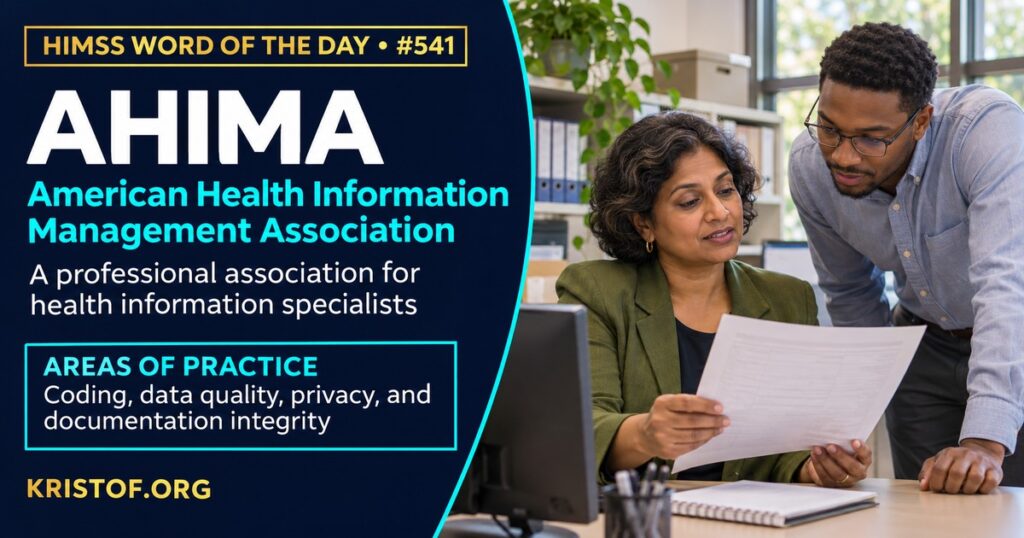
The HIMSS Dictionary lists AHIMA (American Health Information Management Association) in its organizations appendix. It describes AHIMA as a professional association for people who manage health information and who care about how that information, kept electronically or on paper, supports both business and clinical work.
AHIMA describes itself on its own site as a global nonprofit association of health information professionals, and states its mission as “empowering people to impact health.” It says its community works with health data for more than one billion patient visits each year. That figure is AHIMA’s own, so it is best read as the association’s description of its reach.
The name tells the story of the field. According to AHIMA’s history page, the American College of Surgeons established the Association of Record Librarians of North America in 1928 to raise standards for clinical records in hospitals and other medical institutions. It became the American Association of Medical Record Librarians in 1938, the American Medical Record Association in 1970, and the American Health Information Management Association in 1991. The page credits Grace Whiting Myers as AHIMA’s founder. Each change in name followed a change in the work, from keeping records, to managing them, to managing the information inside them.
For health IT students, the practical point is that health information management (HIM) is a profession with its own credentials, standards, and ethics. HIM professionals work on coding, data analytics, privacy and security, and documentation integrity, which are the areas AHIMA’s certification page highlights.
| Item | Detail |
|---|---|
| Type | Nonprofit professional association (AHIMA’s description) |
| Founded | 1928, as the Association of Record Librarians of North America |
| Current name since | 1991 |
| Focus | Coding, health information management, privacy and security, data analytics, documentation integrity |
| Credentials today | CCA, CCS, CCS-P, RHIT, RHIA, CDIP, CHDA, CHPS |
| Shared with HIMSS | The CHPS credential, per AHIMA’s timeline |
⚠️ Exam Alert: AHIMA is the association for health information management (HIM) professionals and issues credentials such as RHIA, RHIT, CCS, and CHPS. HIMSS is a separate organization that offers the CAHIMS and CPHIMS credentials. Do not confuse AHIMA with AMIA (an association for biomedical and health informatics) or ANCC (a nursing certification organization).
🌐 Why It Matters: Real-World Healthcare IT Context
Because AHIMA is an organization rather than a research topic, this section draws on AHIMA’s own pages, which were read directly for this post. They show what the association does, not independent evaluation of it.
Credentials. AHIMA’s certification page lists eight credentials: Certified Coding Associate (CCA), Certified Coding Specialist (CCS), Certified Coding Specialist, Physician-based (CCS-P), Registered Health Information Technician (RHIT), Registered Health Information Administrator (RHIA), Certified Documentation Integrity Practitioner (CDIP), Certified Health Data Analyst (CHDA), and Certified in Healthcare Privacy and Security (CHPS). The page describes the CCA as a self-paced route and the RHIT (two years) and RHIA (four years) as academic routes through accredited schools, and it offers microcredentials for people who are not ready for a full certification. The history timeline shows how long the credential system has been developing: the Registered Record Librarian credential in 1933, the coding specialist credentials in the 1990s, the RHIT and RHIA in 2000, the privacy and security credentials in 2002, the data analyst credential in 2008, and the documentation credential in 2011. According to the same timeline, CHPS was created in 2002 and is sponsored jointly by AHIMA and HIMSS.
Who sets the standards. AHIMA’s certification page points to accreditation by the National Commission for Certifying Agencies as a mark of quality. It says the Commission on Certification for Health Informatics and Information Management, known as CCHIIM, is the authority behind certification and recertification standards. These are AHIMA’s own statements about its programs.
Ethics. AHIMA’s ethics page says its Code of Ethics serves six purposes, including promoting high standards of HIM practice, guiding decisions when obligations conflict, and giving the public a way to hold HIM professionals accountable. The code applies to AHIMA members and to non-members who hold an AHIMA certification. It includes principles that are enforceable and principles that are aspirational, and the extent of enforcement is a matter of professional judgment. AHIMA also publishes companion documents: Standards of Ethical Coding, and Ethical Standards for Clinical Documentation Integrity Professionals. The CCHIIM review panel hears complaints about misconduct by certified individuals.
Advocacy and knowledge. AHIMA’s site lists advocacy focus areas that include patient identification, medical code sets, data standards, privacy and security, and health information exchange and interoperability. It also publishes the Journal of AHIMA, runs a Body of Knowledge site, hosts a conference and virtual summits, and organizes member communities and a mentorship program. The association also publishes a 2024 to 2027 Strategic Plan.
Taken together, the pages show an association that combines a credentialing system, an ethics framework, education, and policy advocacy around one profession.
Common AHIMA mix-ups:
- Treating AHIMA and HIMSS as the same organization
- Assuming HIM work is only medical coding
- Mixing up the RHIT and RHIA, or the CCA and CCS
- Thinking the CAHIMS credential comes from AHIMA
- Overlooking that the Code of Ethics applies to certified non-members as well as members
What AHIMA offers professionals:
- Credentials for coding, HIM, privacy and security, data analytics, and documentation integrity
- A Code of Ethics with companion standards for coders and documentation integrity professionals
- Education, events, and a Body of Knowledge
- Advocacy on code sets, patient identification, data standards, and exchange
- Member communities and mentoring
🏥 The Nurse’s Perspective: Clinical, Bedside, & Workflow
Nurses work with HIM professionals every day, often without noticing, because the quality of the chart depends on both groups.
At the Bedside
Nurses write much of the record that HIM professionals later code, analyze, and release. Complete, timely, and accurate documentation supports patient care and also supports coding, quality reporting, and the legal record. A request from a documentation integrity specialist to clarify a note is a request to make the record complete and clear.
In Clinical Workflow
Nurse informaticists and HIM staff share work on forms, record completion, release of information, and privacy. Questions such as who may see a chart, how a correction is made, and what belongs in the legal record are decided together. AHIMA’s Code of Ethics and its coding and documentation standards give HIM staff a common reference for these conversations, and nursing standards of practice do the same for nurses.
In EHR Implementation (Go-Live Perspective)
During an Epic Go-Live, HIM and nursing questions meet quickly: where does a note file, how does a correction appear, and what happens to scanned paper. Analysts at the elbow hear these questions from both sides and route them to the right owner. Early agreement on documentation rules reduces rework for coders and clinicians alike.
🎓 CAHIMS / CPHIMS & HIMSS Perspective
CAHIMS Exam Domain Mapping
AHIMA connects professional practice, data, and governance:
| CAHIMS Domain | How AHIMA Appears |
|---|---|
| Healthcare & Technology Environments | Professional associations, credentials, and the HIM role in the health system |
| Clinical Informatics | Documentation integrity, coding, and clinical data quality |
| Healthcare Information & Systems Management | Privacy and security, release of information, and data analytics |
| Management & Leadership | Ethics, standards, workforce credentials, and advocacy |
Key Terms to Know Alongside AHIMA
- Health Information Management (HIM) — profession that manages health information across its life cycle
- RHIA — Registered Health Information Administrator, an AHIMA credential tied to a four-year academic path
- RHIT — Registered Health Information Technician, an AHIMA credential tied to a two-year academic path
- CHPS — Certified in Healthcare Privacy and Security, an AHIMA credential sponsored jointly with HIMSS
- Clinical Documentation Integrity (CDI) — work that helps keep clinical documentation complete and accurate
- Code of Ethics — AHIMA’s statement of ethical principles for HIM professionals
HIMSS Organizational Position
HIMSS offers education and research on health information and technology topics through its Resource Center. Members can find related information on the HIMSS Resource Center page.
🧭 More HIMSS Word of The Day Terms
Related terms in the Healthcare Policy series:
- Payer
- Designated Record Set
- Veterans Integrated Service Network (VISN)
- AUC (Appropriate Use Criteria)
Browse all Healthcare Policy terms or the A–Z glossary.
🔗 Explore Further: External References
- AHIMA — About Us https://www.ahima.org/who-we-are/about-us/
- AHIMA — History Timeline https://www.ahima.org/who-we-are/about-us/history/
- AHIMA — Certification overview https://www.ahima.org/certification-careers/certifications-overview/
- AHIMA — Ethics (Code of Ethics and companion standards) https://www.ahima.org/who-we-are/governance/ethics/
- HIMSS — Resource Center https://www.himss.org/resource-center
Term source: HIMSS Dictionary of Health Information and Technology Terms, Acronyms, and Organizations, 6th Edition (2025). All definitions in this series are paraphrased for editorial purposes. Readers are encouraged to consult the primary source for exact language.
Eric Andrew Kristof, RN, CAHIMS is a Healthcare IT professional and HIMSS Arkansas Chapter member based in Hot Springs Village, AR, with hands-on Epic Go-Live experience and a diverse healthcare and IT background. He writes at kristof.org at the intersection of clinical care and healthcare technology.
Leave a Reply