By Eric Andrew Kristof, RN, CAHIMS | Healthcare IT Professional | HIMSS Arkansas Chapter Member
About This Series: The HIMSS Word of The Day is a running blog series drawing from the HIMSS Dictionary of Health Information and Technology Terms, Acronyms, and Organizations, 6th Edition (2025) — the authoritative reference for healthcare IT professionals and the primary study resource for CAHIMS and CPHIMS certification. Each post paraphrases the term in plain language, grounds it in real-world healthcare IT context, and adds a bedside nursing perspective you won’t find in a textbook.
📖 The Term: OON (Out of Network)
Source: HIMSS Dictionary of Health Information and Technology Terms, Acronyms, and Organizations, 6th Edition (2025)
🔍 Plain-Language Definition
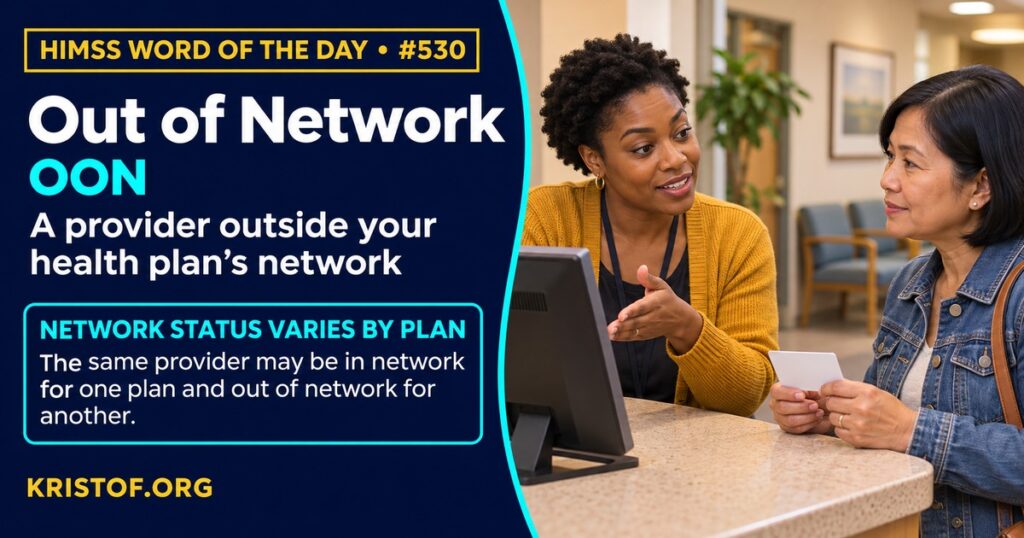
The HIMSS Dictionary defines out of network (OON) as a physician, hospital, or other provider that is not part of a particular insurer’s provider network. A network is a group of providers that agree to deliver services to a health plan’s members, usually at negotiated rates. A provider outside that group is out of network for that plan, and a patient who sees one may face higher costs, different coverage rules, or a bill for the balance that the plan does not pay.
Network status is not a fixed label on a provider. It is a relationship between a specific provider and a specific plan, and it can change when contracts begin, end, or are renegotiated. A hospital may be in network while a physician group that works inside it is not, which is how patients sometimes receive unexpected bills after care at an in-network facility.
This is a data problem as much as a policy problem. Registration and scheduling staff rely on eligibility checks and provider directories to tell patients what to expect. Billing systems assign network status to claims and calculate patient responsibility. Payers maintain provider directories that patients and clinicians consult. When any of these is wrong or out of date, patients and organizations pay for it. Eligibility checks can be done through electronic transactions or by phone, including automated phone lines.
Federal and state laws now limit surprise out-of-network bills in many situations. CMS describes its No Surprise Billing program as helping providers, facilities, plans, and issuers comply with surprise billing protections and resolve out-of-network payment disputes, including through an independent dispute resolution process.
| Term | Meaning |
|---|---|
| In network | Provider has a contract with the plan |
| Out of network (OON) | Provider does not participate in the plan’s network |
| Balance billing | Billing a patient for the difference between a charge and what a plan pays |
| Surprise bill | Unexpected out-of-network bill, often after emergency or in-network facility care |
| Provider directory | Plan’s list of participating providers |
| IDR | Independent dispute resolution for out-of-network payment disagreements |
⚠️ Exam Alert: Out of network (OON) means a provider does not participate in a given insurer’s network. Network status is plan-specific: a provider can be in network for one plan and out of network for another. Do not confuse OON with out-of-pocket (OOP) costs, which are what a patient pays, or with a network in the IT sense (LAN or WAN).
🌐 Why It Matters: Real-World Healthcare IT Context
Studies of out-of-network care mostly use claims data and compare states or time periods. Each source below was checked against its published abstract, and the CMS page was read directly.
Parikh and colleagues, in the Journal of the American College of Radiology (2024), analyzed radiologists’ out-of-network billing trends from 2007 to 2021 using claims from the Optum Clinformatics Data Mart. Of the radiologists’ imaging claims, 5,039,142 (6.3 percent) were out of network. The rate fell from 12.6 percent in 2007 to 1.1 percent in 2021, declining by about 0.74 percentage points a year. The out-of-network rate was 5.0 percent during an inpatient stay and 2.1 percent on the same day as an ED visit that did not lead to admission. The authors suggest the decline may reflect effective negotiation between radiologists and commercial payers and new state surprise billing laws. It is a study of one commercial claims database and one specialty.
Garmon and colleagues, in Health Economics (2024), studied the effects of state surprise billing laws on emergency services. They did not find consistent evidence of effects on prices or charges, but the laws increased network participation and reduced potential surprise billing episodes. They suggest the federal No Surprises Act, which is similar to many state laws, is unlikely to raise prices but may benefit patients through greater network participation.
Garmon and colleagues, in Health Economics, Policy and Law (2024), examined state laws protecting patients from surprise bills by out-of-network hospital-based physicians at in-network hospitals for elective care. Using a multi-payer claims database, they found the laws were associated with lower anesthesiology prices and charges but higher pathology and radiology prices, with large differences between states. California and New Jersey saw more network participation by anesthesiologists and pathologists, but overall they found little evidence of changed network participation across all the states. They suggest the effects of the federal law may vary by state.
Encinosa and colleagues, in the American Journal of Managed Care (2022), studied state balance billing bans for emergency department visits among about 16 million privately insured HMO enrollees from 2007 to 2018, comparing 15 states with bans to 16 without. The bans reduced spending per visit by 14 percent, but ED visits rose by 3 percentage points, offsetting the savings, and the extra visits were 9 percent less urgent. The authors projected that the federal ban would save $5.1 billion but add 3.5 million ED visits and $4.2 billion in extra spending per year. These projections are model estimates, and the study covered HMO enrollees only.
The CMS No Surprise Billing page describes the federal framework and the independent dispute resolution process for out-of-network payment disputes and links to rules, provider resources, and the IDR gateway.
Taken together, the studies show that out-of-network billing has changed over time, that surprise billing laws can shift network participation and prices in different ways, and that policy effects are shaped by how care is delivered and how data flows.
Common out-of-network problems:
- Provider directories that are out of date or inaccurate
- Eligibility or network status checked too late or not at all
- Facility-based clinicians whose network status differs from the facility’s
- Patients unclear about what a bill means or what they owe
- Claims that are processed with the wrong network status
- Payment disputes that take time and documentation to resolve
What supports clear network status:
- Real-time eligibility and network checks at scheduling and registration
- Directory data that is verified and updated regularly
- Clear patient communication about network status before care when possible
- Contract and credentialing data that match claims systems
- Staff training on surprise billing protections
- Documentation to support dispute resolution when needed
🏥 The Nurse’s Perspective: Clinical, Bedside, & Workflow
Network status rarely changes what a nurse does at the bedside, but it shapes what patients ask and worry about.
At the Bedside
Patients sometimes ask whether a specialist, lab, or imaging center is covered by their plan, or are surprised by a bill after a stay. Nurses can direct them to financial counseling and patient access staff rather than guessing. In emergencies, care comes first, and billing questions are handled afterward.
In Clinical Workflow
Referrals, transfers, and discharge planning often involve choosing a facility or service. Case managers and nurses on discharge teams check whether post-acute or home care providers are in network so that patients are not left with unexpected costs. Nurse informaticists help make network and coverage information visible where those decisions are made.
In EHR Implementation (Go-Live Perspective)
During an Epic Go-Live, registration, scheduling, and referral screens bring coverage and network information into daily work. Analysts at the elbow hear when staff cannot find eligibility details or when a referral list shows providers that patients cannot use. These reports point to build or data issues that affect both patients and revenue.
🎓 CAHIMS / CPHIMS & HIMSS Perspective
CAHIMS Exam Domain Mapping
Network status connects payers, data, and patient experience:
| CAHIMS Domain | How OON Appears |
|---|---|
| Healthcare & Technology Environments | Payers, provider networks, and surprise billing regulation |
| Clinical Informatics | Referral and discharge workflows that consider coverage |
| Healthcare Information & Systems Management | Eligibility transactions, provider directory data, and claims |
| Management & Leadership | Payer contracting, revenue cycle, and patient communication |
Key Terms to Know Alongside OON
- Balance Billing — billing a patient for the difference between a provider’s charge and the plan’s payment
- Provider Network — group of providers contracted with a health plan
- Eligibility Verification — checking whether a patient is covered and what the plan covers
- Independent Dispute Resolution — process for resolving out-of-network payment disagreements
- Revenue Cycle — process of capturing, billing, and collecting payment for services
- Out of Pocket — costs a patient pays directly
HIMSS Organizational Position
HIMSS offers education and research on health information and technology topics through its Resource Center. Members can find related information on the HIMSS Resource Center page.
🧭 More HIMSS Word of The Day Terms
Related terms in the Healthcare Policy series:
- Covered Entity (HIPAA)
- J-Codes
- FISMA (Federal Information Security Management Act)
- AHIMA (American Health Information Management Association)
Browse all Healthcare Policy terms or the A–Z glossary.
🔗 Explore Further: External References
- Parikh et al. (2024), Journal of the American College of Radiology — Radiologists’ Out-of-Network Billing Trends, 2007 to 2021 https://pubmed.ncbi.nlm.nih.gov/38244025/
- Garmon et al. (2024), Health economics — The impact of surprise billing laws on emergency services https://pubmed.ncbi.nlm.nih.gov/38988033/
- Garmon et al. (2024), Health economics, policy, and law — The impact of surprise billing laws on hospital-based physician prices and network participation https://pubmed.ncbi.nlm.nih.gov/39659227/
- Encinosa et al. (2022), The American journal of managed care — How state surprise billing protections increased ED visits, 2007-2018: potential implications for the No Surprises Act https://pubmed.ncbi.nlm.nih.gov/36121365/
- CMS — No Surprise Billing https://www.cms.gov/nosurprises
- HIMSS — Resource Center https://www.himss.org/resource-center
Term source: HIMSS Dictionary of Health Information and Technology Terms, Acronyms, and Organizations, 6th Edition (2025). All definitions in this series are paraphrased for editorial purposes. Readers are encouraged to consult the primary source for exact language.
Eric Andrew Kristof, RN, CAHIMS is a Healthcare IT professional and HIMSS Arkansas Chapter member based in Hot Springs Village, AR, with hands-on Epic Go-Live experience and a diverse healthcare and IT background. He writes at kristof.org at the intersection of clinical care and healthcare technology.
Leave a Reply