By Eric Andrew Kristof, RN, CAHIMS | Healthcare IT Professional | HIMSS Arkansas Chapter Member
About This Series: The HIMSS Word of The Day is a running blog series drawing from the HIMSS Dictionary of Health Information and Technology Terms, Acronyms, and Organizations, 6th Edition (2025) — the authoritative reference for healthcare IT professionals and the primary study resource for CAHIMS and CPHIMS certification. Each post paraphrases the term in plain language, grounds it in real-world healthcare IT context, and adds a bedside nursing perspective you won’t find in a textbook.
📖 The Term: DSMO (Designated Standard Maintenance Organization)
Source: HIMSS Dictionary of Health Information and Technology Terms, Acronyms, and Organizations, 6th Edition (2025)
🔍 Plain-Language Definition
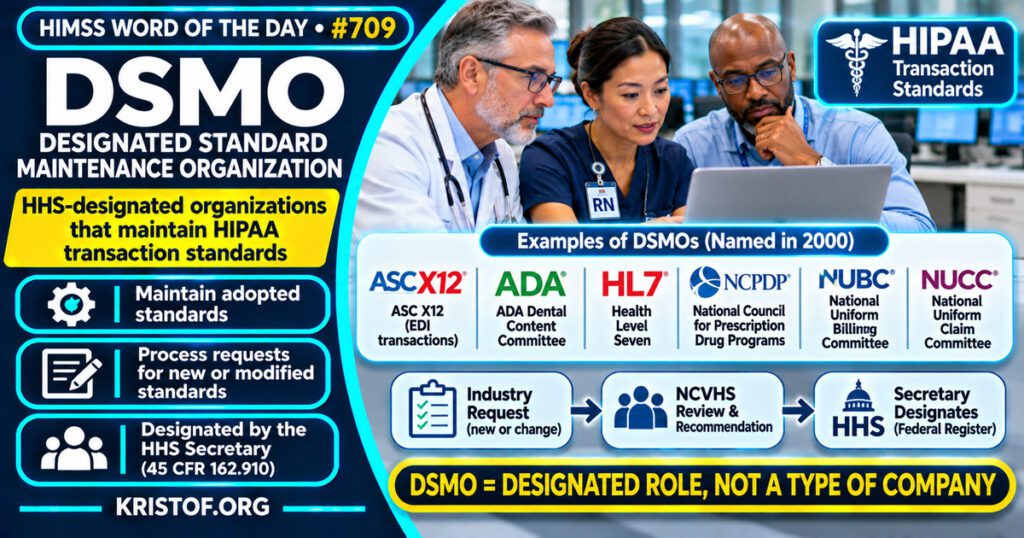
The HIMSS Dictionary describes a DSMO as an organization named by the Secretary of Health and Human Services to maintain the transaction standards that HHS adopted in Subpart I of 45 CFR Part 162, part of the HIPAA rules. A DSMO may also receive and process requests to adopt a new standard or change an adopted one. The word “designated” matters: a DSMO is a role the Secretary assigns, not a type of company.
The table below shows how the role is laid out in the regulation and in the official notices read for this post.
| Item | Detail |
|---|---|
| Regulation | 45 CFR 162.910, maintenance of standards and adoption of modifications and new standards |
| Who designates | The HHS Secretary, by notice in the Federal Register |
| What a DSMO does | Maintains adopted standards and processes requests for new or modified standards |
| Named in 2000 | ASC X12, the ADA Dental Content Committee, HL7, NCPDP, the National Uniform Billing Committee, and the National Uniform Claim Committee |
| Reviewing committee | National Committee on Vital and Health Statistics (NCVHS) receives recommendations |
⚠️ Exam Alert: A DSMO is a designation, while a standards development organization (SDO) or standard-setting organization is a body that writes standards, and several DSMOs are also SDOs. ANSI accredits standards developers and is not a DSMO. CAQH CORE is the designated authoring entity for operating rules, which are separate from the standards a DSMO maintains. NCVHS advises HHS and is not a DSMO. Questions often ask which body maintains the HIPAA transaction standards.
🌐 Why It Matters: Real-World Healthcare IT Context
Because a DSMO is a regulatory role and not a clinical tool, this section draws on the regulation, the Federal Register, CMS, and NCVHS, plus one Federal Register notice indexed in PubMed. I found no peer-reviewed study that evaluates how well DSMOs work, so everything below describes the role and not its results.
What the rule requires. The text of 45 CFR 162.910 lets the Secretary designate an organization as a DSMO if it agrees to maintain the adopted standards and to process requests for new or modified ones, and the designation is made by notice in the Federal Register. A DSMO’s maintenance of a standard counts under the rule if it follows any processes the Secretary requires. The Secretary will consider a recommendation for a new or changed standard only if it came from a process with open public access, coordination with other DSMOs, an appeals process for the requester and for any dissatisfied DSMO, an expedited path for urgent industry content needs where appropriate, and submission to NCVHS. The version I read was a legal reference site’s copy of the regulation, so check the current official text before relying on it.
Who was named. A Federal Register notice dated July 24, 2000, published August 17, 2000, and effective October 16, 2000, designated six organizations: the Accredited Standards Committee X12, the Dental Content Committee of the American Dental Association, Health Level Seven, the National Council for Prescription Drug Programs, the National Uniform Billing Committee, and the National Uniform Claim Committee. CMS’s current page on standard-setting organizations lists the same six as DSMOs. The same page lists NCVHS and WEDI as advisory groups, CAQH CORE as the designated authoring entity for operating rules, and several standard-setting bodies that are not DSMOs, including ANSI and NACHA.
What the work looks like. A 2010 statement to the NCVHS Subcommittee on Standards, written for the DSMO by its steering committee chair, says the group’s first task was a fast-track effort on changes to the X12 004010A1 standard and the NCPDP Telecommunication Standard 5.1 with Batch 1.2, followed by changes to later versions. The statement says the DSMO reports to NCVHS each year on the changes it reviews and that its process lets interested parties submit change requests and view recommendations. A 2010 Federal Register notice, indexed in PubMed, announced maintenance changes made by the DSMOs. It describes them as non-substantive corrections of typographical errors and clarifications to standards adopted in a rule published January 16, 2009, and it explains how to obtain the corrections.
The 2019 review. NCVHS recommended in February 2019 that HHS re-evaluate the function and purpose of the DSMOs, and its Standards Subcommittee held a two-day session on July 10 and 11, 2019 to gather industry views. The meeting summary reports that the DSMO now receives fewer than 10 change requests a year, that change requests now go directly to the standards development organizations, and that formal rulemaking is slow compared with business and technology needs. Ideas discussed included adding members to the DSMO agreement, allowing voluntary use of standards before they are mandated, and requiring pilots and cost-benefit evidence for future updates. The summary describes these as ideas raised in discussion, not decisions.
What I could not confirm. I did not find whether HHS changed the DSMO structure after the 2019 session, so the 2000 designations and the CMS list may not reflect any later change. The CMS page I read carries no date, and I read the 2019 session through its meeting summary and not the full transcript. I found a 2002 article in the Journal of AHIMA on DSMOs, but PubMed lists no abstract and I did not use it. I found no study that measures how DSMO review affects data quality, claim denials, or clinician workload.
Common DSMO problems:
- Treating a DSMO as a kind of standards developer instead of a designation
- Assuming DSMOs write operating rules, which a separate authoring entity handles
- Assuming every standard-setting organization on the CMS page is a DSMO
- Assuming a change request is the same as a standard being adopted
- Quoting the 2000 list without checking the current CMS page
What supports the DSMO role:
- A defined route for requests to adopt or change a transaction standard
- Open public access and an appeals process required by the regulation
- Coordination among the organizations that maintain related standards
- Annual reporting to NCVHS, according to the DSMO’s own 2010 statement
- A public list of named organizations on the CMS site
🏥 The Nurse’s Perspective: Clinical, Bedside, & Workflow
No study reviewed measured nurses’ experience with DSMOs, and nurses rarely hear the term, so this section is workflow context and not evidence.
At the Bedside
Bedside nurses do not file change requests, but the standards a DSMO maintains shape what the registration and billing teams can send to a payer for the care a nurse documents. When a standard is updated, the fields and codes behind the claim can change, and documentation that feeds those fields may need to change with it. That link is an expectation from how claims are built, not a finding from the sources reviewed.
In Clinical Workflow
Nurse informaticists and revenue cycle analysts often learn about a standards change through the vendor, the payer, or an organization such as WEDI or HIMSS, not through a DSMO notice. Knowing that a defined route exists for requesting changes, and that CMS lists the organizations behind it, helps when a project team asks who decides whether an electronic transaction can be modified.
In EHR Implementation (Go-Live Perspective)
During an Epic Go-Live, analysts and at-the-elbow support staff see claim and registration problems as edits, rejected transactions, and missing data on a visit. The cause may be a local build choice or a payer rule, and the DSMO is rarely the place to look. The sources reviewed do not examine go-lives, so this is context from workflow experience.
🎓 CAHIMS / CPHIMS & HIMSS Perspective
CAHIMS Exam Domain Mapping
DSMO connects HIPAA, standards, and the governance of electronic transactions:
| CAHIMS Domain | How DSMO Appears |
|---|---|
| Healthcare & Technology Environments | Standards organizations and the HIPAA regulatory framework |
| Clinical Informatics | How standards change over time and affect data capture |
| Healthcare Information & Systems Management | Transaction standards, versions, and vendor upgrades |
| Management & Leadership | Governance, compliance planning, and standards participation |
Key Terms to Know Alongside DSMO
- HIPAA administrative simplification — the part of HIPAA that sets standards for electronic health care transactions and code sets
- Transaction standard — a standard for a specific electronic exchange such as a claim
- Standards Development Organization — a body that develops and maintains standards through a consensus process
- X12 Standard (ASC X12) — the standards committee whose transaction standards are central to HIPAA
- NCPDP Telecommunication Standard — the pharmacy standard maintained by NCPDP
- ANSI — the American National Standards Institute, which accredits standards developers
HIMSS Organizational Position
HIMSS offers education and research on health information and technology topics through its Resource Center. Members can find related information on the HIMSS Resource Center page.
🧭 More HIMSS Word of The Day Terms
Related terms in the Healthcare Policy series:
- Covered Entity (HIPAA)
- ABC Codes (Alternative Billing Codes)
- Organized Healthcare Arrangement
- Administrative Code Sets
Browse all Healthcare Policy terms or the A–Z glossary.
🔗 Explore Further: External References
- Legal Information Institute (Cornell) — 45 CFR § 162.910, Maintenance of standards and adoption of modifications and new standards. https://www.law.cornell.edu/cfr/text/45/162.910
- ASPE (HHS) — Federal Register, August 17, 2000, Volume 65, Number 160: Announcement of Designated Standard Maintenance Organizations. https://aspe.hhs.gov/federal-register-august-17-2000-volume-65-number-160-0
- CMS — Standard-Setting and Related Organizations. https://www.cms.gov/priorities/key-initiatives/burden-reduction/administrative-simplification/hipaa/standard-setting-related-organizations
- NCVHS — Statement of the Designated Standards Maintenance Organization to the Subcommittee on Standards (2010). https://ncvhs.hhs.gov/wp-content/uploads/2014/05/100720p12.pdf
- NCVHS — Meeting Summary, Visioning Session to Re-evaluate the DSMO (July 10-11, 2019). https://ncvhs.hhs.gov/wp-content/uploads/2019/12/Summary-Standards-Subcommittee-Visioning-Session-July-10-11-2019r.pdf
- Office of the Secretary (2010), Federal Register — Health insurance reform; announcement of maintenance changes to electronic data transaction standards adopted under the Health Insurance Portability and Accountability Act of 1996. Notification. https://pubmed.ncbi.nlm.nih.gov/20941887/
- HIMSS — Resource Center https://www.himss.org/resource-center
Term source: HIMSS Dictionary of Health Information and Technology Terms, Acronyms, and Organizations, 6th Edition (2025). All definitions in this series are paraphrased for editorial purposes. Readers are encouraged to consult the primary source for exact language.
Eric Andrew Kristof, RN, CAHIMS is a Healthcare IT professional and HIMSS Arkansas Chapter member based in Hot Springs Village, AR, with hands-on Epic Go-Live experience and a diverse healthcare and IT background. He writes at kristof.org at the intersection of clinical care and healthcare technology.
Leave a Reply