By Eric Andrew Kristof, RN, CAHIMS | Healthcare IT Professional | HIMSS Arkansas Chapter Member
About This Series: The HIMSS Word of The Day is a running blog series drawing from the HIMSS Dictionary of Health Information and Technology Terms, Acronyms, and Organizations, 6th Edition (2025) — the authoritative reference for healthcare IT professionals and the primary study resource for CAHIMS and CPHIMS certification. Each post paraphrases the term in plain language, grounds it in real-world healthcare IT context, and adds a bedside nursing perspective you won’t find in a textbook.
📖 The Term: WWW (World Wide Web)
Source: HIMSS Dictionary of Health Information and Technology Terms, Acronyms, and Organizations, 6th Edition (2025)
🔍 Plain-Language Definition
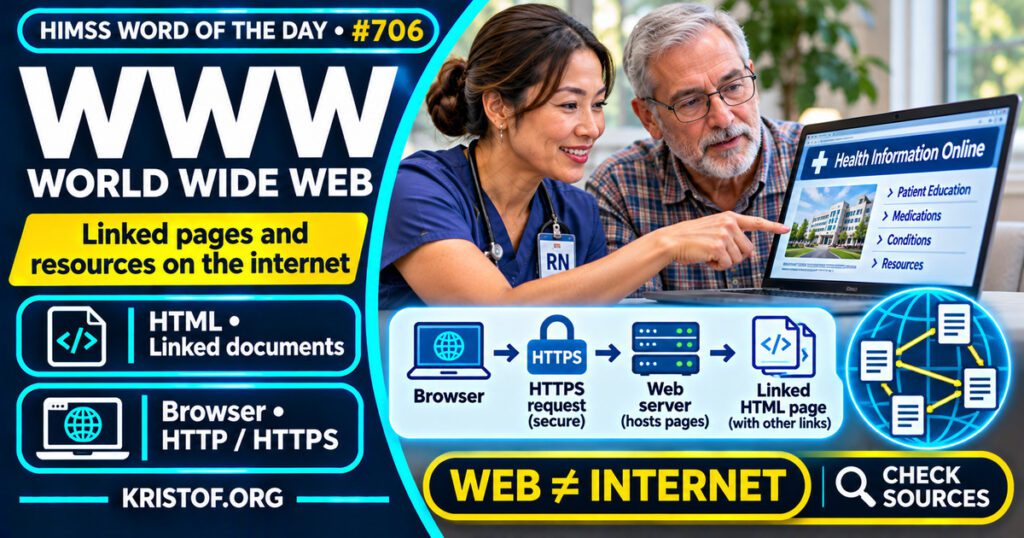
The HIMSS Dictionary treats the World Wide Web, or WWW, as a set of servers on the internet that deliver specially formatted documents. Those documents are written in HTML (HyperText Markup Language), which lets a page link to other pages and to images, sound, and video.
In everyday terms, the web is the part of the internet that most people see through a browser. Email and file transfer also run on the internet, but they are not the web.
| Term | What it is |
|---|---|
| World Wide Web | The system of linked documents and resources reached through browsers |
| Internet | The global network of networks that the web and other services run on |
| HTML | The markup language that describes a web document (dictionary) |
| HTTP | The protocol a browser uses to request a page from a server |
| Browser | The program that requests and displays web pages |
| W3C | The World Wide Web Consortium, which W3C says was founded in October 1994 |
⚠️ Exam Alert: The World Wide Web is not the internet. The internet is the network, and the web is one service on it. HTML describes a document, HTTP carries the request for it, and a browser displays it. HTTPS adds protection, and TLS is the protocol behind that protection. A question about a “web-based” application is usually about how it is delivered, not about the network.
🌐 Why It Matters: Real-World Healthcare IT Context
Because the web is a general technology, this section draws on two history pages and three studies of health information online. The studies are old, and the two history pages are brief accounts, so they show how the question has been studied, not what the web looks like today.
Where it came from. W3C and CERN both say Tim Berners-Lee proposed the Web at CERN in March 1989 and revised the proposal in May 1990. CERN says that by the end of 1990 he had the first web server and browser running at CERN on a NeXT computer, and W3C says the first web server went online there in November 1990. CERN says the software was released in 1991 and that CERN made the WorldWideWeb source code free on April 30, 1993. W3C says the World Wide Web Consortium was founded on October 1, 1994. These accounts agree on the main points, and I did not compare them with other histories.
Quality of health information. Eysenbach et al. (2002) searched the literature through September 2001 and included 79 studies that together evaluated 5,941 health websites and 1,329 pages. Fifty-five studies (70%) concluded that quality is a problem on the web, 17 (22%) were neutral, and 7 (9%) were positive. The positive studies scored lower on search and evaluation methods. The authors found 86 different quality criteria across studies and called for operational definitions, with accuracy, completeness, readability, design, disclosures, and references among the most common. This is a review of studies from the web’s early years, so it does not describe today’s sites.
How people use it. Hesse et al. (2005) analyzed the first Health Information National Trends Survey, with 6,369 adults. In 2003, 63.0% of US adults said they had ever gone online, and 63.7% of those online had looked for health information in the previous 12 months. Physicians remained the most trusted source, with 62.4% expressing a lot of trust. When asked where they actually went for specific health information, 48.6% said online first and 10.9% said their physician first. The authors described a shift toward more patients looking online before talking with their physicians. These are 2003 US figures from a cross-sectional survey, and web use has changed since.
Misinformation. Swire-Thompson and Lazer (2020) reviewed how people meet health misinformation online through search, user-generated content, and mobile apps. They discuss whether access to information helps or hinders outcomes and propose strategies for improving the online information ecosystem. The abstract gives no single quantity I can report.
What I could not confirm. I did not find current data on how patients use the web for health information, so the survey figures should be treated as historical. I did not review the dictionary entry’s age or compare the two history pages against other accounts. I read abstracts for the three studies, not full texts. I did not verify how many health web applications use browsers today.
Common WWW problems:
- Using web and internet as if they were the same thing
- Assuming health information found on the web is reliable
- Confusing HTML with HTTP
- Equating the web with one browser
- Quoting older survey figures on web use as current
What supports reliable use of the web in health care:
- Quality criteria such as accuracy, completeness, readability, disclosures, and references
- Physicians and other clinicians who remain a trusted source, per the 2003 survey
- Clear, shared definitions of quality, which the 2002 review called for
- Strategies for improving the online information ecosystem, as Swire-Thompson and Lazer propose
🏥 The Nurse’s Perspective: Clinical, Bedside, & Workflow
No study reviewed here measured nurses, so the points below are workflow context and not research findings.
At the Bedside
Patients often arrive having looked up symptoms or a diagnosis online. The 2003 survey described more patients going online before seeing a physician, and the sources reviewed do not measure whether that pattern holds today. A nurse can invite the patient to share what was found and then check it against clinical sources, using the same questions the 2002 review catalogued, such as accuracy, completeness, and whether sources are cited. Using those criteria as a patient-education checklist is an inference, not a tested method.
In Clinical Workflow
Nurse informaticists and nurse educators decide which web resources go into patient handouts and discharge instructions. A short review step for each resource, covering who wrote it, when it was last updated, and whether it lists references, helps keep outdated material out of the chart. Many clinical applications and patient portals are reached through a browser, so browser versions, pop-up blockers, and saved passwords can become workflow issues.
In EHR Implementation (Go-Live Perspective)
During an Epic Go-Live, analysts and at-the-elbow support staff hear browser-related problems alongside clinical ones: a window that will not open, a blocked pop-up, or a workstation on an unsupported browser version. Telling a browser problem from an application problem saves time at the elbow. This is context from workflow experience, and the sources reviewed do not examine go-lives.
🎓 CAHIMS / CPHIMS & HIMSS Perspective
CAHIMS Exam Domain Mapping
The web connects infrastructure, patient information, and the applications clinicians use:
| CAHIMS Domain | How the World Wide Web Appears |
|---|---|
| Healthcare & Technology Environments | Internet and web foundations of health IT environments |
| Clinical Informatics | Quality and use of patient-facing health information |
| Healthcare Information & Systems Management | Browser-based applications, security, and support |
| Management & Leadership | Policies for web use and for reviewing patient information |
Key Terms to Know Alongside the World Wide Web
- HTML — the markup language that describes a web document
- World Wide Web Consortium — the international body that develops web standards
- TLS — the protocol that protects web traffic sent over HTTPS
- VPN — a secure tunnel for reaching a private network over the internet
- Personal Health Record — a patient-controlled record that may be reached through the web
- Single Sign-On — one login that covers several applications, including web-based ones
HIMSS Organizational Position
HIMSS offers education and research on health information and technology topics through its Resource Center. Members can find related information on the HIMSS Resource Center page.
🧭 More HIMSS Word of The Day Terms
Related terms in the IT Infrastructure series:
Browse all IT Infrastructure terms or the A–Z glossary.
🔗 Explore Further: External References
- W3C — A Little History of the World Wide Web https://www.w3.org/History.html
- CERN — A short history of the Web https://home.cern/science/computing/the-birth-of-the-web/short-history-web/
- Eysenbach et al. (2002), JAMA — Empirical studies assessing the quality of health information for consumers on the world wide web: a systematic review. https://pubmed.ncbi.nlm.nih.gov/12020305/
- Hesse et al. (2005), Archives of Internal Medicine — Trust and sources of health information: the impact of the Internet and its implications for health care providers: findings from the first Health Information National Trends Survey. https://pubmed.ncbi.nlm.nih.gov/16344419/
- Swire-Thompson and Lazer (2020), Annual Review of Public Health — Public Health and Online Misinformation: Challenges and Recommendations. https://pubmed.ncbi.nlm.nih.gov/31874069/
- HIMSS — Resource Center https://www.himss.org/resource-center
Term source: HIMSS Dictionary of Health Information and Technology Terms, Acronyms, and Organizations, 6th Edition (2025). All definitions in this series are paraphrased for editorial purposes. Readers are encouraged to consult the primary source for exact language.
Eric Andrew Kristof, RN, CAHIMS is a Healthcare IT professional and HIMSS Arkansas Chapter member based in Hot Springs Village, AR, with hands-on Epic Go-Live experience and a diverse healthcare and IT background. He writes at kristof.org at the intersection of clinical care and healthcare technology.
Leave a Reply