By Eric Andrew Kristof, RN, CAHIMS | Healthcare IT Professional | HIMSS Arkansas Chapter Member
About This Series: The HIMSS Word of the Day is a running blog series drawing from the HIMSS Dictionary of Health Information and Technology Terms, Acronyms, and Organizations, 6th Edition (2025) — the authoritative reference for healthcare IT professionals and the primary study resource for CAHIMS and CPHIMS certification. Each post paraphrases the term in plain language, grounds it in real-world healthcare IT context, and adds a bedside nursing perspective you won’t find in a textbook.
📖 The Term: Transport Layer Security (TLS)
Source: HIMSS Dictionary of Health Information and Technology Terms, Acronyms, and Organizations, 6th Edition (2025)
🔍 Plain-Language Definition
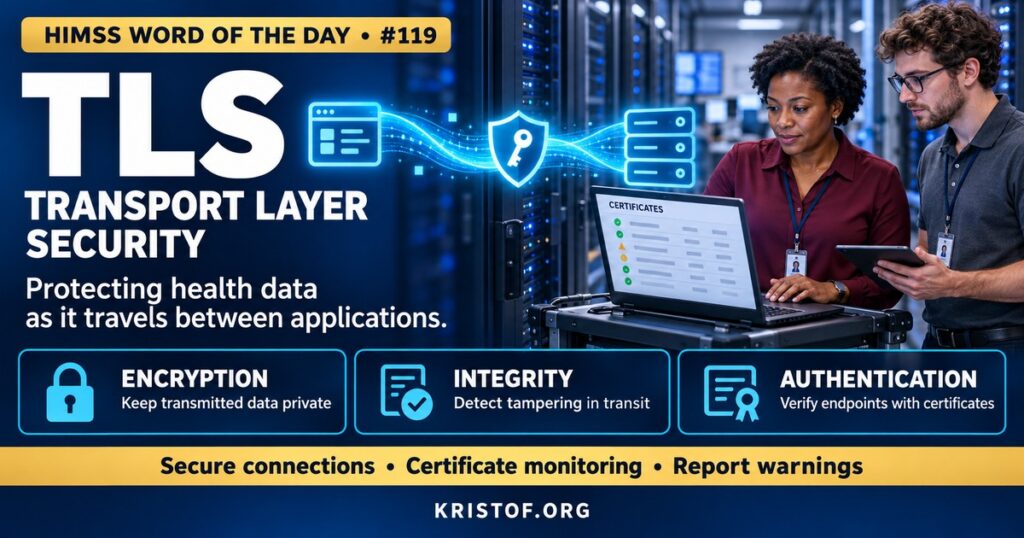
Transport Layer Security (TLS) is a security protocol that encrypts data traveling between two applications over a network and helps confirm that each side is who it claims to be. It is the technology behind HTTPS and the padlock icon in web browsers.
The HIMSS Dictionary describes TLS as a protocol that keeps data private and unaltered as it passes between two applications. It notes that browsers and many other applications rely on TLS whenever data must cross a network securely, including file transfers, VPNs, messaging, and internet calling.
| TLS Concept | What It Does | Healthcare Example |
|---|---|---|
| Encryption | Prevents eavesdroppers from reading data in transit | Protecting patient data sent from a portal to a patient’s browser |
| Integrity | Detects tampering with data in transit | Ensuring a lab result is not altered between systems |
| Authentication | Verifies the server, and sometimes the client, using certificates | Confirming an app is connecting to the real EHR API |
| Handshake | Negotiates versions, algorithms, and keys at the start of a connection | Establishing a secure session for a FHIR API call |
| Certificates | Digital credentials issued by a certificate authority | The certificate presented by a health system’s website |
⚠️ Exam Alert: TLS protects data in transit. Encryption at rest protects stored data. SSL is the older, deprecated predecessor of TLS; the term “SSL” is still used informally. Mutual TLS authenticates both client and server. A VPN creates an encrypted tunnel for broader network access and may use TLS or other protocols such as IPsec.
🌐 Why It Matters: Real-World Healthcare IT Context
Health information constantly moves across networks: between browsers and patient portals, between apps and FHIR APIs, between hospitals and health information exchanges, and between clinical systems inside data centers. TLS protects that movement from interception and tampering.
HIPAA‘s Security Rule includes transmission security as a technical safeguard, requiring organizations to guard against unauthorized access to ePHI transmitted over networks. HHS guidance on rendering PHI unusable, unreadable, or indecipherable refers to NIST guidance for data in motion, including NIST’s guidelines for the selection, configuration, and use of TLS implementations, SP 800-52. Properly encrypted transmissions can reduce breach risk if traffic is intercepted.
Versions matter. Older protocols, including SSL and early versions of TLS, have known weaknesses and have been formally deprecated. Current guidance favors TLS 1.2 and TLS 1.3, which was published by the Internet Engineering Task Force as RFC 8446. Systems still using outdated versions or weak cipher suites may be vulnerable and may fail to connect with modern partners.
Certificates are an operational concern. TLS certificates expire, and an expired certificate can suddenly break interfaces, APIs, or websites, sometimes without obvious warning to clinicians. Certificate inventories and automated renewal help prevent outages.
Inspection creates tradeoffs. Some security tools decrypt and re-encrypt traffic to look for threats hidden inside encrypted connections. That can improve detection, but it must be configured carefully, because it adds complexity and may break applications that expect a direct, verified connection. Organizations should decide deliberately which traffic to inspect and document how privacy is protected.
TLS is necessary but not sufficient. It protects data between two endpoints, but it does not protect data once it arrives, prevent stolen credentials from being used, or stop malware on a compromised device. It works alongside authentication, access control, and encryption at rest.
Medical devices and older interfaces can lag behind. Some legacy systems support only outdated protocols, and upgrading them may require vendor updates or replacement, so organizations sometimes isolate these systems on protected network segments while planning upgrades.
Common TLS issues in healthcare:
- Legacy systems that support only outdated protocol versions
- Expired certificates that break interfaces or portals
- Internal traffic left unencrypted on the assumption that the network is safe
- Weak cipher configurations
- Certificate warnings that users learn to ignore
- Limited visibility into which systems use which versions
Practices for strong TLS use:
- TLS 1.2 or 1.3 with strong cipher suites
- Encryption for internal as well as external connections
- Certificate inventory, monitoring, and automated renewal
- Mutual TLS for sensitive system-to-system connections where appropriate
- Regular scanning for outdated configurations
- Following NIST guidance for configuration
🏥 The Nurse’s Perspective: Clinical, Bedside, & Workflow
TLS is invisible when it works, but nurses may see its effects when it does not.
At the Bedside
Patient portals, telehealth platforms, and web-based clinical tools rely on TLS. A browser warning about an insecure connection or invalid certificate on a clinical website should be reported to the help desk rather than bypassed, because clicking through warnings can expose data or lead to fake sites.
Patients sometimes ask whether it is safe to use the portal or video visits. Nurses can reassure them that legitimate organizational tools use encrypted connections and encourage them to access the portal only through official links.
Home and public networks are a consideration for remote work. Even when a clinical application uses TLS, organizations often require VPNs or approved devices for remote access to add layers of protection.
In Clinical Workflow
When an interface suddenly stops, such as results no longer flowing from a reference lab or an external portal failing to load, an expired certificate or protocol change can be the cause. Reporting the time and affected system helps technical teams find the problem quickly.
Secure messaging, mobile apps, and remote access tools also depend on encrypted connections. Using only approved apps and networks keeps patient information protected in transit.
In EHR Implementation (Go-Live Perspective)
During an Epic Go-Live, technical teams configure TLS for web services, APIs, interfaces, and remote access, and ensure certificates are installed and monitored. External partners may need to update connections to match new endpoints and security requirements.
At-the-elbow support analysts may encounter certificate warnings or connection errors on workstations or devices. Escalating these rather than instructing users to bypass warnings protects both security and data integrity.
🎓 CAHIMS / CPHIMS & HIMSS Perspective
CAHIMS Exam Domain Mapping
TLS appears in security and infrastructure questions:
| CAHIMS Domain | How TLS Appears |
|---|---|
| Healthcare & Technology Environments | HIPAA transmission security; encryption guidance |
| Clinical Informatics | Secure portals, telehealth, and messaging; user response to warnings |
| Healthcare Information & Systems Management | Protocol versions, certificates, API and interface security, configuration |
| Management & Leadership | Certificate management, vendor requirements, risk management |
Key Terms to Know Alongside TLS
- Encryption in Transit — protecting data as it moves across networks
- Certificate Authority (CA) — an entity that issues digital certificates verifying identities
- Public Key Infrastructure (PKI) — the system of keys, certificates, and authorities that supports secure communication
- HTTPS — HTTP secured with TLS, used for websites and web APIs
- Mutual TLS — TLS in which both client and server authenticate with certificates
- Cipher Suite — the set of algorithms used to secure a TLS connection
HIMSS Organizational Position
HIMSS addresses encryption and secure data exchange through its cybersecurity and interoperability work, encouraging organizations to protect health data in transit and at rest. Members can find related education and research through the HIMSS Resource Center.
🔗 Explore Further: External References
- NIST — SP 800-52 Rev. 2, Guidelines for the Selection, Configuration, and Use of TLS Implementations https://csrc.nist.gov/pubs/sp/800/52/r2/final
- IETF — RFC 8446, The Transport Layer Security (TLS) Protocol Version 1.3 https://datatracker.ietf.org/doc/html/rfc8446
- HHS — Guidance to Render Unsecured PHI Unusable, Unreadable, or Indecipherable https://www.hhs.gov/hipaa/for-professionals/breach-notification/guidance/index.html
- eCFR — 45 CFR 164.312, HIPAA Technical Safeguards (Transmission Security) https://www.ecfr.gov/current/title-45/subtitle-A/subchapter-C/part-164/subpart-C/section-164.312
- HL7 — SMART App Launch https://hl7.org/fhir/smart-app-launch/
- HHS 405(d) Program — Health Industry Cybersecurity Practices https://405d.hhs.gov/
Term source: HIMSS Dictionary of Health Information and Technology Terms, Acronyms, and Organizations, 6th Edition (2025). All definitions in this series are paraphrased for editorial purposes. Readers are encouraged to consult the primary source for exact language.
Eric Andrew Kristof, RN, CAHIMS is a Healthcare IT professional and HIMSS Arkansas Chapter member based in Hot Springs Village, AR, with hands-on Epic Go-Live experience and a diverse healthcare and IT background. He writes at kristof.org at the intersection of clinical care and healthcare technology.
Leave a Reply