By Eric Andrew Kristof, RN, CAHIMS | Healthcare IT Professional | HIMSS Arkansas Chapter Member
About This Series: The HIMSS Word of the Day is a running blog series drawing from the HIMSS Dictionary of Health Information and Technology Terms, Acronyms, and Organizations, 6th Edition (2025) — the authoritative reference for healthcare IT professionals and the primary study resource for CAHIMS and CPHIMS certification. Each post paraphrases the term in plain language, grounds it in real-world healthcare IT context, and adds a bedside nursing perspective you won’t find in a textbook.
📖 The Term: Patient-Centric
Source: HIMSS Dictionary of Health Information and Technology Terms, Acronyms, and Organizations, 6th Edition (2025)
🔍 Plain-Language Definition
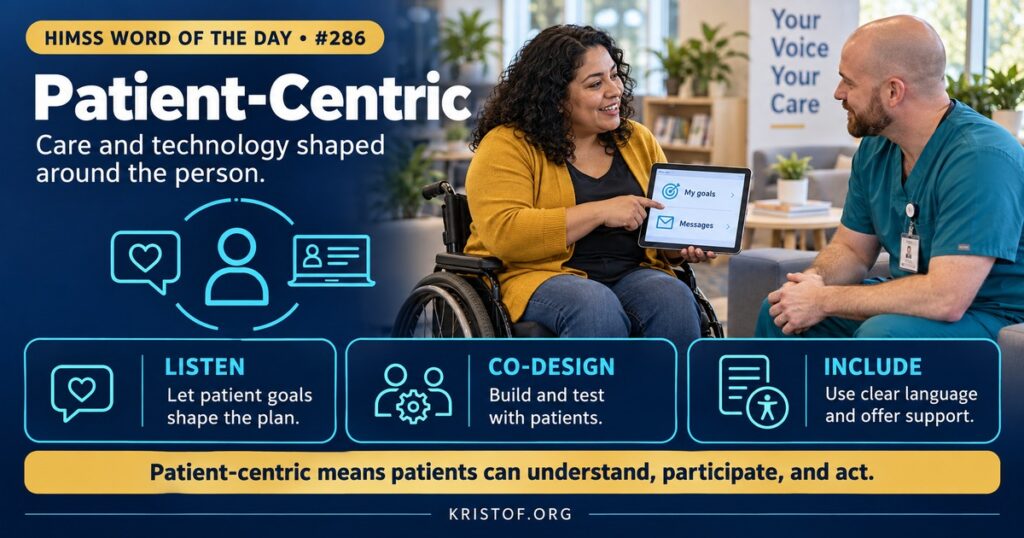
Patient-centric has two related meanings in the HIMSS Dictionary. The first is an approach to care: putting the patient first through open and continuing engagement, so that the patient and family receive respectful, compassionate care and the best possible experience and outcome. The second is a design principle for technology, in which digital tools are built around the patient to support empowerment and engagement. In practice, the two cannot be separated. A care team can hold patient-centric values and still hand patients a portal that confuses them.
The word overlaps with patient-centered care, person-centered care, and patient engagement, and organizations use these terms loosely. A useful test is whether patients helped define the problem, whether their goals shape the plan, and whether they can see, understand, and act on their own information.
| Dimension | Patient-Centric Practice | Technology Example |
|---|---|---|
| Access | Patients can reach their information and team | Portal results, secure messaging |
| Understanding | Information is written for the reader | Plain-language results, translated content |
| Preferences | Patient goals shape the plan | Pre-visit questionnaire in the portal |
| Participation | Patients help design services | Co-design sessions, advisory councils |
| Equity | Tools work for all groups | Language options, digital navigators |
⚠️ Exam Alert: Patient-centric describes an orientation; patient engagement describes activities that involve patients in their health and care; a patient portal is a tool that supports both. A personal health record (PHR) is controlled by the patient, while a portal is usually tethered to a provider’s EHR.
🌐 Why It Matters: Real-World Healthcare IT Context
Calling a system patient-centric is easy; showing that patients can use it is harder. Three recent studies illustrate the gap and ways to close it.
The first looks at the screens patients see. A 2026 heuristic evaluation in Applied Clinical Informatics examined 23 patient portal functions from two major EHR vendors, Oracle Cerner and Epic, across ten diagnosis-related areas such as the display of diagnoses and test results. Three human factors researchers independently found violations of the Nielsen-Schneiderman heuristics, scored their severity, and reconciled their ratings by consensus. They identified 80 violations in total, 76 percent from the Oracle Cerner portal and 24 percent from the Epic portal. The most frequent problems involved system feedback, inconsistencies, and excess information, and the functions with the most violations were the display of diagnoses, test results, messaging, and clinical notes. Most violations were minor (65 percent) and 20 percent were moderate, with no critical issues. The authors warned that the cumulative effect in high-risk functions could harm diagnostic safety and recommended human-centered design, standardized usability assessments, and collaboration among vendors, institutions, and policymakers. It is an expert review of selected functions, so it should not be read as a ranking of overall product quality.
The second looks at the people using the screens. A 2026 needs assessment in Frontiers in Digital Health surveyed 204 patients at an urban primary care clinic in New York City whose patients were mostly Latino (83 percent), 31 percent Spanish-speaking, and 67 percent aged 65 or older. Portal use varied with age and employment: 63.9 percent of patients aged 31 to 64 and 53.7 percent of those 65 and older reported use, and full-time employed respondents reported 95.5 percent use compared with 54.6 percent among retirees. The mean score on the eHealth Literacy Scale was 25.33 out of 40, indicating moderate digital literacy, and roughly half of participants completed individual portal tasks correctly, for example 47 percent for viewing lab results and 50 percent for messaging a provider. Yet 71.6 percent were interested in learning digital health skills, including 83.1 percent of older adults and Spanish speakers. The authors described a tension: those with the least engagement showed the most motivation, and they recommended digital health navigators, culturally tailored training with Spanish-language options, and user-centered design. The single-clinic, cross-sectional design limits generalization, but the pattern is a caution for any organization that equates offering a portal with achieving engagement.
The third shows what co-design can look like. In a 2026 study in BMC Health Services Research, a Dutch university hospital developed a tool with patients and health professionals. After two scoping reviews and meetings and interviews to build a prototype, the team arrived at a digital five-item questionnaire, called “We would like to know you,” which patients complete voluntarily in the portal before a consultation. Professionals read the answers in the EHR and use them to open the conversation. Tryouts in rehabilitation, neuro-oncology, and pediatric departments found that patients thought it useful for sharing preferences, needs, and expectations, and professionals considered it a good starting point. This was a development and feasibility study and did not test effects on outcomes, but it shows how a small, well-placed tool can carry patient voice into the record.
A 2025 narrative review of digital tools for patient-centered care adds a broader view: portals, wearables, telemedicine, and AI-driven tools can improve engagement and access, but interoperability, privacy, algorithmic bias, health literacy gaps, and the digital divide limit equitable adoption, and participatory design with patients and providers is essential.
For informatics teams, patient-centric practice has concrete implications. Test patient-facing screens with real patients, including older adults, people with limited English, and people with disabilities. Write result displays and messages at a level patients can read. Offer help in person and by phone, not only through an app. Collect patient-reported information in structured fields so the team can see it. Measure who uses tools, not only how many.
Common patient-centric problems:
- Patient-facing tools designed from the organization’s view and never tested with patients
- Portal content that is complete but hard to interpret
- Training offered in one language or format only
- Engagement measured by account counts, not by use or understanding
- Patient preferences collected but not visible to the care team
- Digital-only options that exclude people with low digital literacy
What supports patient-centric technology:
- Co-design with patients and families from the start
- Usability testing of patient-facing functions and routine re-evaluation
- Plain-language content and translation
- Digital navigators and non-digital alternatives
- Patient-reported information that flows into the chart
- Reports on use by age, language, and other groups
🏥 The Nurse’s Perspective: Clinical, Bedside, & Workflow
Nurses translate between a patient’s world and the health record, so patient-centric technology succeeds or fails partly at their elbows.
At the Bedside
Nurses help patients log in, find results, and understand what they are reading. They notice when a patient cannot use a tablet, does not read English, or is overwhelmed by a message full of lab values. A nurse who asks what matters most to the patient, and records it where the team can find it, is practicing the principle even without any technology.
In Clinical Workflow
Clinic and unit nurses introduce portals during discharge and visits, teach back how to use them, and flag patients who need other options. Nurse managers decide whether staff have time for this help and whether materials exist in the languages patients speak.
Nurse informaticists contribute to usability reviews, write plain-language content, and ensure that patient-reported questionnaires land in structured fields clinicians actually see. They can also bring patients and families into design and testing.
In EHR Implementation (Go-Live Perspective)
An Epic Go-Live that turns on or changes patient portal features creates new questions at the front desk, in clinics, and at the bedside. At-the-elbow support analysts hear what staff cannot explain to patients and pass those gaps to the build team so that screens, scripts, and handouts can be fixed.
🎓 CAHIMS / CPHIMS & HIMSS Perspective
CAHIMS Exam Domain Mapping
Patient-centric design appears in usability, engagement, and equity questions:
| CAHIMS Domain | How Patient-Centric Practice Appears |
|---|---|
| Healthcare & Technology Environments | Patient rights, access to information, health equity |
| Clinical Informatics | Patient-reported data, shared decision making, portal workflows |
| Healthcare Information & Systems Management | Portal design, usability testing, accessibility |
| Management & Leadership | Patient advisory councils, engagement metrics, change management |
Key Terms to Know Alongside Patient-Centric
- Patient Engagement — activities that involve patients in their own health and care
- Patient Portal — secure site or app giving patients access to parts of their record
- Personal Health Record (PHR) — record of health information managed by the patient
- Heuristic Evaluation — expert review of an interface against usability principles
- Digital Health Literacy — ability to find, understand, and use health information in digital form
- Co-Design — involving users as partners in designing a product or service
HIMSS Organizational Position
HIMSS supports patient engagement and health equity through its research, education, and community work. Members can find related resources through the HIMSS Nursing Informatics Community page.
🔗 Explore Further: External References
- Milicia et al. (2026), Applied Clinical Informatics — Patient Portal Usability Gaps: A Heuristic Evaluation of Two Major Electronic Health Record Systems https://pubmed.ncbi.nlm.nih.gov/41999669/
- Glickstein et al. (2026), Frontiers in Digital Health — Digital Health Literacy in Safety-Net Primary Care: A Needs Assessment and Call to Action for Health Equity https://pubmed.ncbi.nlm.nih.gov/42866528/
- Keizer et al. (2026), BMC Health Services Research — Developing a Tool to Facilitate Person-Centered Care in a University Hospital in Collaboration With Patients and Healthcare Professionals https://pubmed.ncbi.nlm.nih.gov/41749187/
- Ali (2025), Progress in Brain Research — Patient-Centric Care and Digital Health Tools https://pubmed.ncbi.nlm.nih.gov/41314752/
- HIMSS — Nursing Informatics Community https://www.himss.org/networking/communities/nursing-informatics/
Term source: HIMSS Dictionary of Health Information and Technology Terms, Acronyms, and Organizations, 6th Edition (2025). All definitions in this series are paraphrased for editorial purposes. Readers are encouraged to consult the primary source for exact language.
Eric Andrew Kristof, RN, CAHIMS is a Healthcare IT professional and HIMSS Arkansas Chapter member based in Hot Springs Village, AR, with hands-on Epic Go-Live experience and a diverse healthcare and IT background. He writes at kristof.org at the intersection of clinical care and healthcare technology.
Leave a Reply