By Eric Andrew Kristof, RN, CAHIMS | Healthcare IT Professional | HIMSS Arkansas Chapter Member
About This Series: The HIMSS Word of The Day is a running blog series drawing from the HIMSS Dictionary of Health Information and Technology Terms, Acronyms, and Organizations, 6th Edition (2025) — the authoritative reference for healthcare IT professionals and the primary study resource for CAHIMS and CPHIMS certification. Each post paraphrases the term in plain language, grounds it in real-world healthcare IT context, and adds a bedside nursing perspective you won’t find in a textbook.
📖 The Term: WEDI (Workgroup for Electronic Data Interchange)
Source: HIMSS Dictionary of Health Information and Technology Terms, Acronyms, and Organizations, 6th Edition (2025)
🔍 Plain-Language Definition
The HIMSS Dictionary lists WEDI, the Workgroup for Electronic Data Interchange, in its organizations appendix as a membership organization that wants members from every major group in health care so that its representation is broad. The categories it names include individuals, providers, health plans, government, standards organizations, vendors, and not-for-profit groups, along with hybrid organizations and affiliates or regional entities.
WEDI’s current pages describe a membership association that brings together providers, health plans, vendors, and government, and a December 2025 WEDI announcement lists health plans, providers, standards development organizations, vendors, government agencies, and patient advocacy organizations. The pages I read do not mention regional affiliates.
| Item | What the sources say |
|---|---|
| Type | Membership association; tax status not stated on the WEDI pages I read |
| Formed | 1991, by the then Secretary of HHS (its About page) |
| HHS role | WEDI calls itself a statutory advisor to the HHS Secretary; a 2000 HHS rule lists WEDI among groups to be consulted on standards |
| Focus | Standards for electronic administrative transactions, privacy and security, and aligning administrative and clinical data |
| Who joins | Health plans, providers, standards organizations, vendors, government, and patient advocacy groups (WEDI, December 2025) |
| Location | Washington, DC office (its site) |
| Relation to HIMSS | Not verified |
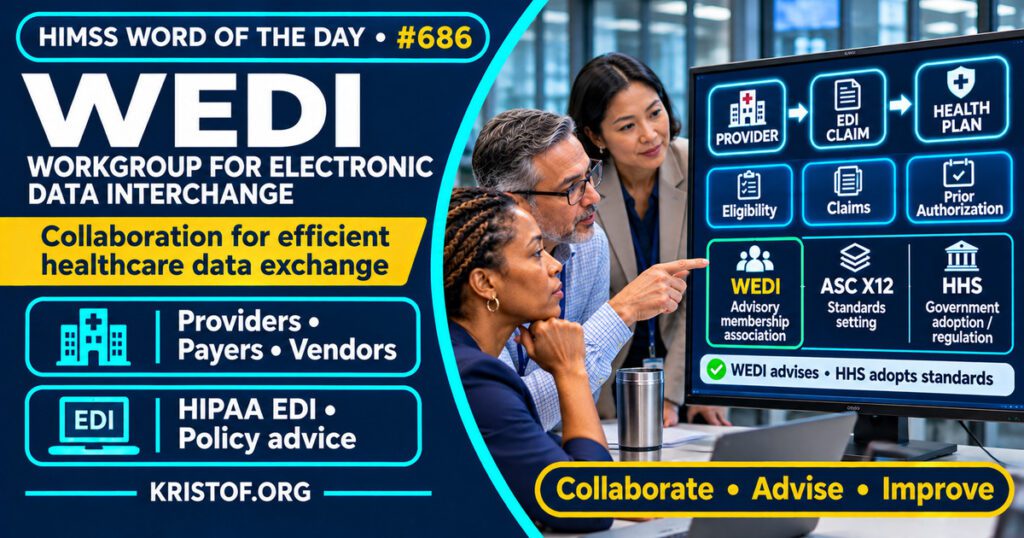
⚠️ Exam Alert: WEDI is a membership association, not a regulator and not a government agency. In the HHS rule below, WEDI is a group that standard setting organizations consult, not a standard setting organization itself. Do not confuse WEDI with ASC X12, the Accredited Standards Committee, or with the agency that adopts HIPAA standards.
🌐 Why It Matters: Real-World Healthcare IT Context
What the organization says about itself. Everything in this section is WEDI’s own statement unless noted otherwise.
Origin and role. WEDI’s About page says it was formed in 1991 by Dr. Louis Sullivan, then Secretary of HHS, to look for ways to make health data exchange more efficient, and that HIPAA in 1996 named it an advisor to the Secretary. It calls itself a formal advisor and says it works closely with CMS, the Office for Civil Rights, and the Office of the National Coordinator. A December 2025 board announcement describes WEDI as a statutory advisor to the HHS Secretary.
Mission and focus. The About page states a mission of multi-stakeholder leadership and guidance on using industry technology, knowledge, and information resources to improve the administrative efficiency, quality, and cost-effectiveness of health care information, and a vision of better health care at lower cost through collective action. Its focus areas are standards for electronic administrative transactions, data privacy and security, and harmonizing administrative and clinical data. The page says WEDI testifies before and advises the National Committee on Vital and Health Statistics.
Programs and resources. The home page lists a knowledge center with papers, fact sheets, podcasts, a blog, and a federal update series, along with resources on HIPAA transactions and operating rules, electronic claims attachments, CMS-0057-F implementation, and the No Surprises Act. It also lists a workgroup community, events, and recent workgroup outputs such as comment letters, a pilot report, AI recommendations, and claim status fact sheets. WEDI’s press release page shows a free interoperability testing directory launched April 30, 2026, AI recommendations released in July 2026, and survey results dated November 16, 2026, so the site was active when I checked.
Accomplishments, as WEDI lists them. The About page cites its work on the HIPAA transaction standards, the X12 5010 transition, ICD-10 education resources, and a machine-readable health ID card implementation guide. I did not verify any of these independently.
Membership. The About page calls WEDI a membership association, says members follow a code of conduct, and gives no member count or eligibility criteria. The membership pages I read do not state dues. The About page says it has 18 workgroups and sub-workgroups, but parts of that page are plainly older, such as a goal of 30 or more webinars for 2020, so the count may be out of date.
What HHS says. An independent source for the HIPAA connection is a final rule from HHS published in the Federal Register on August 17, 2000, titled “Health Insurance Reform: Standards for Electronic Transactions.” Its statutory background says the Secretary may adopt a standard from an accredited standard setting organization only if that organization has consulted WEDI, along with the National Uniform Billing Committee, the National Uniform Claim Committee, and the American Dental Association, and that the Secretary must consult the same groups before adopting other standards. In its comment discussion, the rule describes a WEDI recommendation that health plans not require any standard during the first year after adoption and that providers get at least six months’ notice before a plan requires one. HHS encouraged plans to follow that approach but did not make it a binding requirement. I read only the first part of a very long document.
Two descriptions, not one. WEDI describes itself as named in HIPAA as an advisor. The HHS rule describes WEDI as one of the groups to be consulted. Those are related but not identical, and I did not read the statute itself, so I report each source in its own words.
What I could not confirm. WEDI’s pages do not state its tax-exempt status. I did not confirm its member count, its dues, or the current number of workgroups. I did not find an independent evaluation of its influence on HIPAA standards or of the accomplishments it lists. I did not confirm that regional affiliates, which the dictionary names, still exist. I did not confirm any formal relationship with HIMSS.
Common WEDI mix-ups:
- Treating WEDI as a regulator or government agency
- Confusing its consultation role with the Secretary’s authority to adopt standards
- Confusing WEDI with ASC X12, the standard setting organization
- Reading the name as a temporary government workgroup, when its pages describe a membership association
- Treating the undated workgroup count on its About page as current
What WEDI offers:
- Workgroups on topics such as prior authorization and privacy and security
- A knowledge center with papers, fact sheets, podcasts, and federal updates
- Resources on HIPAA transactions, CMS-0057-F, and the No Surprises Act
- Comment letters and testimony to federal bodies
- Surveys and a free interoperability testing directory
🏥 The Nurse’s Perspective: Clinical, Bedside, & Workflow
Nurses rarely deal with WEDI directly, since its pages describe organizational membership categories and do not mention nurses.
At the Bedside
WEDI’s focus is administrative transactions, so its work sits mostly behind the bedside. The sources reviewed do not describe any effect on bedside care.
In Clinical Workflow
WEDI’s pages list workgroups and resources on prior authorization and claim status. Prior authorization and similar administrative steps can consume clinical staff time, which is general workflow context, and WEDI’s pages do not measure that effect.
In EHR Implementation (Go-Live Perspective)
During an Epic Go-Live, analysts and at-the-elbow support staff may hear about registration, eligibility, and claims problems that touch electronic transactions. That is general workflow context, and WEDI’s pages do not describe go-lives.
🎓 CAHIMS / CPHIMS & HIMSS Perspective
CAHIMS Exam Domain Mapping
WEDI appears in questions about HIPAA, administrative standards, and industry organizations:
| CAHIMS Domain | How WEDI Appears |
|---|---|
| Healthcare & Technology Environments | Industry organizations and the HIPAA standards environment |
| Clinical Informatics | Administrative and clinical data alignment |
| Healthcare Information & Systems Management | Electronic transactions, EDI, and standards adoption |
| Management & Leadership | Policy comment, industry collaboration, and compliance timelines |
Key Terms to Know Alongside WEDI
- HIPAA administrative simplification — the part of HIPAA that sets standards for electronic health care transactions
- EDI — electronic data interchange, the electronic exchange of business information in a standard format
- X12 Standard (ASC X12) — the standards family and committee behind many HIPAA transaction formats
- HIPAA standard setting organization — an organization whose standards HHS may adopt under HIPAA
- Transaction standard — a standard format for an electronic exchange such as a claim
- Electronic prior authorization — electronic requests and responses for coverage approval, a topic WEDI’s pages cover
HIMSS Organizational Position
HIMSS offers education and research on health information and technology topics through its Resource Center. Members can find related information on the HIMSS Resource Center page.
🧭 More HIMSS Word of The Day Terms
Related terms in the Healthcare Policy series:
- Payer
- OEID (Other Entity Identifier)
- National Provider Identifier (NPI)
- HIEx (Health Insurance Exchange)
Browse all Healthcare Policy terms or the A–Z glossary.
🔗 Explore Further: External References
- WEDI — Home page https://www.wedi.org/
- WEDI — About Us https://www.wedi.org/about-us/
- WEDI — WEDI Announces 2026 Board of Directors (December 5, 2025) https://www.wedi.org/2025/12/05/wedi-announces-2026-board-of-directors/
- WEDI — Press Releases https://www.wedi.org/category/press-releases
- HHS — Health Insurance Reform: Standards for Electronic Transactions, final rule, 65 Federal Register 50312 (August 17, 2000) https://www.govinfo.gov/content/pkg/FR-2000-08-17/html/00-20820.htm
- HIMSS — Resource Center https://www.himss.org/resource-center
Term source: HIMSS Dictionary of Health Information and Technology Terms, Acronyms, and Organizations, 6th Edition (2025). All definitions in this series are paraphrased for editorial purposes. Readers are encouraged to consult the primary source for exact language.
Eric Andrew Kristof, RN, CAHIMS is a Healthcare IT professional and HIMSS Arkansas Chapter member based in Hot Springs Village, AR, with hands-on Epic Go-Live experience and a diverse healthcare and IT background. He writes at kristof.org at the intersection of clinical care and healthcare technology.
Leave a Reply