By Eric Andrew Kristof, RN, CAHIMS | Healthcare IT Professional | HIMSS Arkansas Chapter Member
About This Series: The HIMSS Word of The Day is a running blog series drawing from the HIMSS Dictionary of Health Information and Technology Terms, Acronyms, and Organizations, 6th Edition (2025) — the authoritative reference for healthcare IT professionals and the primary study resource for CAHIMS and CPHIMS certification. Each post paraphrases the term in plain language, grounds it in real-world healthcare IT context, and adds a bedside nursing perspective you won’t find in a textbook.
📖 The Term: OEID (Other Entity Identifier)
Source: HIMSS Dictionary of Health Information and Technology Terms, Acronyms, and Organizations, 6th Edition (2025)
🔍 Plain-Language Definition
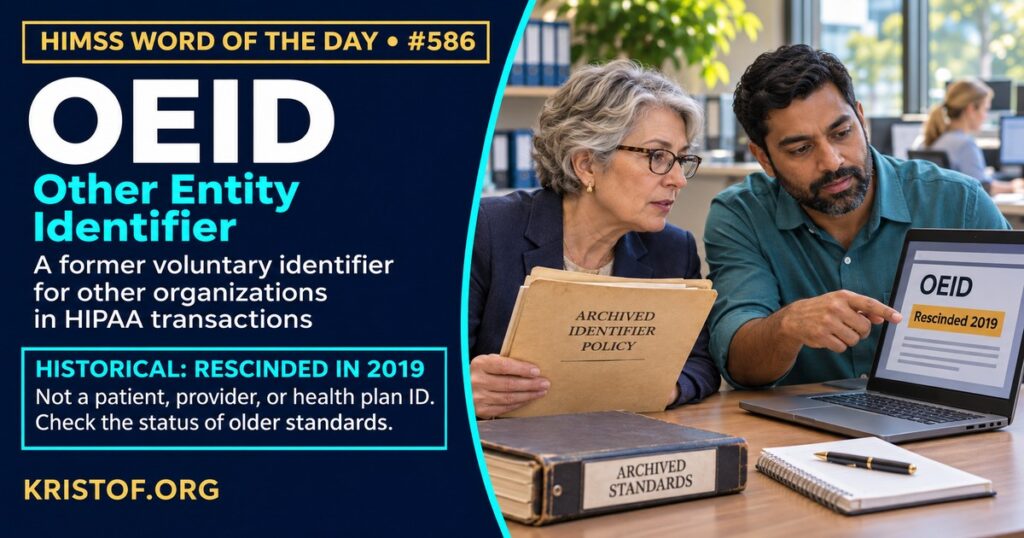
The HIMSS Dictionary describes the OEID, or Other Entity Identifier, as a data element that HHS adopted, meant as an optional identifier for organizations outside the categories of health plan, health care provider, or individual. The entry does not say that the identifier has since been rescinded, so this post treats it as a historical term with a current status you should know.
HHS’s 2019 final rule describes the OEID the same way: an identifier for an entity that is not a health plan, an individual, or a health care provider but that needs to be identified in a HIPAA transaction. Entities that qualified were allowed to obtain one, and they were not required to obtain or use it.
| Identifier | What it identified | Status described in the sources |
|---|---|---|
| HPID (Health Plan Identifier) | Health plans | Adopted in 2012, enforcement delayed in 2014, rescinded by a final rule effective December 27, 2019 |
| OEID (Other Entity Identifier) | Entities that were not health plans, individuals, or providers | Voluntary when adopted, rescinded by the same final rule |
| NPI (National Provider Identifier) | Health care providers | A separate standard, not named in the 2019 rescission |
The table is a teaching sketch based on the documents cited below.
⚠️ Exam Alert: The OEID was voluntary, and it was never the identifier for health plans (that was the HPID), providers (the NPI), or individuals. Because both the OEID and the HPID were rescinded, a question that treats either as a current requirement reflects older material. Check the date of any source that mentions them.
🌐 Why It Matters: Real-World Healthcare IT Context
Peer-reviewed research on the OEID is essentially absent. A PubMed search on the health plan identifier turned up the September 2012 Federal Register final rule, which PubMed indexes, but no study of the OEID itself. This post therefore relies on Federal Register documents and a CMS page, and the point of the post is the regulatory history and current status. Regulatory facts can change, so confirm anything you rely on against the current regulations.
Adoption in 2012. A final rule published September 5, 2012 adopted a standard unique identifier for health plans and the OEID. The final rule that later rescinded them describes the OEID as voluntary, meant for entities that needed to be identified in HIPAA transactions but were not health plans, individuals, or providers.
Delay and doubts. According to the 2019 final rule, stakeholders, mainly health plans, said the health plan identifier was not needed for routing transactions and would be costly. HHS issued a statement of enforcement discretion in October 2014 that delayed enforcement of the health plan identifier requirements, and CMS says covered entities would not be penalized for not complying with them. The 2019 rule also reports that the National Committee on Vital and Health Statistics recommended on September 23, 2014 that the health plan identifier not be used in administrative transactions, and that the committee kept asking for the mandate to be removed through 2018. The December 2018 proposed rule adds that the committee’s June 2017 letter recommended rescinding the rule, and that HHS did not see the OEID as useful, since other numbers, such as taxpayer or employer identification numbers or NAIC codes, could fill those transaction fields.
Rescission in 2019. HHS published a proposed rule in December 2018. The final rule says HHS received 19 timely comments and all of them supported rescission, with commenters saying that payer identifiers already work for routing and that the health plan identifier offered no return on investment. The final rule was published October 28, 2019 and took effect December 27, 2019. It removed the related definitions and Subpart E of 45 CFR Part 162. It also states that only 99 organizations had applied for and received OEIDs since 2014. CMS says active identifiers would be automatically deactivated in its enumeration system, and the rule says that system’s module would stay open for 60 days so entities could view their data.
After the rule. In the proposed rule, HHS noted that two statutes still call for a standard health plan identifier and said it would explore a more effective one in the future. In responding to comments on the final rule, HHS said that trading partners should agree on the identifiers they use to exchange transactions. The documents read for this post do not describe a replacement for the OEID. The CMS page was last modified in September 2024, according to the page itself.
Common OEID problems:
- Treating the OEID as a current identifier, when the 2019 final rule rescinded it
- Assuming the OEID was required, when it was voluntary
- Confusing the OEID with the HPID, which was for health plans, or the NPI, which is a separate provider identifier
- Relying on older training material or dictionary text that describes the identifier without its status
- Assuming deactivation settles which identifiers trading partners use, when HHS said partners should agree among themselves
What supports sound handling of identifiers:
- Checking the effective date and current status of any identifier standard
- Distinguishing identifier types by the kind of entity each one identifies
- Agreeing with trading partners on the identifiers used in transactions
- Keeping dated, sourced notes on regulatory facts in study materials and policies
- Treating older sources as historical until their status is confirmed
🏥 The Nurse’s Perspective: Clinical, Bedside, & Workflow
For nurses, the OEID sits far from the bedside, but its story shows how administrative rules change and why dates matter.
At the Bedside
Bedside care does not depend on the OEID. The identifiers nurses meet every day are patient identifiers, such as the wristband and medical record number, and the identifiers on orders and prescriptions. The OEID was about identifying organizations in billing and administrative transactions, not patients.
In Clinical Workflow
Nurse informaticists who work with revenue cycle, registration, and interface teams may hear about identifiers when a transaction fails or a form asks for a number. Knowing the difference between identifiers for people, providers, plans, and other entities helps nurses ask the right question and reach the right team. A habit worth keeping is to check the date and current status of any rule before quoting it.
In EHR Implementation (Go-Live Perspective)
During an Epic Go-Live, analysts at the elbow mostly field questions about clinical documentation, and identifier questions usually go to registration and billing specialists. Interface and billing builds define which identifiers a system sends in transactions, and those choices follow the rules in force and the agreements with trading partners. Nurses see the effects indirectly, for example when registration data affects billing.
🎓 CAHIMS / CPHIMS & HIMSS Perspective
CAHIMS Exam Domain Mapping
The OEID connects administrative standards, identifiers, and regulatory change:
| CAHIMS Domain | How the OEID Appears |
|---|---|
| Healthcare & Technology Environments | HIPAA administrative simplification, standard transactions, and unique identifiers |
| Clinical Informatics | Identifier types and how people, providers, and organizations are told apart in data |
| Healthcare Information & Systems Management | Transaction standards, enumeration systems, and trading partner agreements |
| Management & Leadership | Regulatory change, policy status checks, and compliance planning |
Key Terms to Know Alongside the OEID
- HPID (Health Plan Identifier) — the identifier adopted for health plans in 2012 and rescinded with the OEID
- NPI (National Provider Identifier) — the standard identifier for health care providers
- HIPAA (Health Insurance Portability and Accountability Act) — the federal law whose administrative simplification provisions led to these identifiers
- Covered entity — a health plan, clearinghouse, or provider subject to HIPAA’s standards
- Unique Patient Identifier — a proposed identifier for individuals that differs from the identifiers for plans and providers
- Administrative simplification — HIPAA provisions that set standards for electronic transactions and identifiers
HIMSS Organizational Position
HIMSS offers education and research on health information and technology topics through its Resource Center. Members can find related information on the HIMSS Resource Center page.
🧭 More HIMSS Word of The Day Terms
Related terms in the Healthcare Policy series:
- TPA (Third-Party Administrator)
- CAH (Critical-Access Hospital)
- HITAC (Health Information Technology Advisory Committee)
Browse all Healthcare Policy terms or the A–Z glossary.
🔗 Explore Further: External References
- Federal Register — Administrative Simplification: Rescinding the Adoption of the Standard Unique Health Plan Identifier and Other Entity Identifier (final rule, October 28, 2019) https://www.federalregister.gov/documents/2019/10/28/2019-23507/administrative-simplification-rescinding-the-adoption-of-the-standard-unique-health-plan-identifier
- CMS — Health Plan Identifier (HPID) and Other Entity Identifier (OEID) https://www.cms.gov/priorities/key-initiatives/burden-reduction/administrative-simplification/unique-identifiers/hpid
- Office of the Secretary (2012), Federal register — Administrative simplification: adoption of a standard for a unique health plan identifier; addition to the National Provider Identifier requirements; and a change to the compliance date for the International Classification of Diseases, 10th Edition (ICD-10-CM and ICD-10-PCS) medical data code sets. Final rule https://pubmed.ncbi.nlm.nih.gov/22950146/
- Federal Register — Administrative Simplification: Rescinding the Adoption of the Standard Unique Health Plan Identifier and Other Entity Identifier (proposed rule, December 19, 2018) https://www.federalregister.gov/documents/2018/12/19/2018-27435/administrative-simplification-rescinding-the-adoption-of-the-standard-unique-health-plan-identifier
- HIMSS — Resource Center https://www.himss.org/resource-center
Term source: HIMSS Dictionary of Health Information and Technology Terms, Acronyms, and Organizations, 6th Edition (2025). All definitions in this series are paraphrased for editorial purposes. Readers are encouraged to consult the primary source for exact language.
Eric Andrew Kristof, RN, CAHIMS is a Healthcare IT professional and HIMSS Arkansas Chapter member based in Hot Springs Village, AR, with hands-on Epic Go-Live experience and a diverse healthcare and IT background. He writes at kristof.org at the intersection of clinical care and healthcare technology.
Leave a Reply