By Eric Andrew Kristof, RN, CAHIMS | Healthcare IT Professional | HIMSS Arkansas Chapter Member
About This Series: The HIMSS Word of the Day is a running blog series drawing from the HIMSS Dictionary of Health Information and Technology Terms, Acronyms, and Organizations, 6th Edition (2025) — the authoritative reference for healthcare IT professionals and the primary study resource for CAHIMS and CPHIMS certification. Each post paraphrases the term in plain language, grounds it in real-world healthcare IT context, and adds a bedside nursing perspective you won’t find in a textbook.
📖 The Term: ePA (Electronic Prior Authorization)
Source: HIMSS Dictionary of Health Information and Technology Terms, Acronyms, and Organizations, 6th Edition (2025)
🔍 Plain-Language Definition
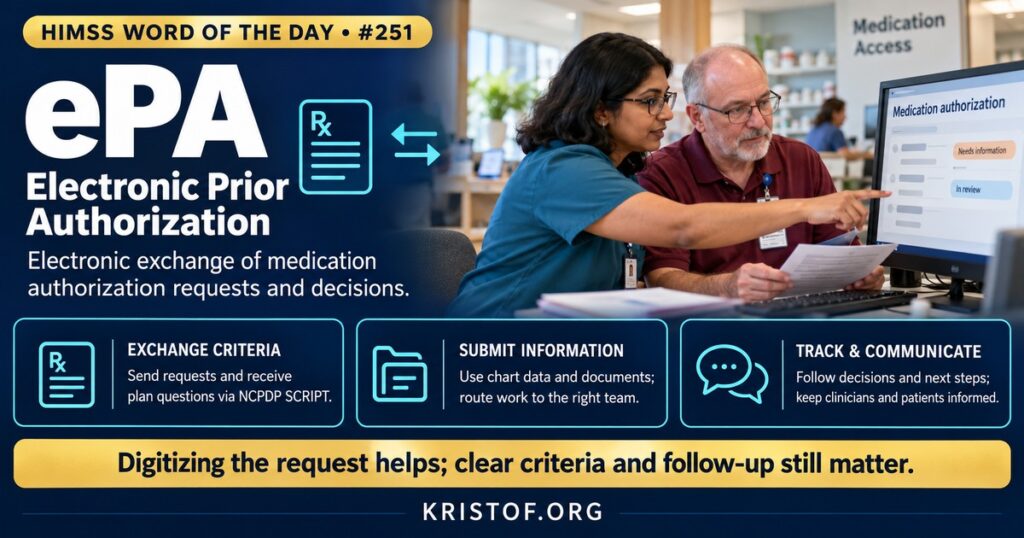
ePA, or electronic prior authorization, is the electronic process defined within the NCPDP SCRIPT standard that lets a prescriber and a health plan exchange patient-specific and drug-specific prior authorization criteria and obtain an approval in real time. The HIMSS Dictionary describes it as a medication-focused process. Instead of phone calls and faxed forms, the prescriber’s EHR sends a request, the plan returns the questions it needs answered, the clinician or staff member responds electronically, and the plan returns a decision.
Prior authorization itself is a health plan requirement that a service or drug be approved before coverage. It exists to manage cost and safety, and it is one of the most common administrative burdens named by clinicians and patients. ePA aims to make the process faster and less error-prone, and to bring it into the workflow where the prescription is written.
| Step | Description | Where Delays Occur |
|---|---|---|
| Prescription | Prescriber orders a medication | Missing coverage information |
| Request | EHR starts an electronic request to the plan | Medication not recognized as needing PA |
| Questionnaire | Plan returns criteria to answer | Questions that do not match the chart |
| Submission | Clinician or staff sends answers and documents | Rework when data are incomplete |
| Decision | Plan approves, denies, or asks for more | Plan review time |
| Pharmacy | Prescription is filled or alternative chosen | Patient not told of the outcome |
⚠️ Exam Alert: ePA as described in the dictionary is the medication process built on NCPDP SCRIPT. The CMS Interoperability and Prior Authorization Final Rule covers medical items and services and excludes drugs. Real-time prescription benefit tools show cost and coverage at the time of prescribing, which is different from submitting a prior authorization.
🌐 Why It Matters: Real-World Healthcare IT Context
Medication prior authorization affects the patient directly. A new prescription can be rejected at the pharmacy counter, the patient leaves without the drug, and the prescriber’s office receives a fax asking for more information. Each step adds days. For conditions where treatment should not wait, the delay itself can harm. Meanwhile, staff spend hours on forms and phone calls.
The standards framework matters. Medicare Part D e-prescribing rules in 42 CFR 423.160 require that electronic prior authorization and other prescription-related transactions use standards incorporated by reference, which include the NCPDP SCRIPT implementation guides. The regulation lists SCRIPT versions 2017071 and 2023011, and companion standards for real-time prescription benefit and formulary and benefit information. Technical standards are updated over time, and organizations need to track which version their EHR and partners use.
Confusion often arises with the CMS Interoperability and Prior Authorization Final Rule, published February 8, 2024. That rule requires certain payers, including Medicare Advantage organizations, state Medicaid and CHIP programs, Medicaid managed care plans, and qualified health plan issuers on the federally facilitated exchanges, to improve prior authorization processes and implement a Prior Authorization API using standards such as FHIR. The rule sets decision timeframes of 72 hours for expedited requests and seven calendar days for standard requests. CMS explained that it excluded drugs from the Prior Authorization API and process requirements because standards and processes for drugs differ from those for medical items and services. API deadlines in the rule fall on January 1, 2027. So a hospital planning for prior authorization needs two tracks: medical services under the CMS rule and FHIR APIs, and medications under NCPDP SCRIPT.
Technology alone does not remove burden. A 2025 cross-sectional study of 8,419 US family physicians who completed certification requirements in 2024 examined three administrative burdens: tracking down external health information, completing prior authorizations, and documenting outside office hours. More than three-quarters reported at least one substantial burden and 15 percent reported substantial burden from all three. Satisfaction with EHR support for obtaining external information was associated with lower burden for that task, but being able to complete prior authorizations within the EHR was not associated with lower prior authorization burden. The authors’ framing suggests that digitizing the form is not enough: payer rules, criteria, and documentation requirements drive the work. For ePA, this means usability and accuracy of the questionnaires, accessible documentation, and clear status updates all matter as much as the transmission standard.
Good implementations treat ePA as a workflow. They identify medications likely to need authorization at the time of prescribing, using real-time benefit information where available. They prepopulate answers from structured chart data, so staff do not retype. They route tasks to the right team members, track status, and notify clinicians and patients of the result. They monitor turnaround time, denial reasons, and abandoned requests, and they share findings with payers.
Common ePA problems:
- Prescribers unaware that a medication needs authorization until the pharmacy rejects it
- Plan questionnaires that ask for data not found in the chart
- Staff retyping information the EHR already holds
- Status of requests hard to find, so patients are not updated
- Confusion between the drug ePA process and the CMS medical-service API rule
- Standards or versions that differ between the EHR, intermediaries, and plans
What supports effective ePA:
- Real-time benefit checks at the point of prescribing
- Structured data that can fill plan questions automatically
- Work queues with owners, due dates, and status tracking
- Metrics on turnaround, denials, and abandoned requests
- Patient notification of outcomes and alternatives
- Tracking of standards versions and regulatory dates
🏥 The Nurse’s Perspective: Clinical, Bedside, & Workflow
Nurses and clinic staff often carry the follow-up when a prescription is stuck, so ePA design affects them directly.
At the Bedside
In inpatient settings, discharge medications that need authorization can delay going home or lead to a patient leaving without a needed drug. Nurses who know the status of discharge prescriptions can set realistic expectations and alert the team early. In clinics, nurses field patient calls about medications that the pharmacy could not fill.
In Clinical Workflow
Ambulatory nurses and medical assistants often prepare ePA requests: gathering diagnoses, prior treatments tried, and test results that the plan requires. Clear work queues, status indicators, and templates reduce phone tag. Nurse leaders track the volume and time spent on prior authorization as part of workload and burnout discussions.
Nurse informaticists help configure ePA workflows, decide who works the queues, and make sure supporting documentation fields in the chart are structured so they can fill plan questionnaires.
In EHR Implementation (Go-Live Perspective)
An Epic Go-Live in ambulatory clinics must include ePA training and testing with real medications and payers. At-the-elbow support analysts help staff find the authorization work queue, interpret plan responses, and attach documentation. They also collect examples of questionnaires that do not match the chart, which informs build changes and conversations with payers.
🎓 CAHIMS / CPHIMS & HIMSS Perspective
CAHIMS Exam Domain Mapping
ePA appears in e-prescribing, standards, and administrative burden questions:
| CAHIMS Domain | How ePA Appears |
|---|---|
| Healthcare & Technology Environments | Payer rules, CMS requirements, standards bodies |
| Clinical Informatics | Prescribing workflow, decision support, structured documentation |
| Healthcare Information & Systems Management | NCPDP SCRIPT, interfaces, intermediaries, work queues |
| Management & Leadership | Revenue cycle impact, payer relationships, burden reduction |
Key Terms to Know Alongside ePA
- NCPDP SCRIPT — standard for electronic prescribing transactions, including ePA
- Prior Authorization — payer approval required before a service or drug is covered
- Real-Time Prescription Benefit (RTPB) — tool that shows patient-specific cost and coverage at prescribing
- Formulary — list of drugs a plan covers, often with tiers and restrictions
- Prior Authorization API — FHIR-based API required of certain payers for medical services
- Step Therapy — requirement to try a preferred drug before another is covered
HIMSS Organizational Position
HIMSS supports standards-based interoperability and reduced administrative burden through its public policy work, research, and education. Members can find related resources through the HIMSS Resource Center and Public Policy and Advocacy pages.
🔗 Explore Further: External References
- eCFR — 42 CFR 423.160, Standards for Electronic Prescribing https://www.ecfr.gov/current/title-42/chapter-IV/subchapter-B/part-423/subpart-D/section-423.160
- Federal Register — Advancing Interoperability and Improving Prior Authorization Processes (CMS-0057-F), February 8, 2024 https://www.federalregister.gov/documents/2024/02/08/2024-00895/medicare-and-medicaid-programs-patient-protection-and-affordable-care-act-advancing-interoperability
- CMS — Administrative Simplification https://www.cms.gov/priorities/key-initiatives/burden-reduction/administrative-simplification
- Gabriel et al. (2026), Journal of General Internal Medicine — The Triple Burden of Administrative Tasks Among US Family Medicine Physicians: A Cross-sectional Study https://pubmed.ncbi.nlm.nih.gov/42552294/
- Lenert (2023), Journal of the American Medical Informatics Association — Could an Artificial Intelligence Approach to Prior Authorization Be More Human? https://pubmed.ncbi.nlm.nih.gov/36809561/
Term source: HIMSS Dictionary of Health Information and Technology Terms, Acronyms, and Organizations, 6th Edition (2025). All definitions in this series are paraphrased for editorial purposes. Readers are encouraged to consult the primary source for exact language.
Eric Andrew Kristof, RN, CAHIMS is a Healthcare IT professional and HIMSS Arkansas Chapter member based in Hot Springs Village, AR, with hands-on Epic Go-Live experience and a diverse healthcare and IT background. He writes at kristof.org at the intersection of clinical care and healthcare technology.
Leave a Reply