By Eric Andrew Kristof, RN, CAHIMS | Healthcare IT Professional | HIMSS Arkansas Chapter Member
About This Series: The HIMSS Word of The Day is a running blog series drawing from the HIMSS Dictionary of Health Information and Technology Terms, Acronyms, and Organizations, 6th Edition (2025) — the authoritative reference for healthcare IT professionals and the primary study resource for CAHIMS and CPHIMS certification. Each post paraphrases the term in plain language, grounds it in real-world healthcare IT context, and adds a bedside nursing perspective you won’t find in a textbook.
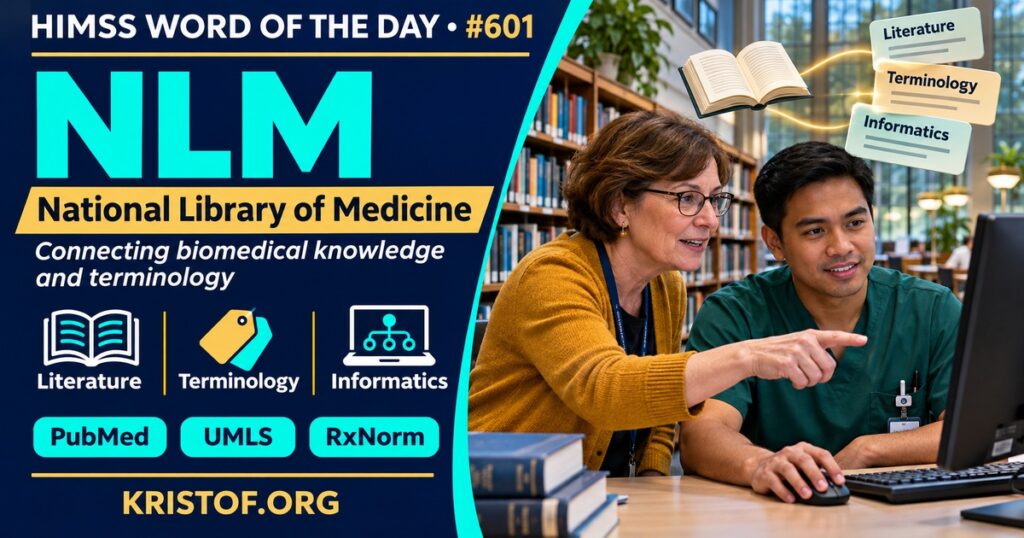
📖 The Term: NLM (National Library of Medicine)
Source: HIMSS Dictionary of Health Information and Technology Terms, Acronyms, and Organizations, 6th Edition (2025)
🔍 Plain-Language Definition
The HIMSS Dictionary lists NLM (National Library of Medicine) in its organizations appendix and describes it as the largest medical library in the world. It says the library gathers material on biomedicine and health care, including work in related fields such as technology, the humanities, and the natural and social sciences. It puts the collection at more than 9 million items and describes NLM as a resource for health science libraries across the country, reached through a national network.
The collection figure deserves care. An NLM news item dated August 24, 2022 describes the library as holding over 17 million items, and NLM’s current About page gives no collection count. NLM’s fact sheet, which gives no publication date and refers to its 2017 to 2027 strategic plan, mentions “more than 9 million” in a different context: free full-text biomedical and life sciences articles. The dictionary’s number may come from an older count, so the figure should be checked at NLM before use.
NLM’s About page, last reviewed March 17, 2026, says NLM has been a center of information innovation since its founding in 1836 and sits on the National Institutes of Health campus in Bethesda, Maryland. It describes itself as the world’s largest biomedical library and says its electronic resources are searched billions of times a year. The fact sheet describes NLM as one of 27 NIH Institutes and Centers and as a global leader in biomedical informatics and computational health data science.
| Item | Detail |
|---|---|
| Type | Federal biomedical library and research organization on the NIH campus (NLM’s description) |
| Founded | 1836, per NLM |
| Location | Bethesda, Maryland, per NLM |
| Focus | Biomedical literature, health information resources, and informatics research |
| Health IT role | Describes itself as the central coordinating body for clinical terminology standards within HHS |
| Relation to HIMSS | None verified for this post, so none is claimed |
⚠️ Exam Alert: NLM is part of NIH and is a library and standards resource, not a regulator. It is separate from the FDA, which regulates products, from ONC, which runs the health IT certification program, and from HIMSS, the source of CAHIMS and CPHIMS. NLM supports vocabularies such as RxNorm, LOINC, and SNOMED CT and is the home of the UMLS, but supporting a vocabulary is not the same as owning it.
🌐 Why It Matters: Real-World Healthcare IT Context
The points below come from NLM’s own pages, so they are NLM’s descriptions of itself and not independent assessments. No independent source was added for this post. Where a page names a resource only by function, the service name in parentheses is the one usually associated with that description and is not stated on the page.
Resources NLM describes. NLM’s fact sheet describes a literature citation database holding more than 36 million citations (PubMed) and a clinical trial registry with nearly 470,000 studies and more than 60,000 results summaries (ClinicalTrials.gov). It describes consumer health information used by nearly 440 million users a year, and a full-text archive of more than 9 million free articles plus nearly 14,000 preprints of NIH-funded research (PubMed Central). It also describes the largest public repository of high-throughput sequencing data, with nearly 70 petabytes available at no charge, including through commercial cloud services.
Terminology standards. NLM’s health IT page describes NLM as the central coordinating body for clinical terminology standards within HHS and says it works with ONC to align its efforts with the national goal of interoperable health IT. The page lists RxNorm, with the RxNav and RxMix tools. It says NLM funds the development of LOINC to improve interoperability of lab results and patient assessment instruments. It says NLM is the U.S. Member Representative to the international SNOMED terminology organization, which allows free use of SNOMED CT in the United States, and it lists NLM’s Value Set Authority Center as a terminology tool. The page gives May 4, 2015 as its first issue date and May 18, 2026 as its last review date.
The UMLS. NLM describes the Unified Medical Language System as a set of files and software that combines many health and biomedical vocabularies so that computer systems can work together, including electronic health records. It lists three components: the Metathesaurus, which holds terms and codes from many vocabularies with their hierarchies, definitions, and relationships; the Semantic Network, which holds broad semantic types and their relationships; and the SPECIALIST Lexicon and Lexical Tools. Individuals can get a license at no charge by signing up for a UMLS Terminology Services account, and licenses are not issued to groups or organizations. NLM notes that some uses may need separate agreements with individual terminology vendors. RxNorm, MeSH, and SNOMED CT are among the vocabularies whose terms and codes appear in the Metathesaurus.
Outreach. The fact sheet says NLM’s national network of libraries has more than 8,800 members in seven regions, while the 2022 news item cited 5,600 member institutions. The two figures differ by source and date, so a current count should come from NLM.
Current status. NLM’s pages were reachable and recently reviewed when read for this post. This post does not name NLM’s current leadership, since that can change.
Common NLM mix-ups:
- Treating NLM as a regulator, when it is a library and standards resource
- Repeating the dictionary’s 9 million figure without checking the current count
- Assuming a vocabulary is owned by NLM because NLM distributes or supports it
- Assuming the UMLS license is issued to an organization, when NLM says licenses go to individuals
- Mixing up NLM with NIH, of which it is a part
What NLM offers:
- Biomedical literature and clinical trial information described on its fact sheet
- Terminology services, including RxNorm tools and the UMLS
- A value set tool, the Value Set Authority Center, listed on its health IT page
- A national network that trains librarians, health professionals, and the public to use its resources
🏥 The Nurse’s Perspective: Clinical, Bedside, & Workflow
Nurses meet NLM resources more often than the name suggests, through literature searches, consumer health pages used in patient teaching, and the vocabularies behind the EHR.
At the Bedside
Nurses who look up evidence for a practice question or find plain-language material for patient education are often using NLM services. NLM describes its consumer health information as reaching nearly 440 million users a year. Checking that any material shared with a patient matches the facility’s approved education sources keeps teaching consistent.
In Clinical Workflow
Nurse informaticists often meet NLM through terminologies. RxNorm and SNOMED CT appear behind medication lists, allergy lists, and problem lists, and NLM describes itself as coordinating clinical terminology standards within HHS. Understanding that a vocabulary is maintained by its own organization, with NLM supporting access, helps when a mapping question arises.
In EHR Implementation (Go-Live Perspective)
During an Epic Go-Live, analysts at the elbow hear questions such as why a medication appears under a different name than the nurse expects. The answer often sits in how the product name maps to a standard drug vocabulary. Capturing the exact entry and the screen, with patient details removed, helps the build team trace the mapping. This post does not claim that any specific go-live involved NLM resources.
🎓 CAHIMS / CPHIMS & HIMSS Perspective
CAHIMS Exam Domain Mapping
NLM supports standards and informatics knowledge:
| CAHIMS Domain | How NLM Appears |
|---|---|
| Healthcare & Technology Environments | Federal agencies, libraries, and the standards ecosystem |
| Clinical Informatics | Terminologies such as SNOMED CT, RxNorm, and LOINC |
| Healthcare Information & Systems Management | Licensing, mapping, and use of vocabularies in systems |
| Management & Leadership | Evidence use and vendor claims about terminology support |
Key Terms to Know Alongside NLM
- UMLS — NLM’s set of files and software that combines many biomedical vocabularies
- RxNorm — a drug vocabulary supported by NLM, per its health IT page
- SNOMED CT — a clinical terminology that NLM says is free to use in the United States
- LOINC — a lab and clinical observation code system whose development NLM says it funds
- MeSH — a vocabulary of subject headings used in the Metathesaurus
- Value Set Authority Center — NLM’s tool for value sets, listed on its health IT page
HIMSS Organizational Position
HIMSS offers education and research on health information and technology topics through its Resource Center. Members can find related information on the HIMSS Resource Center page.
🔗 Explore Further: External References
- NLM — About the National Library of Medicine https://www.nlm.nih.gov/about/index.html
- NLM — Fact Sheet (FY 2025 congressional justification) https://www.nlm.nih.gov/about/2025CJ_NLM_Fact_Sheet.pdf
- NLM — Health IT and Terminology Standards https://www.nlm.nih.gov/healthit/index.html
- NLM — Unified Medical Language System (UMLS) https://www.nlm.nih.gov/research/umls/index.html
- NLM — News item, August 24, 2022 https://www.nlm.nih.gov/news/NLM_to_Host_Data_Health_and_the_Digital_Humanities_Shared_Horizons_II.html
- HIMSS — Resource Center https://www.himss.org/resource-center
Term source: HIMSS Dictionary of Health Information and Technology Terms, Acronyms, and Organizations, 6th Edition (2025). All definitions in this series are paraphrased for editorial purposes. Readers are encouraged to consult the primary source for exact language.
Eric Andrew Kristof, RN, CAHIMS is a Healthcare IT professional and HIMSS Arkansas Chapter member based in Hot Springs Village, AR, with hands-on Epic Go-Live experience and a diverse healthcare and IT background. He writes at kristof.org at the intersection of clinical care and healthcare technology.
Leave a Reply