By Eric Andrew Kristof, RN, CAHIMS | Healthcare IT Professional | HIMSS Arkansas Chapter Member
About This Series: The HIMSS Word of The Day is a running blog series drawing from the HIMSS Dictionary of Health Information and Technology Terms, Acronyms, and Organizations, 6th Edition (2025) — the authoritative reference for healthcare IT professionals and the primary study resource for CAHIMS and CPHIMS certification. Each post paraphrases the term in plain language, grounds it in real-world healthcare IT context, and adds a bedside nursing perspective you won’t find in a textbook.
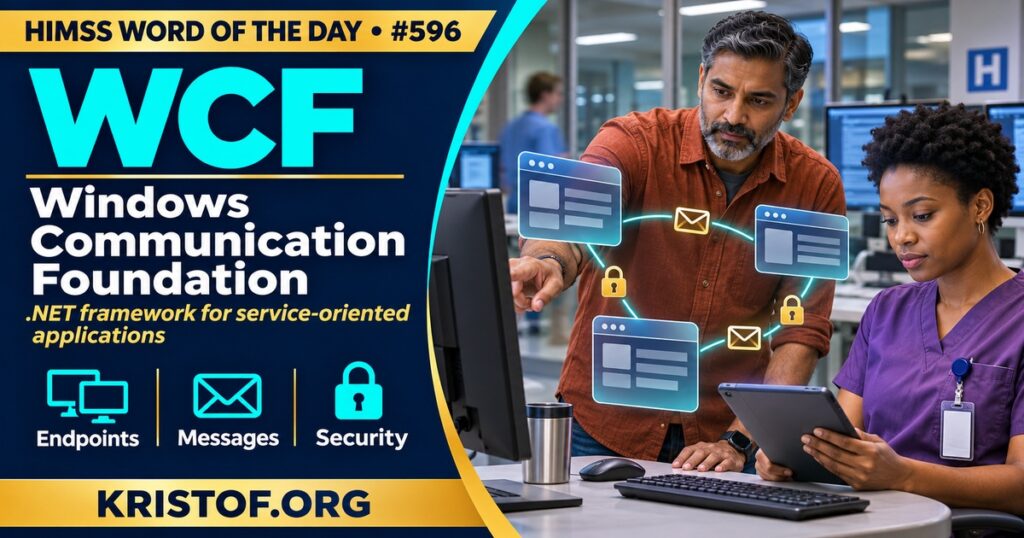
📖 The Term: WCF (Windows Communication Foundation)
Source: HIMSS Dictionary of Health Information and Technology Terms, Acronyms, and Organizations, 6th Edition (2025)
🔍 Plain-Language Definition
The HIMSS Dictionary describes WCF (Windows Communication Foundation) as a technology for building applications on service-oriented architecture (SOA), implemented as a set of classes layered on the .NET Common Language Runtime. It adds that WCF tackles the problem of interoperability for distributed .NET applications.
Microsoft’s documentation describes WCF as a framework for building service-oriented applications in which data travels as asynchronous messages between service endpoints. An endpoint can be part of a service hosted in Internet Information Services or in an application, and an endpoint can also act as a client. The page lists three message patterns: request and reply, one-way, and duplex, in which two endpoints exchange data in both directions. These details were read through a summarizing fetch tool, so exact wording is worth confirming at the source.
| Item | Detail |
|---|---|
| What it is | A Microsoft .NET framework for building service-oriented applications |
| Core idea | Services expose endpoints, and clients and services exchange messages |
| Common setup | Text-encoded SOAP over HTTP, per Microsoft |
| Other transports | TCP, named pipes, and MSMQ |
| Message patterns | Request and reply, one-way, and duplex |
| Modern .NET | Microsoft’s page says a WCF server can run on .NET 6 and later through CoreWCF packages |
| Relation to HIMSS | None verified for this post, so none is claimed |
⚠️ Exam Alert: WCF is a developer framework, so it is not a messaging standard such as HL7 or FHIR, not a transport protocol itself, and not the same as SOAP, which is one message format it commonly uses. It is also not SOA, which is an architectural style that WCF helps implement. CAHIMS and CPHIMS come from HIMSS, not from Microsoft.
🌐 Why It Matters: Real-World Healthcare IT Context
A PubMed search for WCF returned unrelated papers, such as studies that use the same letters for other terms, so there is no healthcare research to cite. This section relies on Microsoft’s documentation, a W3C specification, and a project page, and it does not claim how any EHR or hospital interface uses WCF.
What Microsoft says it supports. The documentation says WCF can send messages as text or in an optimized binary format, and can send binary data efficiently with a standard called MTOM. It describes support for publishing service descriptions in formats such as WSDL, XML Schema, and WS-Policy, so that clients can configure themselves. It lists reliable messaging, queued messaging, transactions, and extensibility points, and it describes encryption and authentication options, including SSL and WS-SecureConversation. It also says WCF can handle plain XML, AJAX and REST-style formats such as JSON and Atom.
SOAP. The W3C describes SOAP Version 1.2 as a lightweight protocol for exchanging structured information in distributed systems. It uses XML to define an extensible messaging framework with an envelope that can travel over different underlying protocols. The second edition was published as a W3C Recommendation on April 27, 2007. WCF’s most common configuration, according to Microsoft, uses SOAP over HTTP.
What replaced it. Microsoft’s WCF page recommends gRPC as a modern alternative and cites advantages in performance, scalability, security, and cross-platform support. The gRPC site describes gRPC as a free, open-source system for remote procedure calls that runs over HTTP/2 and has client libraries in eleven languages. A Microsoft page on technologies that are unavailable when moving from .NET Framework, last updated June 18, 2026 per the fetched page, says a WCF server can run on .NET 6 and later by using CoreWCF packages. CoreWCF’s GitHub page says it ports the server side of WCF to modern .NET, is supported by the .NET Foundation, and uses the MIT license. It does not include an explicit support commitment, so a team relying on it should confirm the terms.
Why it matters for health IT readers. Many integration and enterprise applications were built as web services, and a reader may meet WCF in vendor documentation, interface specifications, or a hospital’s custom services. The sources here do not say how common that is in healthcare, so that point is background reasoning rather than a finding.
Common WCF problems:
- Treating WCF as a data standard, when it is a programming framework
- Confusing WCF with SOAP, SOA, or web services in general
- Assuming WCF works the same way in modern .NET as in the older .NET Framework, which Microsoft’s page says needs CoreWCF for servers
- Overlooking security settings such as encryption and authentication when exposing a service
- Assuming the dictionary’s date-free description reflects current Microsoft guidance, which now points to gRPC for new work
What supports a layered service approach like WCF:
- Published service descriptions that clients can use to configure themselves
- Several transports and message patterns for different needs
- Built-in options for encryption, authentication, reliable messaging, and transactions
- A documented path to modern .NET through CoreWCF and to gRPC for new designs
🏥 The Nurse’s Perspective: Clinical, Bedside, & Workflow
Nurses do not build services, but the apps they use may depend on services that pass data between systems behind the scenes.
At the Bedside
When a device, kiosk, or mobile app shows data from a central system, a service call usually sits between them. If the screen shows an error or a delay, reporting the exact message, the app, and the time helps the support team find which service or connection to examine.
In Clinical Workflow
Nurse informaticists often work with analysts and developers who build or test interfaces. Knowing that services have endpoints, messages, and security settings helps these nurses follow what the technical team describes and ask whether a change could affect a clinical workflow, such as a result that is slow to appear.
In EHR Implementation (Go-Live Perspective)
During an Epic Go-Live, analysts at the elbow hear reports such as a third-party app that does not refresh. A plain description of what the user did and what appeared lets the interface team check the service layer without guessing. This post does not claim that any specific go-live used WCF.
🎓 CAHIMS / CPHIMS & HIMSS Perspective
CAHIMS Exam Domain Mapping
WCF supports infrastructure and integration knowledge:
| CAHIMS Domain | How WCF Appears |
|---|---|
| Healthcare & Technology Environments | Software frameworks and the vendors that publish them |
| Clinical Informatics | Services that move clinical data between applications |
| Healthcare Information & Systems Management | Endpoints, transports, security settings, and interface troubleshooting |
| Management & Leadership | Deciding when to maintain older services and when to move to newer designs |
Key Terms to Know Alongside WCF
- SOA (Service-Oriented Architecture) — a design style that builds software from services that exchange messages
- SOAP (Simple Object Access Protocol) — an XML-based messaging protocol commonly used by WCF services
- REST (Representational state transfer) — an architectural style for web services that uses standard web operations
- XML (Extensible Markup Language) — a text format used to structure messages and service descriptions
- Web service — a service that applications call over a network using standard protocols
- Interface engine — software that routes and transforms messages between systems
HIMSS Organizational Position
HIMSS offers education and research on health information and technology topics through its Resource Center. Members can find related information on the HIMSS Resource Center page.
🔗 Explore Further: External References
- Microsoft Learn — What Is Windows Communication Foundation https://learn.microsoft.com/en-us/dotnet/framework/wcf/whats-wcf
- Microsoft Learn — .NET Framework technologies unavailable on .NET 6+ https://learn.microsoft.com/en-us/dotnet/core/porting/net-framework-tech-unavailable
- CoreWCF — GitHub project page https://github.com/CoreWCF/CoreWCF
- W3C — SOAP Version 1.2 Part 1: Messaging Framework (Second Edition) https://www.w3.org/TR/soap12-part1/
- gRPC — About https://grpc.io/about/
- HIMSS — Resource Center https://www.himss.org/resource-center
Term source: HIMSS Dictionary of Health Information and Technology Terms, Acronyms, and Organizations, 6th Edition (2025). All definitions in this series are paraphrased for editorial purposes. Readers are encouraged to consult the primary source for exact language.
Eric Andrew Kristof, RN, CAHIMS is a Healthcare IT professional and HIMSS Arkansas Chapter member based in Hot Springs Village, AR, with hands-on Epic Go-Live experience and a diverse healthcare and IT background. He writes at kristof.org at the intersection of clinical care and healthcare technology.
Leave a Reply