By Eric Andrew Kristof, RN, CAHIMS | Healthcare IT Professional | HIMSS Arkansas Chapter Member
About This Series: The HIMSS Word of The Day is a running blog series drawing from the HIMSS Dictionary of Health Information and Technology Terms, Acronyms, and Organizations, 6th Edition (2025) — the authoritative reference for healthcare IT professionals and the primary study resource for CAHIMS and CPHIMS certification. Each post paraphrases the term in plain language, grounds it in real-world healthcare IT context, and adds a bedside nursing perspective you won’t find in a textbook.
📖 The Term: PHIN-MS (Public Health Information Network-Messaging System)
Source: HIMSS Dictionary of Health Information and Technology Terms, Acronyms, and Organizations, 6th Edition (2025)
🔍 Plain-Language Definition
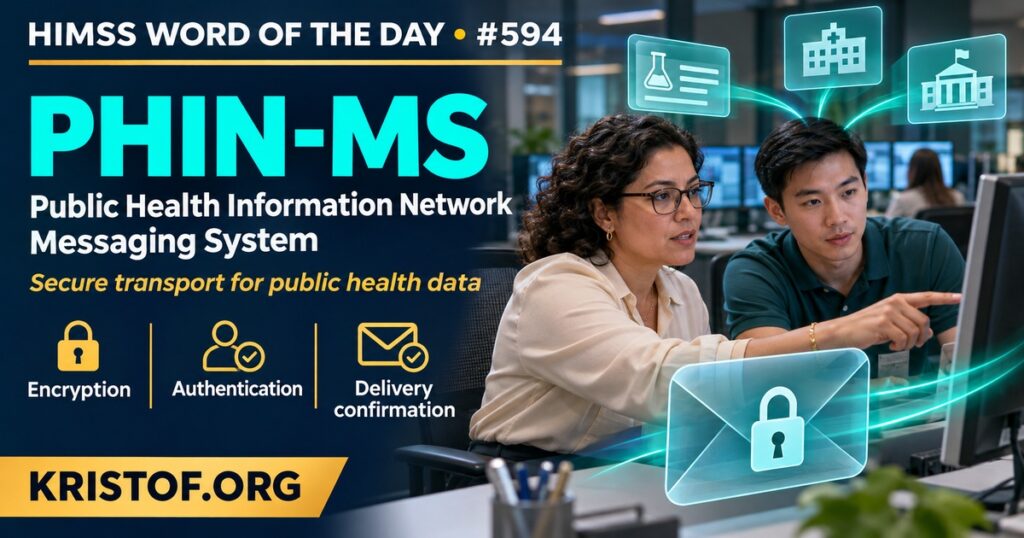
The HIMSS Dictionary describes PHIN-MS as a protocol for secure data transmission, based on the ebXML model, that the Centers for Disease Control and Prevention (CDC) built and continues to support, according to the entry. It adds that the system lets rapid, secure messages carry sensitive health information over the Internet to local, state, and federal organizations and to CDC.
CDC’s own pages use a slightly different frame. They call PHINMS (the usual CDC spelling) software that securely transports electronic messages between public health information systems, so that organizations can exchange sensitive data without integrating their systems directly. The software uses ebXML, short for Electronic Business using Extensible Markup Language, and the pages say it can carry common public health formats such as HL7, XML, image files, and CSV files. The dictionary’s word “protocol” is therefore best read as shorthand for the messaging approach the software implements.
The dictionary describes PHIN-MS in the present tense, but CDC has announced its retirement, which the Why It Matters section explains. These pages were read through a summarizing fetch tool, so exact wording is worth confirming at the source.
| Item | Detail |
|---|---|
| What it is | CDC-provided software for secure messaging between public health systems |
| Technology base | ebXML messaging over HTTPS, per CDC’s implementation guide |
| Message content | HL7, XML, image files, CSV files, and other formats |
| Main parts | A sender, a receiver, and message queues, per the implementation guide |
| Security features described | Encryption, authentication, addressing and routing, auditing, and delivery confirmations |
| Status | CDC says it will retire PHINMS by November 30, 2026 |
| Relation to HIMSS | None verified for this post, so none is claimed |
⚠️ Exam Alert: PHIN-MS is the messaging software, while PHIN is the broader Public Health Information Network, and a message format such as HL7 describes content rather than transport. It is also not a clinical messaging tool for bedside staff, and it is not Direct secure messaging. CAHIMS and CPHIMS come from HIMSS, not from CDC.
🌐 Why It Matters: Real-World Healthcare IT Context
There is little peer-reviewed literature on PHINMS in the sources found for this post, so this section relies on CDC’s own pages and attributes the claims to CDC.
What it did. CDC’s PHINMS page says the software provides a consistent approach to encryption and authentication, standard addressing and routing, auditing, and delivery confirmations. It describes the users as public health organizations that run many different information systems and need to share critical data with partners. These are CDC’s statements about its own product, and this post did not evaluate how well it performed.
How it worked. CDC’s PHINMS 3.3 Implementation Guide, whose cover is dated October 31, 2023, describes a sender and a receiver. Messages wait in a transport queue on the sending side and a worker queue on the receiving side. The guide names HTTPS as the secure channel, says each sender is identified by a party identifier, and says sending data to CDC requires a digital certificate. It lists TLS 1.2 as a requirement and describes client-certificate authentication, encryption of data sent to CDC, and message signing and verification for nonrepudiation, which it says was added in version 3.2. The guide covers installation and basic configuration and points to a separate technical guide for advanced setup.
The retirement notice. CDC’s PHIN Sunset page, first published September 1, 2026 and last updated September 15, 2026, says CDC will sunset all PHIN systems by November 30, 2026. For PHINMS, it says CDC stops sending and receiving data through PHINMS on November 2, 2026, that some local, within-jurisdiction functions may still work with CDC support until November 30, and that all remaining PHIN tools and support end on November 30. The page recommends Mercury S3, which it describes as a secure file transfer service built on Amazon S3 and offered at no cost, and says the Association of Public Health Laboratories is moving its connection between its AIMS platform and CDC onto Mercury S3. It also lists replacements for the vocabulary service, such as VSAC and HL7 Terminology. Because dates and plans can change, anyone who depends on PHINMS should confirm the current status with CDC, whose contact addresses are on that page.
A dictionary entry that has aged. The dictionary’s present-tense description may have been accurate when written. Readers preparing for an exam should know the concept, ebXML-based secure transport for public health messages, and should also know that the specific tool is being retired.
Common PHIN-MS problems:
- Treating PHIN-MS as a standard message format, when it is a transport tool and the formats ride inside it
- Confusing PHIN-MS with PHIN, the larger network and set of services
- Assuming it is still available without checking CDC’s sunset dates
- Overlooking the certificate requirement when planning a connection
- Forgetting that a local or state partner may use a different file transfer route than CDC recommends
What supports secure public health messaging like this:
- A defined transport approach with queues, routing, and delivery confirmations
- Encryption and certificate-based authentication, per the implementation guide
- Support for common content formats such as HL7 and CSV
- Published CDC guidance, including an implementation guide and a sunset page with contacts
🏥 The Nurse’s Perspective: Clinical, Bedside, & Workflow
Nurses rarely see PHIN-MS directly, but the records they create, such as reportable conditions and immunizations, can feed public health systems that depend on transport tools like it.
At the Bedside
Accurate documentation of immunizations, exposures, and reportable conditions is what makes later reporting possible. If a patient asks whether a report was sent, the nurse can explain what was documented and refer questions about the reporting route to the infection prevention or health information team, which usually knows how reports leave the organization.
In Clinical Workflow
Infection preventionists and nurse informaticists often work with health department reporting. Knowing that transport tools carry messages and that the content formats are a separate topic helps when a report is rejected or delayed, because the cause may be the message content, the connection, or a certificate.
In EHR Implementation (Go-Live Perspective)
During an Epic Go-Live, analysts at the elbow hear about public health reporting mostly as a checklist item, such as whether immunization or lab reports reach the health department. Collecting what was sent, when, and to whom, with patient details removed, helps the interface and public health teams work out whether the problem sits in the build, the transport, or the receiver.
🎓 CAHIMS / CPHIMS & HIMSS Perspective
CAHIMS Exam Domain Mapping
PHIN-MS supports public health and exchange knowledge:
| CAHIMS Domain | How PHIN-MS Appears |
|---|---|
| Healthcare & Technology Environments | CDC systems, public health networks, and secure transport |
| Clinical Informatics | Reportable conditions and immunization data moving to public health |
| Healthcare Information & Systems Management | Message queues, certificates, and replacing retired tools |
| Management & Leadership | Planning a transition when a federal tool is retired |
Key Terms to Know Alongside PHIN-MS
- PHIN (Public Health Information Network) — the CDC initiative and set of standards within which PHIN-MS operated
- HL7 V2 — a widely used messaging standard whose messages can travel inside a transport tool
- PKI (Public Key Infrastructure) — the system of keys and certificates that supports authentication and encryption
- Encryption — protecting data so only authorized parties can read it
- Public health reporting — sending required health information to public health agencies
- HAN (Health Alert Network) — CDC’s system for sending health alerts to public health partners
HIMSS Organizational Position
HIMSS offers education and research on health information and technology topics through its Resource Center. Members can find related information on the HIMSS Resource Center page.
🔗 Explore Further: External References
- CDC — PHIN Sunset https://cdc.gov/phin/php/sunset/index.html
- CDC — PHIN Messaging System (PHINMS) https://www.cdc.gov/phin/php/phinms
- CDC — PHINMS 3.3 Implementation Guide (cover dated October 31, 2023) https://www.cdc.gov/phin/tools/phinms/documents/PHINMS-Implementation-Guide-3.3-508.pdf
- CDC — Attention PHIN Users (modernization notice) https://www.cdc.gov/phin/site.html
- HIMSS — Resource Center https://www.himss.org/resource-center
Term source: HIMSS Dictionary of Health Information and Technology Terms, Acronyms, and Organizations, 6th Edition (2025). All definitions in this series are paraphrased for editorial purposes. Readers are encouraged to consult the primary source for exact language.
Eric Andrew Kristof, RN, CAHIMS is a Healthcare IT professional and HIMSS Arkansas Chapter member based in Hot Springs Village, AR, with hands-on Epic Go-Live experience and a diverse healthcare and IT background. He writes at kristof.org at the intersection of clinical care and healthcare technology.
Leave a Reply