By Eric Andrew Kristof, RN, CAHIMS | Healthcare IT Professional | HIMSS Arkansas Chapter Member
About This Series: The HIMSS Word of The Day is a running blog series drawing from the HIMSS Dictionary of Health Information and Technology Terms, Acronyms, and Organizations, 6th Edition (2025) — the authoritative reference for healthcare IT professionals and the primary study resource for CAHIMS and CPHIMS certification. Each post paraphrases the term in plain language, grounds it in real-world healthcare IT context, and adds a bedside nursing perspective you won’t find in a textbook.
📖 The Term: FDA (U.S. Food and Drug Administration)
Source: HIMSS Dictionary of Health Information and Technology Terms, Acronyms, and Organizations, 6th Edition (2025)
🔍 Plain-Language Definition
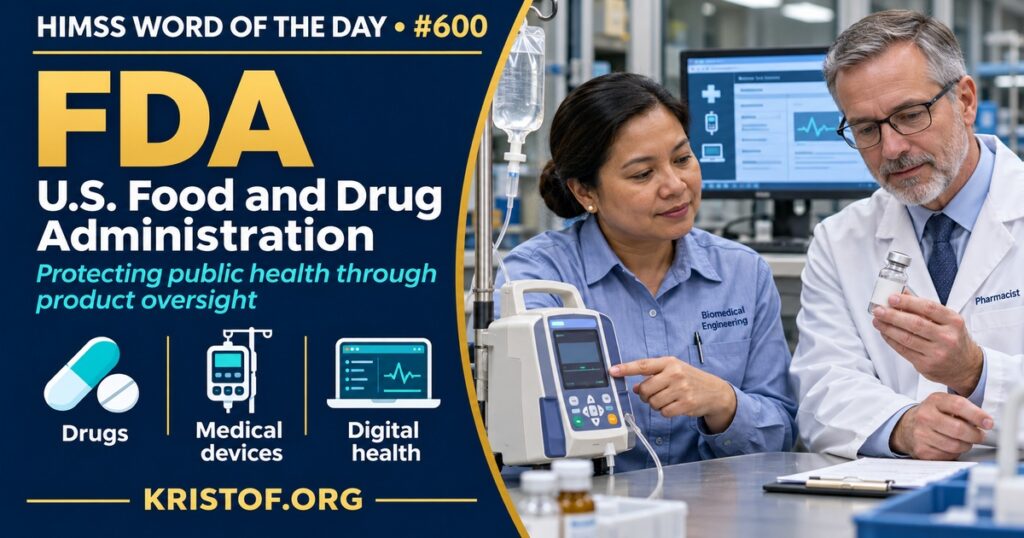
The HIMSS Dictionary lists the FDA (U.S. Food and Drug Administration) in its organizations appendix and describes it as the federal agency charged with protecting public health. Its list of areas covers drugs for people and for animals, biologics, and medical devices, along with the food supply, cosmetics, and radiation-emitting products, with safety, effectiveness, and security as the goals.
The FDA’s own “What We Do” page uses much the same scope and adds tobacco products. It describes the mission as protecting public health by making sure the products it oversees are safe, effective, and secure. It also says the agency aims to speed innovation so medical products work better, are safer, and cost less, and to give the public science-based information. It names a counterterrorism role as well, including protecting the food supply and supporting the development of medical products for deliberate and natural health threats. The page does not mention digital health.
FDA’s organization page describes the FDA as a federal regulatory agency within the Department of Health and Human Services, led through an Office of the Commissioner. Because FDA leadership can change, this post does not name anyone in that office.
| Item | Detail |
|---|---|
| Type | Federal regulatory agency within HHS (FDA’s description) |
| Regulates | Drugs, biologics, medical devices, food, cosmetics, radiation-emitting products, tobacco (FDA’s list) |
| Product centers | Biologics, Devices and Radiological Health, Drug Evaluation and Research, Human Foods Program, Tobacco Products, Veterinary Medicine |
| Roots | 1848 federal chemical analysis; modern regulation from the 1906 Pure Food and Drugs Act; present name since 1930 (FDA history page) |
| Health IT link | Digital Health Center of Excellence within the device center |
| Relation to HIMSS | None verified for this post, so none is claimed |
⚠️ Exam Alert: The FDA oversees the safety and effectiveness of products such as drugs and medical devices. It does not run the Medicare program, which is CMS, and it does not run the ONC Health IT Certification Program, which is ONC. It is also separate from AHRQ, which supports health care research, and from HIMSS, the source of CAHIMS and CPHIMS. Questions about medical software usually turn on whether a software function counts as a device.
🌐 Why It Matters: Real-World Healthcare IT Context
The points below come from FDA’s own pages, plus one independent source, the text of the law as published by Cornell’s Legal Information Institute. Statements about what the FDA says or does are attributed to its pages, which may change.
History. FDA says it is the oldest comprehensive consumer protection agency in the federal government. It traces its roots to 1848, when the government began using chemical analysis to check the safety of farm products, a job the Department of Agriculture took over in 1862 and the FDA later inherited. FDA’s modern regulatory role began with the 1906 Pure Food and Drugs Act, which banned interstate sales of contaminated or falsely labeled foods and drugs, and a chemist at the Department of Agriculture, Harvey Washington Wiley, drove its passage and led early enforcement. The agency did not carry its present name until 1930, according to its history page.
The 1938 law. FDA’s device history page says the Federal Food, Drug, and Cosmetic Act of 1938 gave the agency its main authority over medical products. It extended the ban on interstate commerce in misbranded and adulterated products to therapeutic medical devices and authorized factory inspections.
Medical device law. FDA’s device history page says the 1976 Medical Device Amendments created a three-class, risk-based classification and two main premarket routes: premarket approval and premarket notification, known as 510(k). It also lists the investigational device exemption and postmarket duties such as establishment registration, device listing, and adverse event reporting. It adds that the 1990 Safe Medical Devices Act required user facilities, such as hospitals, to report device adverse events, and that the 1997 FDA Modernization Act created the De Novo pathway. For software, it says the 2016 21st Century Cures Act clarified which categories of medical software can and cannot be regulated as devices.
Software and the device definition. The text of 21 U.S.C. 360j(o), added in 2016 and read at Cornell’s Legal Information Institute, lists software functions that are not devices. They include administrative support such as billing and scheduling, healthy lifestyle software, electronic patient records that store and display a chart without interpreting data to diagnose or treat, software that transfers, stores, converts, or displays lab and device data without analyzing it, and some clinical decision support, provided the clinician can independently review the basis for its recommendations. The statute also lets FDA treat some of these categories as devices if it finds that use is reasonably likely to cause serious adverse health consequences, and the software must be named in a final order after a proposed order is published for public comment. The amendment history shown on the page lists no later change to this subsection. Whether a particular product qualifies is a regulatory question for each product, and this post does not decide any.
Where digital health sits. FDA’s Digital Health Center of Excellence page says the center is part of the Center for Devices and Radiological Health and runs its digital health program. The page lists focus areas including software as a medical device, mobile medical apps, AI-enabled devices, cybersecurity, augmented and virtual reality, and wireless devices and interoperability.
How the agency is organized. FDA’s organization page lists six product centers: biologics, devices and radiological health, drug evaluation and research, the Human Foods Program, tobacco products, and veterinary medicine. It also lists the Office of Inspections and Investigations and the Oncology Center of Excellence.
Common FDA mix-ups:
- Assuming every piece of health software is regulated as a medical device, when the statute excludes several categories
- Assuming the FDA runs EHR certification, which belongs to ONC
- Mixing up the FDA with CMS, which administers Medicare and other payment programs
- Treating a vendor’s regulatory statement as proof of FDA clearance without checking
- Quoting a rule without checking whether it has been updated
What the FDA offers:
- Public pages that describe its history, structure, and product centers
- A published legal framework for which software counts as a device
- A Digital Health Center of Excellence that publishes information on software, AI, and cybersecurity topics
- Device adverse event reporting duties for user facilities such as hospitals, per its history page
🏥 The Nurse’s Perspective: Clinical, Bedside, & Workflow
Nurses use FDA-regulated products on every shift, from infusion pumps and monitors to medications and dressings.
At the Bedside
When a device behaves unexpectedly, the nurse is often the first to notice. FDA’s device history says user facilities such as hospitals have had a duty to report certain device adverse events since the 1990 Safe Medical Devices Act. Following the facility’s process for reporting a problem, and keeping the device and its alarm history available when policy allows, supports that duty.
In Clinical Workflow
Nurse informaticists often sit between clinical engineering, pharmacy, and the EHR team when devices and software connect. Knowing that some software functions are excluded from the device definition while others are not helps them ask regulatory and biomedical colleagues the right question about a new tool.
In EHR Implementation (Go-Live Perspective)
During an Epic Go-Live, analysts at the elbow hear questions about device integrations, such as monitor data flowing into flowsheets. Capturing what was connected, what displayed, and what the nurse saw gives the right team the facts. This post does not claim that any specific go-live involved a regulated device issue.
🎓 CAHIMS / CPHIMS & HIMSS Perspective
CAHIMS Exam Domain Mapping
The FDA supports policy and technology environment knowledge:
| CAHIMS Domain | How the FDA Appears |
|---|---|
| Healthcare & Technology Environments | Federal agencies and what each one regulates |
| Clinical Informatics | Devices, clinical decision support, and medication safety |
| Healthcare Information & Systems Management | Device integration, vendor regulatory claims, and adverse event processes |
| Management & Leadership | Compliance, risk, and governance around regulated products |
Key Terms to Know Alongside FDA
- Unique device identifier — a code that identifies a medical device
- Clinical decision support — software that helps clinicians make decisions, some of which the statute excludes from the device definition
- Software as a medical device — software that functions as a medical device, a focus area of FDA’s digital health center
- ONC — the federal office that runs the health IT certification program
- HIPAA — the federal law setting privacy and security rules for health information
- Adverse event — an unwanted outcome that may be linked to a product or process, reported in medication and device safety systems
HIMSS Organizational Position
HIMSS offers education and research on health information and technology topics through its Resource Center. Members can find related information on the HIMSS Resource Center page.
🔗 Explore Further: External References
- FDA — What We Do https://www.fda.gov/about-fda/what-we-do
- FDA — FDA History https://www.fda.gov/about-fda/fda-history
- FDA — FDA Organization https://www.fda.gov/about-fda/fda-organization
- FDA — A History of Medical Device Regulation & Oversight in the United States https://www.fda.gov/medical-devices/overview-device-regulation/history-medical-device-regulation-oversight-united-states
- FDA — Digital Health Center of Excellence https://www.fda.gov/medical-devices/digital-health-center-excellence
- Cornell Legal Information Institute — 21 U.S.C. 360j (software exclusions at subsection (o)) https://www.law.cornell.edu/uscode/text/21/360j
- HIMSS — Resource Center https://www.himss.org/resource-center
Term source: HIMSS Dictionary of Health Information and Technology Terms, Acronyms, and Organizations, 6th Edition (2025). All definitions in this series are paraphrased for editorial purposes. Readers are encouraged to consult the primary source for exact language.
Eric Andrew Kristof, RN, CAHIMS is a Healthcare IT professional and HIMSS Arkansas Chapter member based in Hot Springs Village, AR, with hands-on Epic Go-Live experience and a diverse healthcare and IT background. He writes at kristof.org at the intersection of clinical care and healthcare technology.
Leave a Reply