By Eric Andrew Kristof, RN, CAHIMS | Healthcare IT Professional | HIMSS Arkansas Chapter Member
About This Series: The HIMSS Word of The Day is a running blog series drawing from the HIMSS Dictionary of Health Information and Technology Terms, Acronyms, and Organizations, 6th Edition (2025) — the authoritative reference for healthcare IT professionals and the primary study resource for CAHIMS and CPHIMS certification. Each post paraphrases the term in plain language, grounds it in real-world healthcare IT context, and adds a bedside nursing perspective you won’t find in a textbook.
📖 The Term: PIV (Personal Identification Verification)
Source: HIMSS Dictionary of Health Information and Technology Terms, Acronyms, and Organizations, 6th Edition (2025)
🔍 Plain-Language Definition
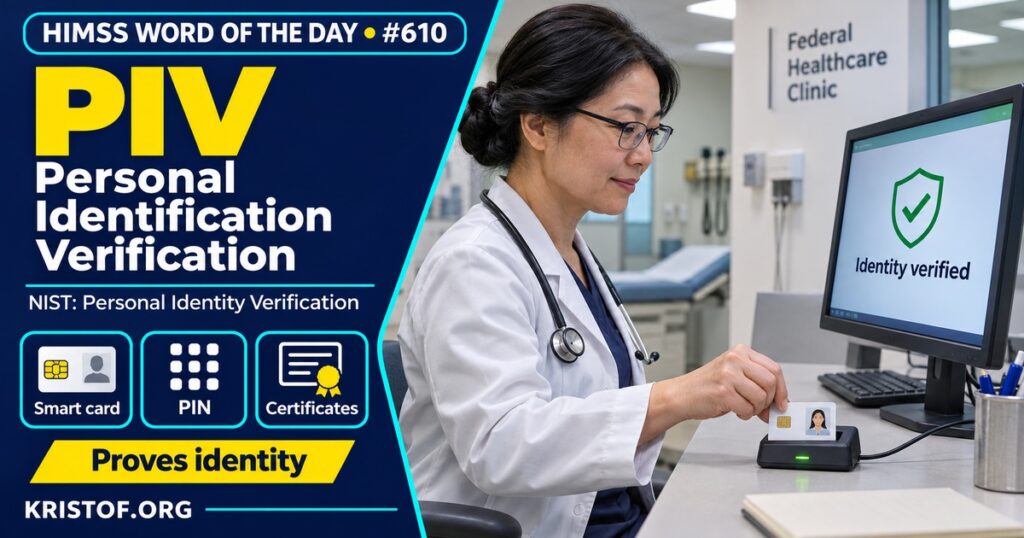
The HIMSS Dictionary lists PIV (Personal Identification Verification) as a physical artifact, such as an identity card or smart card, that holds stored identity credentials, including a photo, cryptographic keys, and a digitized fingerprint. Someone can then check a claimed identity against those credentials, either by looking at the card or through an automated process.
NIST‘s name differs slightly. Its publication and project pages say Personal Identity Verification, not “Identification.” FIPS 201-3, issued by NIST in January 2022 and superseding FIPS 201-2, is titled Personal Identity Verification (PIV) of Federal Employees and Contractors. According to the document, it sets requirements for a PIV system that meets the objectives of Homeland Security Presidential Directive 12 (HSPD-12). It covers identity credentials that federal agencies issue to employees and contractors for access to federally controlled facilities and information systems, and it excludes national security systems. Its abstract names identity proofing, interoperability infrastructure, and accreditation of the organizations that issue PIV credentials.
| Item | Detail |
|---|---|
| Official standard | FIPS 201-3, NIST (January 2022) |
| Who it applies to | Federal employees and contractors, per the standard |
| What the card holds | Photo, fingerprint templates, and certificates, per the portion of FIPS 201-3 read for this post |
| Scope limit | Authenticating identity only; authorization and access control decisions are outside the standard |
| Health IT link | Federal clinical systems that use PIV cards for signing controlled substance orders |
⚠️ Exam Alert: A PIV card proves identity, which is authentication. It does not decide what a person may do, which is authorization. In clinical research, the letters PIV are also used for unrelated measures, such as a pan-immune-inflammation value, so spelling out the term matters.
🌐 Why It Matters: Real-World Healthcare IT Context
PIV is mainly a federal program, but it appears in health IT wherever federal agencies run clinical systems, and it is a useful example of how a standardized credential supports strong authentication.
What the standard covers. FIPS 201-3 says identity authentication is a core part of physical and logical access control. In the portion of the document read for this post (about the first third of its text), the biometric requirements include two fingerprints for off-card comparison and an electronic facial image that is stored on the card and printed on it, with irises and on-card fingerprint comparison as options. The card holds a PIV authentication certificate and a card authentication certificate, and cardholders with government-issued email accounts also have digital signature and key management certificates. The document states that its scope is limited to authenticating an individual’s identity, and that authorization and access control decisions are outside it. Parts of the document not read here may add detail.
Program status. NIST’s PIV project page says PIV credentials are secure, reliable identity credentials issued to federal employees and contractors, used by authentication mechanisms to control access to federal facilities, information systems, and applications. The page names FIPS 201-3 as the current version. It was created on May 24, 2016 and last updated on December 30, 2025, according to the page, so anyone relying on it should check for newer revisions.
VA clinical software. A help page for the Department of Veterans Affairs CPRS, as hosted at code.worldvista.org, says signing outpatient controlled substance orders requires two-factor authentication. The provider enters an electronic signature and also uses a smart card, such as a PIV card, in a reader attached to the workstation, with a PIN and a digital certificate on the card. The page has no date, so it describes one version of that software, and the current VA process is not established by this source.
Indian Health Service documentation. An Indian Health Service RPMS electronic prescribing FAQ, dated August 2019, says two-factor authentication is required for credentialing and for digitally signing controlled substance prescriptions, and that the second factor is either a USB cryptographic token or a PIV card. It says PIV cards are managed through existing HSPD-12 processes and that the credentialing process is the same for cards and tokens. This is a 2019 document for one software package, so it does not show current practice.
Other uses of the same letters. PubMed returns many clinical papers that use PIV for unrelated concepts, such as the 2026 Zhang et al. study of a pan immune inflammatory index (PIV) in severe urinary sepsis. It is cited here only to show that the abbreviation is not unique and says nothing about identity cards.
Common PIV problems:
- Treating a PIV card as an authorization or role system rather than proof of identity
- Assuming a PIV card applies to private-sector staff who are not federal employees or contractors
- Using the dictionary’s spelling without noting NIST’s title says “Identity”
- Assuming an old VA or IHS document describes current practice
- Confusing the identity-card meaning of PIV with clinical uses of the same abbreviation
What supports PIV use in health IT:
- A standard that defines identity proofing and issuer accreditation
- Strong authentication for high-risk actions such as signing controlled substance orders
- Interoperable credentials that work with PKI-based digital signatures
- Clear separation between who a person is and what the person may do
🏥 The Nurse’s Perspective: Clinical, Bedside, & Workflow
Most nurses do not carry a PIV card, but nurses at federal facilities, or those who work with federal prescribers, may meet the workflow.
At the Bedside
At sites that use PIV cards, a prescriber’s card and PIN are part of how controlled substance orders are signed, according to the VA CPRS help page. A nurse may see the effect when a missing card, a reader problem, or an expired certificate delays an order. At federal facilities, nurses may also use the cards for logging on, but the sources reviewed do not state that, and local practice varies.
In Clinical Workflow
Nurse informaticists often help staff with sign-in and signing problems. Understanding that a card proves identity, while role and privilege settings in the clinical application decide what a user can do, helps them sort a card problem from a permissions problem. Sorting these apart also shortens the handoff to the right support team.
In EHR Implementation (Go-Live Perspective)
During an Epic Go-Live, analysts at the elbow hear sign-in and signing questions, such as why an order will not sign or why a badge or card is not read. Distinguishing a credential problem from a build problem is part of triage. This post does not claim that any specific go-live used PIV cards.
🎓 CAHIMS / CPHIMS & HIMSS Perspective
CAHIMS Exam Domain Mapping
PIV supports security and identity management knowledge:
| CAHIMS Domain | How PIV Appears |
|---|---|
| Healthcare & Technology Environments | Federal standards, HSPD-12, and credential types |
| Clinical Informatics | Signing orders and the role of strong authentication |
| Healthcare Information & Systems Management | Card readers, certificates, and identity proofing |
| Management & Leadership | Credential issuance, renewal, and policy ownership |
Key Terms to Know Alongside PIV
- Authentication — verifying that a person is who they claim to be
- Identity proofing — confirming a person’s identity before issuing a credential
- Smartcard — a card with an embedded chip that stores credentials
- PKI — the infrastructure for issuing and managing digital certificates
- Digital signature — a cryptographic way to bind a signature to a document or order
- Biometrics — measurable physical traits, such as fingerprints, used to identify people
HIMSS Organizational Position
HIMSS offers education and research on health information and technology topics through its Resource Center. Members can find related information on the HIMSS Resource Center page.
🧭 More HIMSS Word of The Day Terms
Related terms in the Cybersecurity and Privacy series:
- ePHI (Electronic Protected Health Information)
- Symmetric-Key Cryptography
- Health Information
- Hijacking
Browse all Cybersecurity and Privacy terms or the A–Z glossary.
🔗 Explore Further: External References
- NIST — FIPS 201-3, Personal Identity Verification (PIV) of Federal Employees and Contractors (January 2022) https://nvlpubs.nist.gov/nistpubs/FIPS/NIST.FIPS.201-3.pdf
- NIST CSRC — Personal Identity Verification (PIV) project https://csrc.nist.gov/projects/piv
- Department of Veterans Affairs CPRS help — Digital Signature Overview, as hosted at code.worldvista.org https://code.worldvista.org/files/clients/FOIA_VistA/CPRS/1_0_30_72/Help/Digital_Signature_%28PKI%29_Overview.htm
- Indian Health Service — RPMS Electronic Prescribing of Controlled Substances (BEPC) FAQ, Version 1.0 (August 2019) https://www.ihs.gov/rpms/packagedocs/BEPC/bepc010o_EPCS_FAQ.pdf
- Zhang et al. (2026), Frontiers in medicine — The relationship between pan immune inflammatory index (PIV) and 28 day mortality in patients with severe urinary sepsis: a retrospective study of a multinational dual cohort study https://pubmed.ncbi.nlm.nih.gov/42500521/
- HIMSS — Resource Center https://www.himss.org/resource-center
Term source: HIMSS Dictionary of Health Information and Technology Terms, Acronyms, and Organizations, 6th Edition (2025). All definitions in this series are paraphrased for editorial purposes. Readers are encouraged to consult the primary source for exact language.
Eric Andrew Kristof, RN, CAHIMS is a Healthcare IT professional and HIMSS Arkansas Chapter member based in Hot Springs Village, AR, with hands-on Epic Go-Live experience and a diverse healthcare and IT background. He writes at kristof.org at the intersection of clinical care and healthcare technology.
Leave a Reply