By Eric Andrew Kristof, RN, CAHIMS | Healthcare IT Professional | HIMSS Arkansas Chapter Member
About This Series: The HIMSS Word of The Day is a running blog series drawing from the HIMSS Dictionary of Health Information and Technology Terms, Acronyms, and Organizations, 6th Edition (2025) — the authoritative reference for healthcare IT professionals and the primary study resource for CAHIMS and CPHIMS certification. Each post paraphrases the term in plain language, grounds it in real-world healthcare IT context, and adds a bedside nursing perspective you won’t find in a textbook.
📖 The Term: CCDS (Common Clinical Data Set)
Source: HIMSS Dictionary of Health Information and Technology Terms, Acronyms, and Organizations, 6th Edition (2025)
🔍 Plain-Language Definition
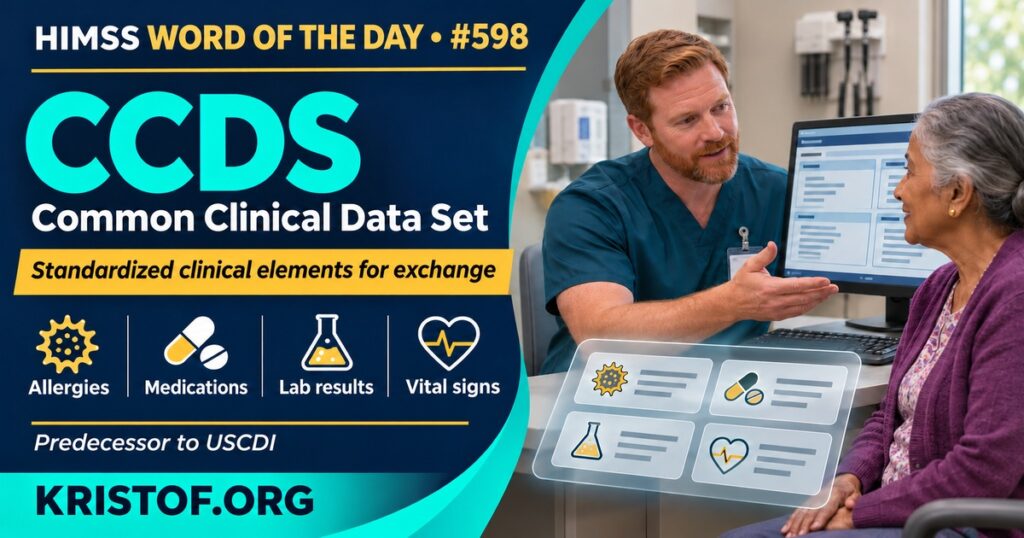
The HIMSS Dictionary describes the Common Clinical Data Set (CCDS) as a defined group of clinical data elements named in ONC’s 2014 and 2015 Edition EHR certification criteria, with an emphasis on how that data is represented when systems exchange it. It says the set pairs a list of elements with the standards used to express them, and that it was later absorbed into USCDI, giving the year as 2017.
That year is worth checking. The Federal Register final rule read for this post, published on May 1, 2020, says ONC proposed removing the CCDS definition and its references from the 2015 Edition and replacing them with USCDI. It also says ONC finalized USCDI as a standard, naming USCDI Version 1 in 45 CFR 170.213, and that the rule took effect on June 30, 2020. This post did not find a source that dates the replacement to 2017, so the 2020 rule is the date supported here, and the dictionary’s year should be verified before it is relied on.
ONC’s 2015 Edition companion guide for the CCDS, version 1.6 dated February 9, 2018, describes the set as clinical data elements that are each expressed according to specified standards. It says the CCDS cannot be certified by itself and is instead a required part of specific 2015 Edition criteria. That PDF was read through a fetch tool, but its web address returned a not-found response to an automated link check, so it is not linked in the references. A search of healthit.gov for its title should locate it.
| Item | Detail |
|---|---|
| What it is | A defined group of clinical data elements, each tied to a standard for representing it |
| Purpose | Consistent representation of clinical data during exchange |
| Where it appeared | 2015 Edition certification criteria; the dictionary also names the 2014 Edition |
| Earlier name | Common Meaningful Use Data Set, per CMS |
| Certified alone? | No; a required part of specified criteria, per the 2015 Edition companion guide |
| Successor | USCDI, with Version 1 named in 45 CFR 170.213 by the 2020 final rule |
⚠️ Exam Alert: The CCDS is a roster of clinical fields together with the standards that govern how each is written. It is not a document format, because C-CDA is the document standard that carries many of those elements, and it is not the same as USCDI, which replaced it and covers additional data classes. The earlier name, Common Meaningful Use Data Set, ties it to Meaningful Use. The same four letters also appear in the medical literature for computerized clinical decision support, which is an unrelated topic.
🌐 Why It Matters: Real-World Healthcare IT Context
Published research on the CCDS itself is thin. A PubMed search for the acronym returned mostly unrelated work, such as clinical decision support and clinical service studies, so this section relies on federal documents rather than studies.
Lineage. The Measures Management System Hub page from CMS on data standards says the CCDS was an updated and renamed version of the Common Meaningful Use Data Set. It says the CCDS was adopted when ONC updated the EHR certification criteria in 2015 and added section 170.315 to 45 CFR, and that the update tied each data element to one or more standard terminologies, such as SNOMED CT and LOINC.
What the 2015 rule clarified. A Federal Register correction published on December 11, 2015 defines the CCDS in general terms as data expressed, where indicated, according to specified standards. It says four items refer to specific C-CDA sections: the unique device identifier for an implantable device, assessment and plan of treatment, goals, and health concerns. It clarifies that referring to those sections does not require developers to use C-CDA syntax, as long as the data are represented as discrete, clearly distinguishable elements. It also says that for assessment and plan of treatment, goals, and health concerns, only the narrative part of the section is needed to meet the CCDS, and testing and certification focus on that narrative content.
What the companion guide lists. ONC’s 2015 Edition CCDS companion guide, again not linked for the reason above, lists these elements: patient name, sex, date of birth, race, ethnicity, preferred language, smoking status, problems, medications, medication allergies, laboratory tests and results, vital signs, procedures, care team members, immunizations, unique device identifiers for implantable devices, assessment and plan of treatment, goals, and health concerns. It notes that the care plan fields from the 2014 Edition are no longer a separate item in 2015, because assessment and plan of treatment, goals, and health concerns cover that content.
The move to USCDI. The 2020 final rule describes USCDI as the replacement for the CCDS and says it adds data classes beyond the CCDS that ONC considered necessary for value-based care. The CMS page reads the same way, calling USCDI the successor to the CCDS and noting that the Cures Act final rule adopted Version 1.
Versions since then. ONC’s USCDI page lists versions 1 through 6, with Version 6 published on July 24, 2025, though the page itself carries no date. ONC’s HTI-1 final rule page says Version 3 becomes the baseline for the ONC Health IT Certification Program starting January 1, 2026, and gives March 11, 2024 as the effective date for that rule’s provisions. That page does not say whether or how Version 1 stays in use, and the January 2026 date has now passed. Anyone who needs the current baseline should check healthit.gov, because later rulemaking could have changed it.
Why an older term still matters. CCDS wording remains in older certification documents, in legacy interface specifications, and in exam material. Knowing what it held helps explain why USCDI looks the way it does.
Common CCDS problems:
- Treating the CCDS and USCDI as the same list, when USCDI is its successor and covers more data classes
- Assuming the CCDS was a certification of its own, when it was a required part of specified criteria
- Confusing the CCDS, which is the data, with C-CDA, which is a document standard that carries it
- Repeating the dictionary’s 2017 date without checking it against the 2020 final rule
- Applying the 2015 Edition element list to systems judged under later criteria
What supports the CCDS and its successors:
- A defined list of elements, each tied to a named standard
- Federal rulemaking documents that show what changed and why
- A versioned successor in USCDI, with later versions listed by ONC
- Requirements for discrete elements, so receiving systems can find data without reading free text
🏥 The Nurse’s Perspective: Clinical, Bedside, & Workflow
Nurses record many CCDS-type facts on every shift, even though the term itself rarely appears at the unit level.
At the Bedside
Vital signs, allergies, immunizations, smoking status, and a patient’s goals are everyday nursing entries. Whether each one goes into a discrete field or into free text decides whether it can travel in a summary to the next facility. A nurse who records an allergy in a note instead of the allergy list has documented it for colleagues on the unit but not for the receiving system.
In Clinical Workflow
Nurse informaticists often review where flowsheet rows, problem lists, and care plan goals map to standard fields. The 2015 correction’s emphasis on discrete, distinguishable elements is a useful reminder that a structured field, not just a note, is what makes an item exchangeable. Care plan content such as goals and health concerns appears in the CCDS list, which gives nursing documentation a direct link to what is exchanged.
In EHR Implementation (Go-Live Perspective)
During an Epic Go-Live, analysts at the elbow hear questions such as where to document smoking status, or why an allergy typed into a note does not show in a summary. The practical answer is usually to use the structured field. This post does not claim that any specific go-live was built around the CCDS by name.
🎓 CAHIMS / CPHIMS & HIMSS Perspective
CAHIMS Exam Domain Mapping
The CCDS supports standards and certification knowledge:
| CAHIMS Domain | How the CCDS Appears |
|---|---|
| Healthcare & Technology Environments | Federal certification rules, standards, and how a data set is defined and replaced |
| Clinical Informatics | Structured clinical data elements and the terminologies attached to them |
| Healthcare Information & Systems Management | Interoperability requirements and what a certified system must exchange |
| Management & Leadership | Tracking regulatory change from the CCDS to successive USCDI versions |
Key Terms to Know Alongside CCDS
- USCDI — the standardized set of health data classes and elements that replaced the CCDS in certification
- C-CDA — the Consolidated Clinical Document Architecture, a document standard that carries many CCDS elements
- Certified EHR Technology — EHR technology that meets the ONC certification criteria
- Meaningful Use — the incentive program that used the earlier Common Meaningful Use Data Set
- SNOMED CT — a clinical terminology the CCDS tied to some elements, per CMS
- LOINC — a laboratory and clinical observation code system the CCDS tied to some elements, per CMS
HIMSS Organizational Position
HIMSS offers education and research on health information and technology topics through its Resource Center. Members can find related information on the HIMSS Resource Center page.
🔗 Explore Further: External References
- Federal Register — 21st Century Cures Act: Interoperability, Information Blocking, and the ONC Health IT Certification Program; Final Rule (May 1, 2020) https://www.govinfo.gov/content/pkg/FR-2020-05-01/html/2020-07419.htm
- Federal Register — 2015 Edition Health IT Certification Criteria, 2015 Edition Base EHR Definition, and ONC Health IT Certification Program Modifications; Correction (December 11, 2015) https://www.govinfo.gov/content/pkg/FR-2015-12-11/html/2015-31255.htm
- CMS — Measures Management System Hub, Data Standards https://mmshub.cms.gov/measure-lifecycle/measure-specification/specify-code/data-standards
- ONC — United States Core Data for Interoperability (USCDI) https://isp.healthit.gov/united-states-core-data-interoperability-uscdi
- ONC — HTI-1 Final Rule https://healthit.gov/regulations/hti-rules/hti-1-final-rule/
- HIMSS — Resource Center https://www.himss.org/resource-center
Term source: HIMSS Dictionary of Health Information and Technology Terms, Acronyms, and Organizations, 6th Edition (2025). All definitions in this series are paraphrased for editorial purposes. Readers are encouraged to consult the primary source for exact language.
Eric Andrew Kristof, RN, CAHIMS is a Healthcare IT professional and HIMSS Arkansas Chapter member based in Hot Springs Village, AR, with hands-on Epic Go-Live experience and a diverse healthcare and IT background. He writes at kristof.org at the intersection of clinical care and healthcare technology.
Leave a Reply