By Eric Andrew Kristof, RN, CAHIMS | Healthcare IT Professional | HIMSS Arkansas Chapter Member
About This Series: The HIMSS Word of The Day is a running blog series drawing from the HIMSS Dictionary of Health Information and Technology Terms, Acronyms, and Organizations, 6th Edition (2025) — the authoritative reference for healthcare IT professionals and the primary study resource for CAHIMS and CPHIMS certification. Each post paraphrases the term in plain language, grounds it in real-world healthcare IT context, and adds a bedside nursing perspective you won’t find in a textbook.
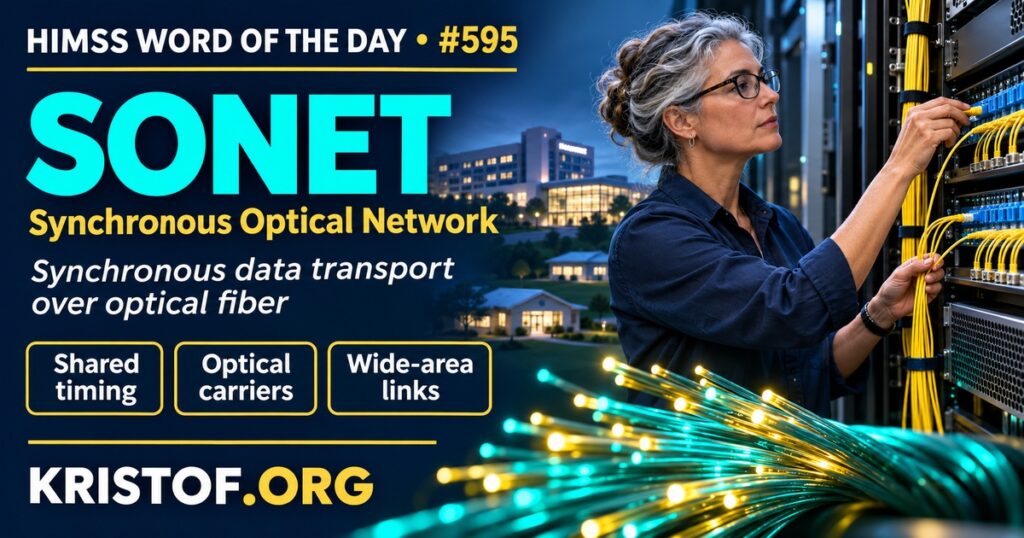
📖 The Term: SONET (Synchronous Optical Network)
Source: HIMSS Dictionary of Health Information and Technology Terms, Acronyms, and Organizations, 6th Edition (2025)
🔍 Plain-Language Definition
The HIMSS Dictionary describes SONET (Synchronous Optical Network) as an American National Standards Institute (ANSI) standard for linking high-speed, high-quality digital fiber optic transmission systems. It notes that the international equivalent is the synchronous digital hierarchy (SDH) and points readers to ATM and frame relay.
IEEE’s Technology Navigator page adds some detail. It describes SONET as a North American standard for synchronous data transmission over optical fiber that defines signal rates, frame formats, and network management for carrying digital traffic. It says ANSI standardized it in the late 1980s so that optical equipment from different vendors could interconnect, and that its rate hierarchy starts at STS-1, about 51.84 megabits per second, with higher rates built by multiplexing. The optical versions are called OC-N, for optical carrier level N. These details were read through a summarizing fetch tool, so exact wording is worth confirming at the source.
| Item | Detail |
|---|---|
| What it is | A North American standard for synchronous transmission over optical fiber |
| Standardized by | ANSI, per the dictionary and IEEE |
| International counterpart | SDH, standardized by ITU-T |
| Base rate | STS-1 (electrical) and OC-1 (optical), about 51.84 Mbps |
| Naming | STS-N for electrical signals and OC-N for optical carriers |
| SDH link | SDH’s STM-1 (155.52 Mbps) matches SONET’s STS-3c, per IEEE |
| Relation to HIMSS | None verified for this post, so none is claimed |
⚠️ Exam Alert: SONET is a physical-layer transport standard, so it is not an application protocol, a messaging standard such as HL7, or a wireless technology. SDH is the international counterpart and the two are not identical, since IEEE says they differ in base-rate definitions and overhead byte assignments. CAHIMS and CPHIMS come from HIMSS, not from ANSI or ITU-T.
🌐 Why It Matters: Real-World Healthcare IT Context
A PubMed search for the term returned mostly unrelated papers, including studies that use “SONET” as an acronym for a score or a trial, so there is no healthcare research to cite here. This section relies on a standards page and an IEEE page, and it does not claim how any hospital uses SONET.
What it carries. IEEE’s page lists typical applications such as long-haul and metropolitan fiber backbones, aggregation of carrier voice trunk traffic, transport for older ATM networks, and enterprise wide-area connectivity over leased optical circuits. A hospital system with several sites is the kind of organization that buys wide-area links, but the sources do not say which technology any particular organization uses.
SONET and SDH. The IEEE page says SDH is the international counterpart, with its transport specifications in the ITU-T G.707 and G.803 series. It says the two use the same synchronous multiplexing approach and were designed to work together, and that SDH’s higher levels line up with SONET’s OC-12, OC-48, and OC-192. ITU’s page for G.707, titled “Network node interface for the synchronous digital hierarchy (SDH),” lists the current edition as G.707/Y.1322 (01/07), in force, and does not mention SONET.
Why “synchronous” matters. In general network terms, a synchronous design keeps the parts of a network on a shared timing reference, which is why the standard defines frame formats and timing and not just signal rates. That is background explanation and is not taken from the pages read here.
Benefits and limits. A TechTarget glossary page says ANSI T1.105 and T1.117 specify SONET and lists benefits such as high data rates, long transmission distances, support for data, voice, and video, support for IP, and multi-vendor interoperability. It names cost as a limitation. The same page gives figures that disagree with each other, such as a standard maximum of 10 Gbps in one place and 40 Gbps for OC-768 in another, so this post does not repeat its rate numbers. A reader who needs exact rates should use the standard itself or the IEEE and ITU pages.
Who sets the standards. ANSI describes itself on its own page as a privately run, not-for-profit body that oversees the U.S. voluntary standards and conformity assessment system, and says it provides the framework for standards development rather than writing standards itself. The dictionary’s credit to ANSI is therefore best read as the standard being approved within ANSI’s framework.
Where it sits today. IEEE’s page lists migration toward Optical Transport Network technology among its topics, which suggests SONET now sits alongside newer transport options. How much any given carrier or hospital still depends on it is outside what these sources say, so a reader who needs that answer should ask the organization’s network team or carrier.
Common SONET problems:
- Treating SONET as an application-level or wireless technology
- Confusing the electrical name (STS-N) with the optical name (OC-N), which share the same rates
- Assuming SONET and SDH are identical, when IEEE notes differences in base rates and overhead
- Mixing up SONET with ATM or frame relay, which are separate technologies the dictionary cross-references
- Assuming the dictionary’s description reflects what any particular network uses today
What supports SONET as a concept to know:
- A defined rate hierarchy, with STS-1 at about 51.84 Mbps and higher levels built from it
- An international counterpart, SDH, designed to interwork with it
- Standards published by recognized bodies, ANSI for SONET and ITU-T for SDH
- Frame formats and management functions defined as part of the standard, per IEEE
🏥 The Nurse’s Perspective: Clinical, Bedside, & Workflow
Nurses rarely hear the word SONET, but a hospital’s links between sites are what keep shared records, imaging, and messaging reachable.
At the Bedside
When a system slows or a remote site cannot reach a central application, the cause may sit in the network between sites rather than in the application itself. Reporting exactly what was slow, where, and when helps the network team separate an application problem from a link problem.
In Clinical Workflow
Nurse informaticists who work on downtime procedures often meet network vocabulary such as links, circuits, and failover. A basic idea of what a wide-area transport standard does helps them ask good questions when planning for a site that depends on a single connection to the main data center.
In EHR Implementation (Go-Live Perspective)
During an Epic Go-Live, analysts at the elbow sometimes support clinics and smaller sites that connect to a central system over leased or carrier links. When one clinic is slow and others are fine, a plain description of the symptom, with the time and the workstation, helps the infrastructure team check the link before anyone assumes the build is wrong. This post does not claim that any specific go-live used SONET.
🎓 CAHIMS / CPHIMS & HIMSS Perspective
CAHIMS Exam Domain Mapping
SONET supports infrastructure knowledge:
| CAHIMS Domain | How SONET Appears |
|---|---|
| Healthcare & Technology Environments | Network standards and the bodies that publish them |
| Clinical Informatics | Reliable connections that keep clinical systems reachable |
| Healthcare Information & Systems Management | Wide-area links, carriers, and capacity planning |
| Management & Leadership | Weighing connectivity options and downtime risk |
Key Terms to Know Alongside SONET
- WAN (Wide Area Network) — a network that connects sites over long distances
- ANSI (American National Standards Institute) — the organization the dictionary credits with the SONET standard
- ATM (Asynchronous Transfer Mode) — a separate network technology the dictionary cross-references
- Frame relay — another wide-area technology named in the dictionary entry
- Bandwidth — the amount of data a connection can carry in a given time
- Downtime — a period when a system or connection is unavailable
HIMSS Organizational Position
HIMSS offers education and research on health information and technology topics through its Resource Center. Members can find related information on the HIMSS Resource Center page.
🔗 Explore Further: External References
- IEEE Technology Navigator — SONET https://technav.ieee.org/topic/sonet/
- ITU-T — Recommendation G.707, Network node interface for the synchronous digital hierarchy (SDH) https://www.itu.int/rec/T-REC-G.707
- TechTarget — Synchronous Optical Network (SONET) https://www.techtarget.com/news/What-is-Synchronous-Optical-Network-SONET/857626/
- ANSI — About ANSI https://www.ansi.org/about/introduction
- HIMSS — Resource Center https://www.himss.org/resource-center
Term source: HIMSS Dictionary of Health Information and Technology Terms, Acronyms, and Organizations, 6th Edition (2025). All definitions in this series are paraphrased for editorial purposes. Readers are encouraged to consult the primary source for exact language.
Eric Andrew Kristof, RN, CAHIMS is a Healthcare IT professional and HIMSS Arkansas Chapter member based in Hot Springs Village, AR, with hands-on Epic Go-Live experience and a diverse healthcare and IT background. He writes at kristof.org at the intersection of clinical care and healthcare technology.
Leave a Reply