By Eric Andrew Kristof, RN, CAHIMS | Healthcare IT Professional | HIMSS Arkansas Chapter Member
About This Series: The HIMSS Word of The Day is a running blog series drawing from the HIMSS Dictionary of Health Information and Technology Terms, Acronyms, and Organizations, 6th Edition (2025) — the authoritative reference for healthcare IT professionals and the primary study resource for CAHIMS and CPHIMS certification. Each post paraphrases the term in plain language, grounds it in real-world healthcare IT context, and adds a bedside nursing perspective you won’t find in a textbook.
📖 The Term: Data Origin Authentication
Source: HIMSS Dictionary of Health Information and Technology Terms, Acronyms, and Organizations, 6th Edition (2025)
🔍 Plain-Language Definition
The HIMSS Dictionary describes data origin authentication as confirmation that data arriving from a source really did come from the party it names. In plain terms, it answers one question about a message or a record: is the claimed sender the true sender?
NIST‘s glossary entry uses nearly the same idea, confirming that the source of received data is who or what it claims to be, and it takes that definition from the Committee on National Security Systems glossary, which in turn draws on RFC 4949, the Internet Security Glossary. RFC 4949 is an informational document dated August 2007, and its own text says its recommendations reflect the author’s views rather than an official IETF position. The NIST page does not say how the term differs from related ones, so the contrasts below come from other sources named in the references.
| Item | Detail |
|---|---|
| What it is | A security service confirming the claimed source of received data |
| Question it answers | Did this data really come from the source it names? |
| Related but different | Data integrity (was it changed), entity authentication (who is the party in the exchange), nonrepudiation (can the source deny it later) |
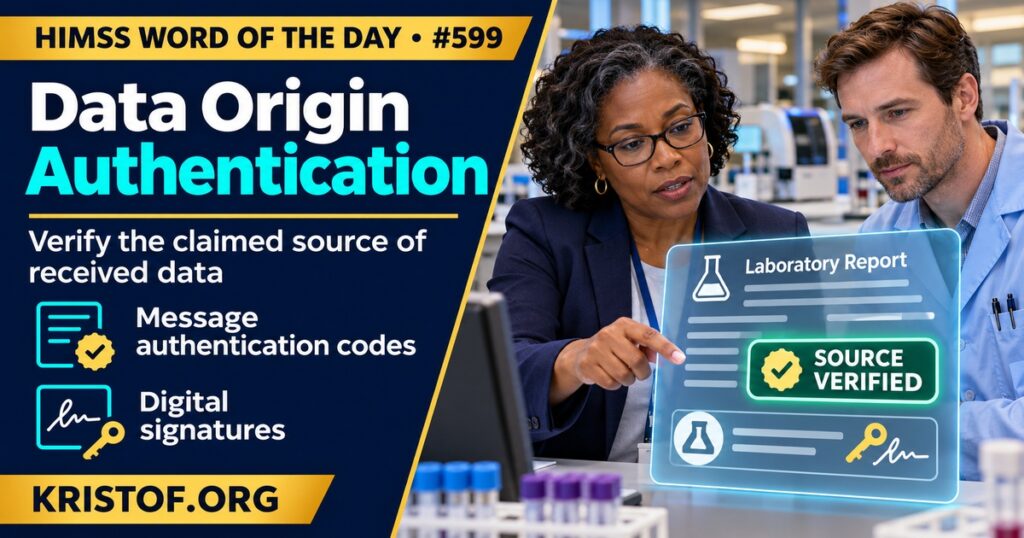
| Common mechanisms | Message authentication codes and digital signatures |
| Where it applies | Messages, files, and records that move between systems or organizations |
⚠️ Exam Alert: Do not confuse data origin authentication with authentication of a person logging in. A user logging in proves identity to a system, while data origin authentication is about a particular piece of received data. It is also separate from data integrity, which asks whether content changed, and from nonrepudiation, which asks whether a source can later deny sending. Questions often offer all four as choices.
🌐 Why It Matters: Real-World Healthcare IT Context
Published research specific to this term in health care is thin; a PubMed search returned only loosely related security papers, so this section relies on standards documents, an engineering reference, and the HIPAA regulation text rather than studies.
Two forms of authentication service. RFC 4949’s entry for authentication service says data origin authentication is one of two general forms, with the other being peer entity authentication. The RFC also notes that the IP Authentication Header offers connectionless data origin authentication for IP datagrams, with replay protection left optional and chosen by the receiver. That detail matters because proving that a message came from a source does not by itself prove it is fresh. A genuine message can be captured and sent again.
How the pieces differ. The IEEE Technology Navigator page on message authentication treats two goals as separate. Data integrity confirms the content was not changed in transit, and data origin authentication confirms the claimed sender is the real one. Both differ from confidentiality, which concerns secrecy, and from nonrepudiation, which concerns provable origin that a sender cannot later deny. Encryption keeps content secret without showing who created it, and an authenticated message that is not encrypted can still be read by anyone along the way.
Two main tools. The same IEEE page describes two families. Message authentication codes use a secret key shared by the sender and receiver. The sender attaches a short tag, and the receiver recomputes it with the same key to check for a match. Because both sides hold the key, a valid tag shows the message came from someone with that key, and the page notes it does not give the signer-only proof that signatures give. Digital signatures use a key pair, with the sender signing using a private key and anyone with the matching public key able to verify. No secret has to be shared in advance, and because only the signer holds the private key, signatures also support nonrepudiation.
Where it touches HIPAA. The text of the HIPAA Security Rule at 45 CFR 164.312, read at the Electronic Code of Federal Regulations, does not use the term data origin authentication. It contains related standards. The integrity standard calls for policies and procedures that protect electronic protected health information from improper alteration or destruction, and its implementation specification, labeled addressable, calls for electronic mechanisms that can confirm the information has not been altered or destroyed in an unauthorized way. The person or entity authentication standard calls for procedures that verify that a person or entity seeking access is who or what it claims to be. The transmission security standard has addressable specifications for integrity controls and encryption. The eCFR page lists the section’s original adoption in 2003 and one later amendment in 2013. This post does not map any particular mechanism to a specific compliance obligation, and readers who need that should consult the regulation, HHS guidance, and their compliance office, because rulemaking can change.
Why it matters in health care. Clinical systems receive data from laboratories, devices, pharmacies, payers, and other organizations. A downstream system that trusts the claimed source of a message can act on forged or misrouted data, so confirming the origin is a design question for every interface, not only for the security team.
Common data origin authentication problems:
- Assuming encryption alone proves who sent a message
- Treating a login or session check as proof of where each record came from
- Using shared-key tags where a party may later need to prove it did not create a message
- Forgetting replay, since a valid captured message can be sent again
- Mixing up data origin authentication with data integrity on an exam question
What supports data origin authentication:
- Message authentication codes where both parties share a secret key
- Digital signatures where origin needs to be provable to third parties
- Certificates and key management that tie a key to a named party
- Interface designs that check the source on every message, not just at connection time
- Logging that records which source a message was attributed to
🏥 The Nurse’s Perspective: Clinical, Bedside, & Workflow
Nurses depend on data origin authentication without seeing it, because every result, order, and alert that appears in a chart is assumed to come from the system or person it names.
At the Bedside
A critical lab value or an outside-facility document in the chart is trusted partly because the system shows where it came from. Nurses who notice a result attributed to an unexpected source, or an order that looks out of pattern, are acting as a human check on origin. Reporting that observation to the charge nurse and the help desk is appropriate even when the cause turns out to be a mapping error.
In Clinical Workflow
Nurse informaticists often help define which sources are allowed to send which kinds of messages into a unit’s workflow. Source labels on results, device feeds, and outside records are only meaningful if the receiving system verifies them. Asking how an interface confirms the source of a message is a reasonable informatics question.
In EHR Implementation (Go-Live Perspective)
During an Epic Go-Live, analysts at the elbow hear reports such as a result showing under the wrong source or an outside document that nurses cannot place. Capturing the exact source label, the time, and the screen, with patient identifiers handled as local policy requires, gives the interface and security teams what they need. This post does not claim that any specific go-live involved a data origin failure.
🎓 CAHIMS / CPHIMS & HIMSS Perspective
CAHIMS Exam Domain Mapping
Data origin authentication supports security and interoperability knowledge:
| CAHIMS Domain | How Data Origin Authentication Appears |
|---|---|
| Healthcare & Technology Environments | Security services and how data is trusted between organizations |
| Clinical Informatics | Confidence in the source of results, orders, and outside documents |
| Healthcare Information & Systems Management | Interface design, message verification, and key management |
| Management & Leadership | Compliance with the HIPAA Security Rule and security governance |
Key Terms to Know Alongside Data Origin Authentication
- Authentication — verifying that a person or system is who or what it claims to be
- Data integrity — assurance that data has not been changed improperly
- Digital signature — a value created with a private key that lets others verify the signer and the content
- Nonrepudiation — assurance that a party cannot credibly deny having sent or approved something
- Hash function — a function that turns data into a short fixed-size value used in integrity and signature schemes
- HIPAA Security Rule — the federal standards for safeguarding electronic protected health information
HIMSS Organizational Position
HIMSS offers education and research on health information and technology topics through its Resource Center. Members can find related information on the HIMSS Resource Center page.
🔗 Explore Further: External References
- NIST — Computer Security Resource Center Glossary, Data Origin Authentication https://csrc.nist.gov/glossary/term/data_origin_authentication
- IETF — RFC 4949, Internet Security Glossary, Version 2 (August 2007) https://www.rfc-editor.org/info/rfc4949/
- IEEE Technology Navigator — Message Authentication https://technav.ieee.org/topic/message-authentication/
- eCFR — 45 CFR 164.312, Technical Safeguards https://www.ecfr.gov/current/title-45/subtitle-A/subchapter-C/part-164/subpart-C/section-164.312
- HIMSS — Resource Center https://www.himss.org/resource-center
Term source: HIMSS Dictionary of Health Information and Technology Terms, Acronyms, and Organizations, 6th Edition (2025). All definitions in this series are paraphrased for editorial purposes. Readers are encouraged to consult the primary source for exact language.
Eric Andrew Kristof, RN, CAHIMS is a Healthcare IT professional and HIMSS Arkansas Chapter member based in Hot Springs Village, AR, with hands-on Epic Go-Live experience and a diverse healthcare and IT background. He writes at kristof.org at the intersection of clinical care and healthcare technology.
Leave a Reply