By Eric Andrew Kristof, RN, CAHIMS | Healthcare IT Professional | HIMSS Arkansas Chapter Member
About This Series: The HIMSS Word of the Day is a running blog series drawing from the HIMSS Dictionary of Health Information and Technology Terms, Acronyms, and Organizations, 6th Edition (2025) — the authoritative reference for healthcare IT professionals and the primary study resource for CAHIMS and CPHIMS certification. Each post paraphrases the term in plain language, grounds it in real-world healthcare IT context, and adds a bedside nursing perspective you won’t find in a textbook.
📖 The Term: Scalability
Source: HIMSS Dictionary of Health Information and Technology Terms, Acronyms, and Organizations, 6th Edition (2025)
🔍 Plain-Language Definition
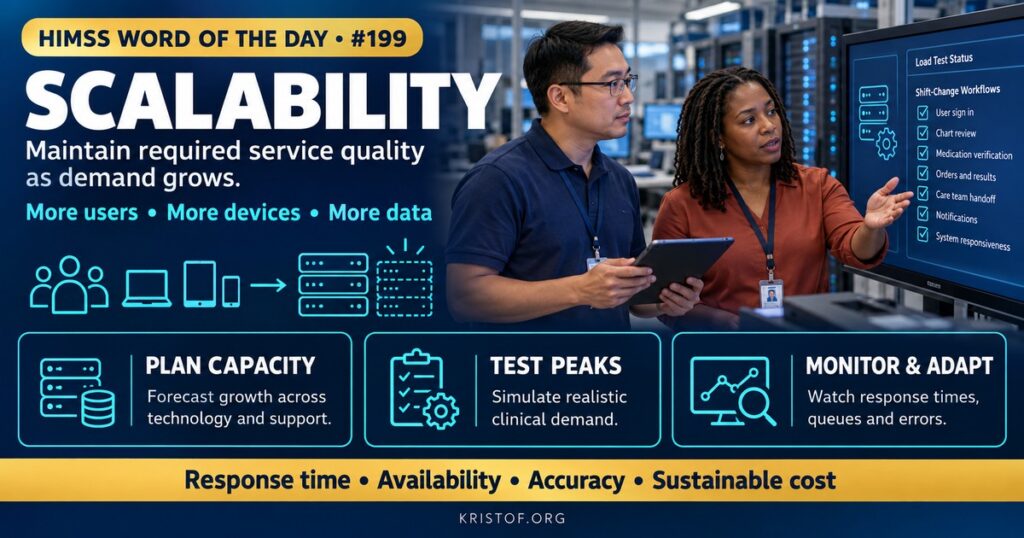
Scalability is the ability of a system to keep delivering the required quality of service as the load on it increases. Load can mean more users, more patients, more transactions, more devices, or more data.
The HIMSS Dictionary frames scalability in terms of service quality, which is the useful test. A system is not scalable simply because it can be made bigger. It is scalable when response time, availability, and accuracy stay acceptable as demand grows, at a cost the organization can sustain.
| Scaling Approach | How It Works | Healthcare Example |
|---|---|---|
| Vertical Scaling (Scale Up) | Add more power to one server | More memory for a database server |
| Horizontal Scaling (Scale Out) | Add more servers sharing the work | Additional application servers for a larger user base |
| Cloud Elasticity | Resources grow and shrink on demand | Extra capacity during a telehealth surge |
| Load Balancing | Spread requests across servers | Distribute logins across servers at shift change |
| Caching and Queuing | Smooth bursts of work | Interface queue holds messages during a spike |
| Process Scaling | Training, support, and governance grow with the system | More at-the-elbow support for a larger go-live |
⚠️ Exam Alert: Scalability is about handling growth in load. Availability is about being up when needed. Performance is about speed at a given load. Elasticity is the ability to add and release resources quickly, a characteristic NIST lists for cloud computing. A system can be fast today and still not be scalable.
🌐 Why It Matters: Real-World Healthcare IT Context
Clinical systems face uneven demand. Hundreds of nurses and physicians may log in within minutes at shift change. Morning rounds push chart reviews and order entry to a peak. Seasonal illness, a mass casualty event, or a sudden shift to virtual care can multiply volume in days. Mergers add thousands of users and many new locations, and a go-live can push a system to loads it has never seen.
Scaling takes planning in several layers. Application and database servers must handle concurrent users. Interfaces must process bursts of messages from labs, monitors, and registration without growing queues that delay results. Networks and wireless coverage must support dense device use in patient rooms and nursing stations. Storage must grow with imaging, documents, and device data. Printers, scanners, and authentication services can also become bottlenecks that users experience as the system being slow.
Capacity planning and testing reduce surprises. Teams estimate growth, measure current use, and set thresholds for adding resources. Load testing simulates realistic peaks, such as a full shift change of logins combined with medication administration and results, to find weak points before real patients are affected. Monitoring after launch tracks response times and queue depth so problems are caught early.
Cloud services change the economics. NIST describes rapid elasticity as one of the essential characteristics of cloud computing, which allows resources to expand and contract with demand. Organizations that use hosted services can add capacity faster than those buying hardware, although they still need to plan for cost, security obligations, and business associate agreements. Elasticity does not remove the need to design applications that can use additional resources.
Data exchange needs to scale as well. The HL7 FHIR Bulk Data specification exists because exchanging data for large groups of patients differs from retrieving a single record. In 2026, researchers evaluated an open-source, FHIR-based data segmentation platform that helps protect sensitive substance use information, benchmarking its throughput and scalability using 11,519 synthetic patient records. Studies like this show how scalability can be measured rather than assumed, which matters as privacy tools, analytics, and artificial intelligence services are added to clinical workflows.
Availability and scalability are linked. A system that slows to a crawl under load behaves like a system that is down, and clinicians may revert to paper or workarounds. Planning for peak conditions is therefore part of patient safety and downtime preparedness.
Scalability also applies to people and processes. Support desks, training programs, and governance structures that work for one hospital may fail for a system of twenty. Standardized build, shared knowledge, and clear escalation paths help operations grow with the technology.
Common scalability problems:
- Performance that degrades at predictable peaks such as shift change
- Interface queues that grow during bursts
- Wireless coverage that cannot support device density
- Testing only at average load
- Growth in data volume that outpaces storage planning
- Support and training that do not grow with the user base
What supports scalable systems:
- Capacity planning tied to growth forecasts
- Load testing with realistic clinical peaks
- Monitoring of response times, queues, and errors
- Elastic cloud resources where appropriate
- Load balancing and redundancy
- Process and support models that scale with the system
🏥 The Nurse’s Perspective: Clinical, Bedside, & Workflow
Nurses experience scalability as speed. A system that loads quickly during a quiet night and slowly at the start of the shift is showing a capacity problem.
At the Bedside
Slowness has patient care consequences. Waiting for a chart to load while a call light is on, or for a medication scan to complete, pulls attention away from the patient and encourages shortcuts. Noting when slowness occurs helps teams find the cause.
Specific details speed up diagnosis. Reporting the time, unit, device, and what was being done, such as logging in, opening the MAR, or scanning, helps IT tell whether the issue lies in the application, the network, a device, or an interface.
In Clinical Workflow
Peak-time patterns matter. If delays appear at shift change or during rounds, capacity planning and staggered workflows, such as spreading logins or schedule-based tasks, can help.
When a unit grows, adds beds, or starts using more devices, informing IT early allows wireless and workstation capacity to be checked beforehand.
Nurse informaticists contribute by describing realistic usage patterns for test scenarios, such as how many nurses scan medications within the same ten minutes, and by reviewing performance complaints for clinical impact.
In EHR Implementation (Go-Live Perspective)
An Epic Go-Live concentrates demand. Many new users log in at once, learning workflows that make heavier use of the system than usual. Command centers monitor performance, and technical teams watch servers, interfaces, and network conditions.
At-the-elbow support analysts hear about slowness first. Passing along patterns, such as a particular unit or time of day, helps technical teams adjust resources and separate system performance from training needs.
🎓 CAHIMS / CPHIMS & HIMSS Perspective
CAHIMS Exam Domain Mapping
Scalability appears in infrastructure, architecture, and planning questions:
| CAHIMS Domain | How Scalability Appears |
|---|---|
| Healthcare & Technology Environments | Cloud models, telehealth growth, emerging technologies |
| Clinical Informatics | Impact of performance on workflow and safety |
| Healthcare Information & Systems Management | Capacity planning, load testing, architecture, monitoring |
| Management & Leadership | Budgeting for growth, service level agreements, vendor selection |
Key Terms to Know Alongside Scalability
- Load Testing — simulating expected or peak use to evaluate system behavior
- Capacity Planning — forecasting resource needs for future demand
- Elasticity — ability to add and release resources quickly as demand changes
- Load Balancing — distributing requests across multiple servers
- Service Level Agreement (SLA) — measurable commitments for performance and availability
- Availability — degree to which a system is operational when needed
HIMSS Organizational Position
HIMSS supports healthcare infrastructure maturity and resilient technology operations through its maturity models, education, and research. Members can find related resources through the HIMSS Resource Center and the maturity model pages.
🔗 Explore Further: External References
- NIST — SP 800-145, The NIST Definition of Cloud Computing https://csrc.nist.gov/pubs/sp/800/145/final
- HL7 International — FHIR Bulk Data Access Implementation Guide https://hl7.org/fhir/uv/bulkdata/
- Lee et al. (2026), Applied Clinical Informatics — Assessing the Effectiveness and Scalability of Fast Healthcare Interoperability Resource-Based Granular Data Segmentation Technology https://pubmed.ncbi.nlm.nih.gov/42285541/
- HHS — Guidance on HIPAA and Cloud Computing https://www.hhs.gov/hipaa/for-professionals/special-topics/health-information-technology/cloud-computing/index.html
- ONC — SAFER Guides (including Contingency Planning) https://healthit.gov/clinical-quality-and-safety/safer-guides/
- HIMSS — Maturity Models https://www.himss.org/maturity-models
Term source: HIMSS Dictionary of Health Information and Technology Terms, Acronyms, and Organizations, 6th Edition (2025). All definitions in this series are paraphrased for editorial purposes. Readers are encouraged to consult the primary source for exact language.
Eric Andrew Kristof, RN, CAHIMS is a Healthcare IT professional and HIMSS Arkansas Chapter member based in Hot Springs Village, AR, with hands-on Epic Go-Live experience and a diverse healthcare and IT background. He writes at kristof.org at the intersection of clinical care and healthcare technology.
Leave a Reply