By Eric Andrew Kristof, RN, CAHIMS | Healthcare IT Professional | HIMSS Arkansas Chapter Member
About This Series: The HIMSS Word of the Day is a running blog series drawing from the HIMSS Dictionary of Health Information and Technology Terms, Acronyms, and Organizations, 6th Edition (2025) — the authoritative reference for healthcare IT professionals and the primary study resource for CAHIMS and CPHIMS certification. Each post paraphrases the term in plain language, grounds it in real-world healthcare IT context, and adds a bedside nursing perspective you won’t find in a textbook.
📖 The Term: Data Mining
Source: HIMSS Dictionary of Health Information and Technology Terms, Acronyms, and Organizations, 6th Edition (2025)
🔍 Plain-Language Definition
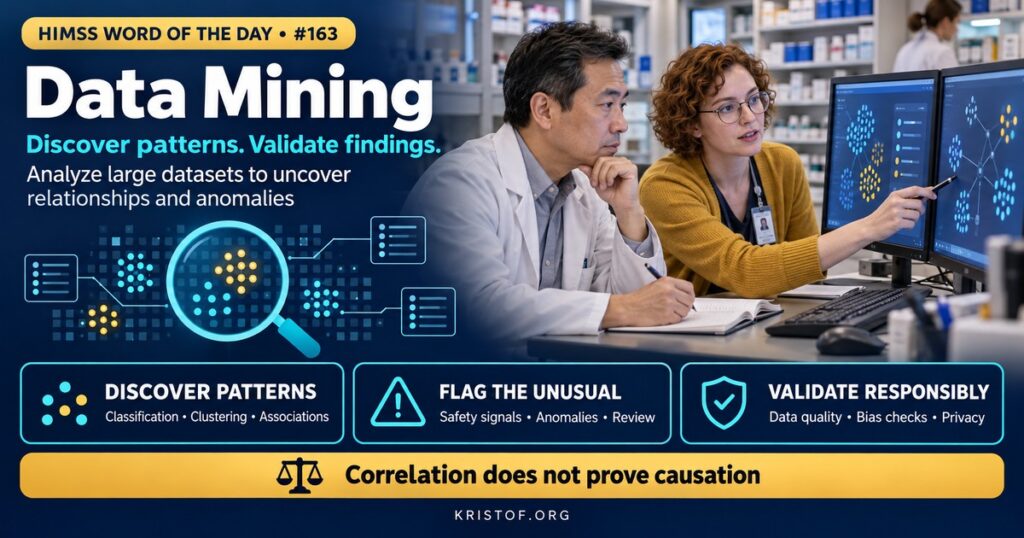
Data mining is the process of analyzing large data sets to discover patterns, relationships, trends, and anomalies that are not obvious, using statistical, mathematical, and machine learning techniques.
The HIMSS Dictionary offers two descriptions. It describes data mining as searching big collections of data for unusual values, patterns, and relationships that help forecast results and address problems. It also describes data mining as examining hidden patterns from different perspectives to turn data into useful, actionable information, often after data has been assembled in places such as data warehouses, so organizations can make better decisions, such as reducing costs, increasing revenue, or serving customers better.
| Technique | What It Does | Healthcare Example |
|---|---|---|
| Classification | Assigns records to predefined categories | Predicting which patients are at high risk of readmission |
| Clustering | Groups similar records without predefined categories | Identifying subgroups of patients with similar chronic disease patterns |
| Association Rules | Finds items that occur together | Detecting medication combinations associated with adverse events |
| Anomaly Detection | Flags unusual records | Identifying suspicious billing patterns |
| Regression | Estimates relationships between variables | Estimating length of stay from patient characteristics |
| Text Mining | Extracts patterns from unstructured text | Finding symptoms mentioned in clinical notes |
⚠️ Exam Alert: Data mining discovers patterns in existing data. Predictive modeling uses patterns to forecast outcomes. Machine learning provides many of the algorithms used in data mining. Correlation found through data mining does not prove causation. Knowledge discovery in databases (KDD) is the broader process that includes data mining.
🌐 Why It Matters: Real-World Healthcare IT Context
Healthcare data, from EHRs, claims, registries, devices, and genomics, holds patterns that can improve safety, efficiency, and care. Data mining helps organizations find those patterns in volumes too large for manual review, often drawing on data warehouses and big data platforms.
Drug safety is a long-standing application. Regulators and researchers mine adverse event reports and electronic health data to detect safety signals, such as unexpected associations between drugs and harms. A 2026 scoping review of data mining for adverse drug reaction analysis found that signal detection still relies mainly on classical statistical methods, with slower adoption of advanced machine learning and limited public data sets.
Program integrity is another major use. Payers and government agencies analyze claims data to detect patterns that suggest fraud, waste, or abuse, such as unusual billing volumes, impossible combinations of services, or outlier providers. Detected patterns guide investigations rather than proving wrongdoing.
Operations and quality benefit too. Mining scheduling, flow, and staffing data can reveal causes of delays, no-show patterns, and resource bottlenecks. Quality teams can identify patient subgroups with higher complication rates or variations in practice.
Research uses data mining to generate hypotheses, identify patient phenotypes, and discover potential predictors of disease. Findings typically require confirmation through rigorous studies before changing practice.
Data mining overlaps heavily with machine learning and AI. Modern techniques can find complex, nonlinear patterns, but they also increase the need for careful validation, interpretation, and monitoring.
Regulators continue to modernize safety surveillance. In 2026, the FDA began consolidating its separate adverse event reporting databases into a single Adverse Event Monitoring System, intended to bring reports for drugs, vaccines, devices, and other products into one platform. Consolidated data can make mining for safety signals more efficient, although questions remain about verifying the quality of reports.
Pitfalls are significant. Large data sets make it easy to find spurious correlations, especially when many variables are tested. Data quality problems, missing data, and documentation patterns can create misleading results. Bias in historical data can lead to patterns that reflect inequities rather than true clinical differences.
Privacy and ethics matter. Mining identifiable health data requires appropriate permissions, governance, and security. De-identification reduces but does not eliminate risk, and combining data sources can increase re-identification potential. Patients increasingly expect transparency about how their data is used.
Common data mining pitfalls:
- Mistaking correlation for causation
- Spurious findings from testing many variables
- Poor data quality and missing values
- Historical bias embedded in data
- Results that cannot be reproduced or validated
- Privacy risks from linking data sources
Practices for responsible data mining:
- Clear questions and analysis plans
- Data quality assessment before analysis
- Validation on separate data sets
- Clinical and statistical review of findings
- Attention to bias and fairness
- Governance, privacy safeguards, and transparency
🏥 The Nurse’s Perspective: Clinical, Bedside, & Workflow
Nursing documentation is a rich source for data mining, and nurses help interpret what patterns mean.
At the Bedside
Patterns discovered through data mining, such as factors associated with falls, pressure injuries, or deterioration, can inform risk assessment tools and nursing protocols. Nurses applying these tools benefit from understanding that they reflect statistical patterns, not certainties about individual patients.
Accurate documentation of assessments, interventions, and outcomes makes data mining results more reliable. Inconsistent charting can create misleading patterns.
In Clinical Workflow
Medication safety teams, often including nurses and pharmacists, review signals from mined data, such as unusual override patterns in dispensing cabinets that may suggest diversion. Data identifies cases for review; human investigation determines what actually happened.
Nurse researchers use data mining techniques to study nursing-sensitive outcomes, staffing effects, and patient experience. Collaboration with data scientists combines clinical insight with technical expertise.
Clinical context helps interpret results. A pattern showing that patients on a certain unit have more alarms may reflect patient acuity rather than poor care, and nurses can explain these nuances.
Documentation habits matter for future analysis. Choosing the most specific option in a structured field, rather than a generic or free-text entry, makes nursing data far more useful for discovering patterns.
In EHR Implementation (Go-Live Perspective)
After an Epic Go-Live, data from the new system flows into warehouses used for analysis. Changes in documentation structure can make before-and-after comparisons tricky, so analysts work with nursing informatics to map old and new data elements.
At-the-elbow support analysts can reinforce documentation in structured fields, which improves the quality of data available for future analysis.
🎓 CAHIMS / CPHIMS & HIMSS Perspective
CAHIMS Exam Domain Mapping
Data mining appears in analytics, safety, and privacy questions:
| CAHIMS Domain | How Data Mining Appears |
|---|---|
| Healthcare & Technology Environments | Pharmacovigilance; program integrity; research trends |
| Clinical Informatics | Risk tools derived from data, documentation quality, interpretation |
| Healthcare Information & Systems Management | Data warehouses, algorithms, data preparation, validation |
| Management & Leadership | Analytics strategy, governance, privacy, ethical use |
Key Terms to Know Alongside Data Mining
- Knowledge Discovery in Databases (KDD) — the overall process of extracting knowledge from data, including data mining
- Classification — assigning records to known categories
- Clustering — grouping similar records without predefined labels
- Association Rules — patterns describing items that occur together
- Signal Detection — identifying possible safety concerns in adverse event data
- Predictive Modeling — using data patterns to forecast outcomes
HIMSS Organizational Position
HIMSS supports responsible use of data and analytics through education on data governance, AI, and privacy, encouraging organizations to pair analytic power with strong safeguards. Members can find related education and research through the HIMSS Resource Center.
🔗 Explore Further: External References
- Jacoby et al. (2026), International Journal of Medical Informatics — Data Mining Methods, Tasks, and Algorithms for Adverse Drug Reaction Analysis in Pharmacovigilance: A Scoping Review https://pubmed.ncbi.nlm.nih.gov/42378892/
- FDA — Adverse Event Monitoring System (AEMS) https://www.fda.gov/drugs/surveillance-post-drug-approval-activities/fda-adverse-event-monitoring-system-aems
- NIST — Big Data Interoperability Framework, Volume 1: Definitions https://www.nist.gov/publications/nist-big-data-interoperability-framework-volume-1-definitions
- HHS Office of Inspector General https://oig.hhs.gov/
- HHS — HIPAA and Research https://www.hhs.gov/hipaa/for-professionals/special-topics/research/index.html
- HIMSS — Public Policy & Advocacy https://www.himss.org/public-policy-advocacy-overview
Term source: HIMSS Dictionary of Health Information and Technology Terms, Acronyms, and Organizations, 6th Edition (2025). All definitions in this series are paraphrased for editorial purposes. Readers are encouraged to consult the primary source for exact language.
Eric Andrew Kristof, RN, CAHIMS is a Healthcare IT professional and HIMSS Arkansas Chapter member based in Hot Springs Village, AR, with hands-on Epic Go-Live experience and a diverse healthcare and IT background. He writes at kristof.org at the intersection of clinical care and healthcare technology.
Leave a Reply