By Eric Andrew Kristof, RN, CAHIMS | Healthcare IT Professional | HIMSS Arkansas Chapter Member
About This Series: The HIMSS Word of the Day is a running blog series drawing from the HIMSS Dictionary of Health Information and Technology Terms, Acronyms, and Organizations, 6th Edition (2025) — the authoritative reference for healthcare IT professionals and the primary study resource for CAHIMS and CPHIMS certification. Each post paraphrases the term in plain language, grounds it in real-world healthcare IT context, and adds a bedside nursing perspective you won’t find in a textbook.
📖 The Term: Data Warehouse
Source: HIMSS Dictionary of Health Information and Technology Terms, Acronyms, and Organizations, 6th Edition (2025)
🔍 Plain-Language Definition
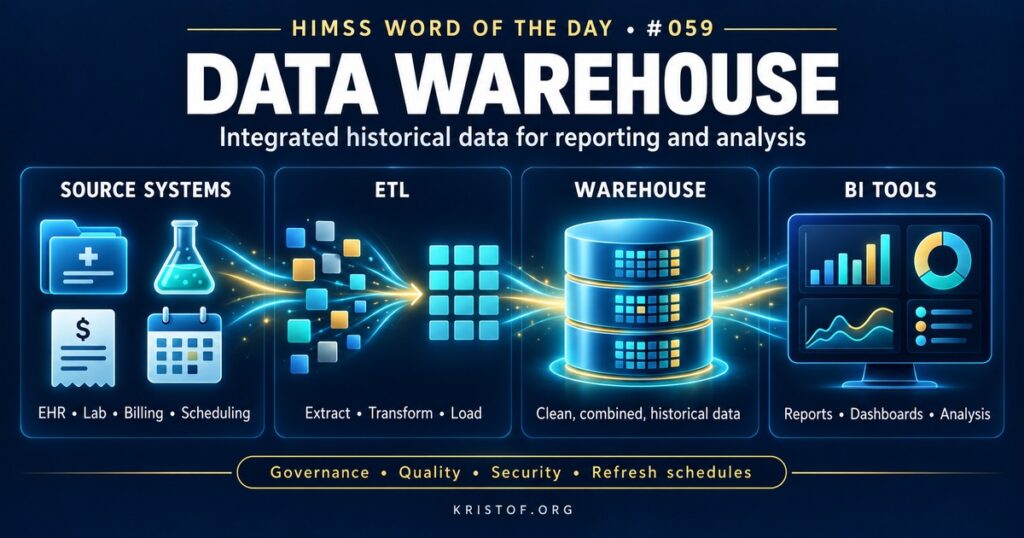
A data warehouse is a central storage system built for reporting and analysis. It copies data from the systems people use every day, such as the EHR, laboratory, billing, and scheduling systems, cleans and combines it, and organizes it so that analysts can answer questions across the whole organization without slowing down the systems clinicians rely on.
The HIMSS Dictionary describes a data warehouse as a storage design that holds data pulled from transaction systems, operational data stores, and outside sources. The warehouse brings that data together in aggregated and summarized form for enterprise-wide analysis and reporting that meets defined business needs. The Dictionary lists five components: the production systems that supply the data, the processes that extract and convert it, the database management system that stores it, the administration of the warehouse, and the business intelligence tools people use to explore it.
| Component | Role | Healthcare Example |
|---|---|---|
| Source Systems | Systems where data is created | EHR, laboratory, pharmacy, claims, scheduling |
| Extract, Transform, Load (ETL) | Copies data, cleans it, standardizes it, and loads it | Mapping local lab codes to LOINC and units to a standard |
| Warehouse Database | Stores integrated historical data designed for analysis | Tables organized by patient, encounter, date, and measure |
| Administration and Governance | Manages security, definitions, quality, and refresh schedules | Defining what counts as a “readmission” for every report |
| Business Intelligence Tools | Let users query, visualize, and share results | Dashboards, scorecards, and self-service reporting |
⚠️ Exam Alert: A transactional database supports day-to-day operations with fast reads and writes. A data warehouse supports analysis of integrated, historical data. A data mart is a smaller, subject-focused subset of a warehouse, such as a nursing quality mart. A data lake stores large amounts of raw data in its original form for later processing. Expect questions about which one fits a reporting or research scenario.
🌐 Why It Matters: Real-World Healthcare IT Context
Running complex reports directly against a live EHR database can slow the system for clinicians, and the EHR’s structure is designed for care delivery, not analysis. Data warehouses solve both problems by copying data to a separate environment designed for questions such as “How did our sepsis bundle compliance change over three years?” or “Which clinics have the highest no-show rates?”
Warehouses also integrate sources that do not live in the EHR, such as claims, cost accounting, patient experience surveys, staffing, and external benchmarks. That integration is essential for value-based care, population health, and quality reporting.
Design approaches vary. Some organizations build an integrated enterprise model first and create subject-focused marts from it; others build dimensional marts, often in star schemas, and connect them over time. Many now combine warehouses with data lakes or cloud platforms that can handle large and varied data, including imaging metadata, device streams, and text.
Research networks rely on common data models that standardize structure and terminology across institutions. The OMOP Common Data Model, maintained by the OHDSI community, allows the same analysis to run across many organizations’ data. A 2015 paper by George Hripcsak and colleagues described how OHDSI uses this shared model to support large-scale observational research. PCORnet and i2b2 provide other widely used models and tools.
Common data warehouse problems:
- Different definitions of the same measure in different reports
- Data refreshed overnight being mistaken for real-time information
- ETL errors that silently drop or duplicate records
- Free-text data that cannot be analyzed without additional processing
- Uncontrolled access to sensitive identifiable data
- Legacy data from previous systems that does not map cleanly
Characteristics of a strong warehouse program:
- Data governance with documented, shared definitions
- Automated data quality checks on every load
- Clear labeling of data latency, such as “as of last night”
- Role-based access with de-identified data sets for research
- Integration of clinical, financial, and operational sources
- Close partnership between analysts and clinical experts
🏥 The Nurse’s Perspective: Clinical, Bedside, & Workflow
Nurses may never query a data warehouse directly, but many of the numbers that shape their work come from one.
At the Bedside
Nursing documentation is a major source of warehouse data. Fall risk scores, skin assessments, restraint documentation, line and catheter days, and pain reassessments become the raw material for quality reports on falls, pressure injuries, and device-associated infections. If those items are documented in free text or in the wrong place, they may be missing from the warehouse even though the care was delivered.
Real-time information comes from the EHR, not the warehouse. A nurse checking a patient’s latest potassium should look at the chart; a warehouse report showing that value may be hours old.
In Clinical Workflow
Nurse managers use warehouse-driven dashboards to track staffing, overtime, quality indicators, and patient experience. Understanding how each measure is defined, such as which patients are included, which time period is used, and when data was last refreshed, helps leaders interpret results and avoid drawing the wrong conclusions.
Nurse researchers and quality specialists often request data extracts from the warehouse. Clear questions and precise definitions lead to better data sets, and governance processes protect patient privacy in the process.
In EHR Implementation (Go-Live Perspective)
An Epic Go-Live affects the data warehouse in two ways. New EHR data must flow into reporting databases and the enterprise warehouse with updated mappings, and historical data from the legacy system must remain available, either converted or archived, so long-term trends are not broken.
At-the-elbow support analysts may hear that reports look different after Go-Live. Sometimes the difference reflects a real build or mapping issue; sometimes it reflects a new documentation workflow that changes how data is captured. Routing these observations, with specific examples, to reporting teams helps them align definitions quickly.
🎓 CAHIMS / CPHIMS & HIMSS Perspective
CAHIMS Exam Domain Mapping
Data warehouses appear in data management and analytics questions:
| CAHIMS Domain | How Data Warehouses Appear |
|---|---|
| Healthcare & Technology Environments | Value-based care and population health data needs; research networks |
| Clinical Informatics | Quality reporting; nursing-sensitive indicators; documentation that feeds analytics |
| Healthcare Information & Systems Management | ETL, data marts, data lakes, common data models, data latency, security |
| Management & Leadership | Data governance, analytics strategy, access policies, investment in data platforms |
Key Terms to Know Alongside Data Warehouse
- ETL (Extract, Transform, Load) — the process of copying data from sources, standardizing it, and loading it into a warehouse
- Data Mart — a subject-focused subset of a data warehouse for a specific department or purpose
- Data Lake — a repository that stores large volumes of raw data in its native format
- Operational Data Store (ODS) — an integrated store of current operational data used for near-real-time reporting
- Common Data Model — a standardized structure and vocabulary that lets data from different organizations be analyzed together
- Business Intelligence (BI) — tools and practices that turn warehouse data into reports and dashboards
HIMSS Organizational Position
HIMSS addresses data warehousing as part of analytics maturity. Its Analytics Maturity Assessment Model (AMAM) evaluates how organizations build the data foundation, governance, and tools needed to use analytics well. Members can find related education and research through the HIMSS Resource Center.
🔗 Explore Further: External References
- OHDSI — OMOP Common Data Model https://ohdsi.github.io/CommonDataModel/
- Hripcsak et al. (2015), Studies in Health Technology and Informatics — OHDSI: Opportunities for Observational Researchers https://pubmed.ncbi.nlm.nih.gov/26262116/
- PCORnet — The National Patient-Centered Clinical Research Network https://pcornet.org/
- i2b2 — Informatics for Integrating Biology and the Bedside https://i2b2.org/
- HL7 — FHIR Bulk Data Access https://hl7.org/fhir/uv/bulkdata/
- HIMSS — Analytics Maturity Assessment Model (AMAM) https://www.himss.org/maturity-models/amam
Term source: HIMSS Dictionary of Health Information and Technology Terms, Acronyms, and Organizations, 6th Edition (2025). All definitions in this series are paraphrased for editorial purposes. Readers are encouraged to consult the primary source for exact language.
Eric Andrew Kristof, RN, CAHIMS is a Healthcare IT professional and HIMSS Arkansas Chapter member based in Hot Springs Village, AR, with hands-on Epic Go-Live experience and a diverse healthcare and IT background. He writes at kristof.org at the intersection of clinical care and healthcare technology.
Leave a Reply