By Eric Andrew Kristof, RN, CAHIMS | Healthcare IT Professional | HIMSS Arkansas Chapter Member
About This Series: The HIMSS Word of The Day is a running blog series drawing from the HIMSS Dictionary of Health Information and Technology Terms, Acronyms, and Organizations, 6th Edition (2025) — the authoritative reference for healthcare IT professionals and the primary study resource for CAHIMS and CPHIMS certification. Each post paraphrases the term in plain language, grounds it in real-world healthcare IT context, and adds a bedside nursing perspective you won’t find in a textbook.
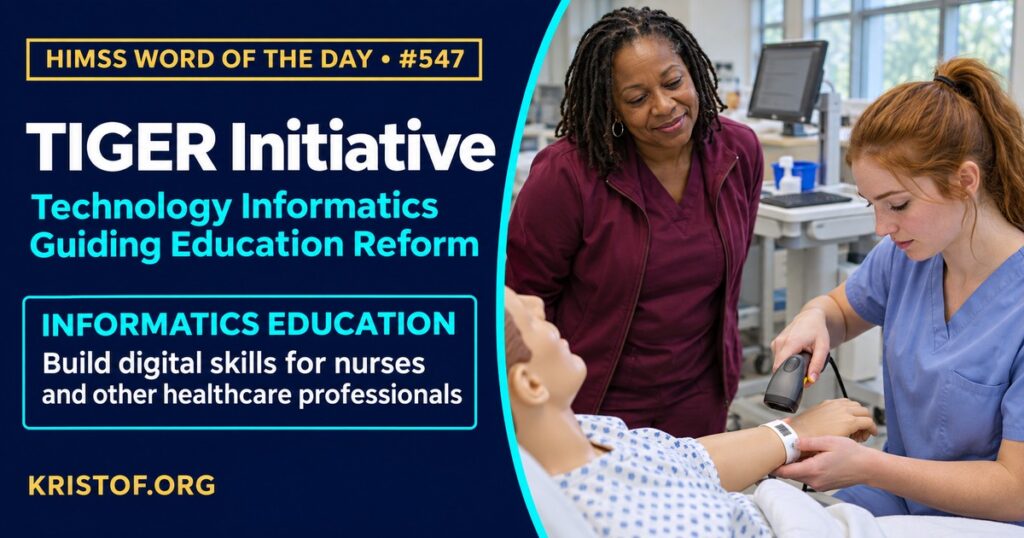
📖 The Term: TIGER Initiative (Technology Informatics Guiding Education Reform)
Source: HIMSS Dictionary of Health Information and Technology Terms, Acronyms, and Organizations, 6th Edition (2025)
🔍 Plain-Language Definition
The HIMSS Dictionary lists the TIGER Initiative (Technology Informatics Guiding Education Reform) in its organizations appendix. It describes TIGER as an effort aimed at education reform and interprofessional community building, with the goal of weaving technology and informatics into everyday practice, education, and the development of research resources.
TIGER has a longer history than that summary suggests. A 2017 paper in Nurse Education Today by O’Connor and colleagues says the initiative was established in 2006 in the United States to develop key areas of informatics in nursing, including bringing informatics competencies into nursing curricula and lifelong learning. In 2009, it developed an informatics competency framework, which the authors say helped raise the emphasis on informatics in US nursing education standards. In 2012, TIGER expanded to the international community to help synthesize informatics competencies for nurses and pool educational resources, and it moved toward an interprofessional approach.
A Healthcare Innovation Group news report published on September 30, 2014 says HIMSS announced that day that TIGER had come under the aegis of HIMSS, effective September 22. It quotes HIMSS’s release as saying TIGER began in 2006 as a grassroots initiative with support from more than 70 organizations, two Robert Wood Johnson Foundation grants, and a personal endowment. The same report lists planned HIMSS activities, including curriculum reform, a virtual learning environment, faculty development, and a graduate informatics internship program.
The name has changed. The HIMSS community page now presents the group as the HIMSS Technology Informatics for Global Education and Readiness (TIGER) Global Community, and it describes a mission of advancing interprofessional health care informatics education globally. Another HIMSS page, titled The TIGER Initiative, still uses the Dictionary’s wording, “Technology Informatics Guiding Education Reform.” A HIMSS news article titled “New Name, Same TIGER Spirit” appears in search results for the site, but the page could not be opened for this post, so the date and details of the renaming are not confirmed here.
| Item | Detail |
|---|---|
| Type | Education and community initiative, now within HIMSS |
| Started | 2006 in the United States (O’Connor and colleagues, 2017) |
| With HIMSS since | September 2014 (Healthcare Innovation Group report) |
| Focus | Informatics education, competencies, and interprofessional community |
| Current name on HIMSS community page | Technology Informatics for Global Education and Readiness (TIGER) Global Community |
| Not | A certification, an exam, or a credentialing body |
⚠️ Exam Alert: TIGER is an education and community initiative for informatics competencies, now within HIMSS. It does not issue credentials. HIMSS itself offers the CAHIMS and CPHIMS certifications, ANCC is a nursing certification organization, and AMIA is an association for biomedical and health informatics. Do not confuse TIGER’s competency frameworks with a certification exam.
🌐 Why It Matters: Real-World Healthcare IT Context
Because TIGER is an initiative rather than a research topic, this section draws on HIMSS pages, a news report, and two peer-reviewed papers, all read for this post. The HIMSS pages show how the group describes its own work. The news report and the papers are independent of HIMSS’s current pages, although the news report relays a HIMSS press release.
The competency frameworks. HIMSS’s page on Global Health Informatics Competency Recommendation Frameworks describes how the work developed. The first phase compiled national case studies submitted by committee members from Australia, Brazil, China and Taiwan, Finland, Germany (with Austria and Switzerland), Ireland, New Zealand, the Philippines, Portugal, Scotland, and the United States. The second phase deployed a survey of 24 areas of core competencies within five domains: clinical nursing, nursing management, quality management, information technology management in nursing, and coordination of interprofessional care. The survey went to 21 countries and drew 43 experts. The third phase produced the first framework, focused on nursing. HIMSS adds that a later effort, together with the EU*US eHealth Work Project, drew on survey input from 51 countries and 22 global case studies to produce a second framework for a broad range of health professionals.
The peer-reviewed account of the first framework. Hübner and colleagues, in Methods of Information in Medicine (2018), describe the same work in a journal article. They surveyed 43 nursing experts from 21 countries, held a workshop at the International Nursing Informatics Conference in June 2016, and compiled exemplar case studies from Brazil, Germany, New Zealand, Taiwan and China, Scotland, and the United States. The result was a recommendation framework of 24 core competency areas for five major nursing roles (HIMSS calls its five groupings domains), grouped into domains such as data, information, and knowledge; information exchange and sharing; ethical and legal issues; systems life cycle management; management; and biostatistics and medical technology. The authors say the framework offers a grid for teachers and learners and a method that other professions could use. The abstract describes expert opinion and consensus, not tests of whether the competencies improve care, and the sample of experts is small.
The initiative’s history. O’Connor and colleagues, in Nurse Education Today (2017), give the 2006, 2009, and 2012 milestones noted above and describe the EU*US eHealth Work Project, which began in 2016 to map gaps in health IT skills and training needs globally. The paper is a call for educators, researchers, practitioners, and policy makers to engage with TIGER, so it reads as advocacy as well as history.
Today’s community. The HIMSS community page lists a monthly webinar series with recent topics such as artificial intelligence in clinical practice and education and certification and career advancement in nursing informatics. It also links to resources such as a survey on how informatics is integrated into medical and nursing curricula. It also lists liaisons to several HIMSS committees. These are HIMSS’s own descriptions of current activity.
Taken together, the sources show a long-running, volunteer-driven effort that produced widely cited competency frameworks and now operates within HIMSS under a newer name. They do not measure outcomes in practice or in education.
Common TIGER mix-ups:
- Treating TIGER as a certification or credentialing body
- Using the Dictionary’s older name without noting that HIMSS now uses a newer one
- Assuming TIGER’s frameworks are binding rules rather than recommendations
- Confusing the first nursing-focused framework with the later interprofessional one
- Mixing up TIGER with HIMSS itself, AMIA, or ANCC
- Treating consensus competency lists as evidence of better outcomes
What TIGER offers:
- Recommended core informatics competencies for nursing and other professions
- A community for informatics educators, practitioners, and students
- Educational resources, reports, and a virtual learning environment, as described on HIMSS pages and in the 2014 news report
- A monthly webinar series within the HIMSS community
- A voice for education in HIMSS committees through designated liaisons
🏥 The Nurse’s Perspective: Clinical, Bedside, & Workflow
TIGER began in nursing, and its work is aimed at the skills nurses need around technology.
At the Bedside
Bedside nurses use technology constantly, from bar code scanners to monitoring equipment to the electronic record. The competency work behind TIGER treats informatics knowledge as part of everyday practice, not a specialty reserved for a few people. Units that onboard new nurses with clear expectations for documentation, data use, and safe handling of information follow the same idea.
In Clinical Workflow
Nurse informaticists often teach, build, and support tools, so competency frameworks help them describe what staff should know and what training to offer. A framework that names roles, from clinical nursing to nursing management and quality management, supports conversations about who needs which skills and at what depth.
In EHR Implementation (Go-Live Perspective)
During an Epic Go-Live, analysts at the elbow see which skills help nurses adapt quickly, such as navigating the record, understanding what data is captured, and knowing whom to ask for help. Those observations feed back into training plans for the next unit, which is the practical side of the education reform that TIGER describes.
🎓 CAHIMS / CPHIMS & HIMSS Perspective
CAHIMS Exam Domain Mapping
TIGER connects education, competencies, and workforce development:
| CAHIMS Domain | How TIGER Appears |
|---|---|
| Healthcare & Technology Environments | Professional communities, informatics education, and the HIMSS organization |
| Clinical Informatics | Informatics competencies for nurses and other clinicians |
| Healthcare Information & Systems Management | Training, support, and skill needs around health information systems |
| Management & Leadership | Workforce development, curriculum planning, and interprofessional collaboration |
Key Terms to Know Alongside TIGER
- Nursing Informatics — specialty that integrates nursing science with information and analytical sciences
- Informatics Competencies — knowledge and skills needed to use and manage health information and technology
- Interprofessional Education — learning together across health professions
- Competency Framework — structured list of skills expected for a role or level
- Learning Health System — health system that uses data and experience to improve care continuously
- HIMSS Community — HIMSS member group built around a topic or profession
HIMSS Organizational Position
HIMSS offers education and research on health information and technology topics through its Resource Center. Members can find related information on the HIMSS Resource Center page.
🧭 More HIMSS Word of The Day Terms
Related terms in the Clinical Informatics series:
- Plan of Care (Care Plan)
- Biomedical Informatics
- Simulation
- APACHE (Acute Physiology and Chronic Health Evaluation)
Browse all Clinical Informatics terms or the A–Z glossary.
🔗 Explore Further: External References
- HIMSS — Technology Informatics for Global Education and Readiness (TIGER) Global Community https://www.himss.org/networking/communities/tiger/
- HIMSS — The TIGER Initiative https://www.himss.org/professional-development/tiger-initiative
- HIMSS — Global Health Informatics Competency Recommendation Frameworks https://www.himss.org/resources/global-health-informatics-competency-recommendation-frameworks/
- Healthcare Innovation Group — The TIGER Initiative Comes Under HIMSS Management (Hagland, 2014) https://www.hcinnovationgroup.com/clinical-it/news/13024011/the-tiger-initiative-comes-under-himss-management
- O’Connor et al. (2017), Nurse education today — Time for TIGER to ROAR! Technology Informatics Guiding Education Reform https://pubmed.ncbi.nlm.nih.gov/28918322/
- Hübner et al. (2018), Methods of information in medicine — Technology Informatics Guiding Education Reform – TIGER https://pubmed.ncbi.nlm.nih.gov/29956297/
- HIMSS — Resource Center https://www.himss.org/resource-center
Term source: HIMSS Dictionary of Health Information and Technology Terms, Acronyms, and Organizations, 6th Edition (2025). All definitions in this series are paraphrased for editorial purposes. Readers are encouraged to consult the primary source for exact language.
Eric Andrew Kristof, RN, CAHIMS is a Healthcare IT professional and HIMSS Arkansas Chapter member based in Hot Springs Village, AR, with hands-on Epic Go-Live experience and a diverse healthcare and IT background. He writes at kristof.org at the intersection of clinical care and healthcare technology.
Leave a Reply