By Eric Andrew Kristof, RN, CAHIMS | Healthcare IT Professional | HIMSS Arkansas Chapter Member
About This Series: The HIMSS Word of The Day is a running blog series drawing from the HIMSS Dictionary of Health Information and Technology Terms, Acronyms, and Organizations, 6th Edition (2025) — the authoritative reference for healthcare IT professionals and the primary study resource for CAHIMS and CPHIMS certification. Each post paraphrases the term in plain language, grounds it in real-world healthcare IT context, and adds a bedside nursing perspective you won’t find in a textbook.
📖 The Term: DSM (Diagnostic and Statistical Manual of Mental Disorders)
Source: HIMSS Dictionary of Health Information and Technology Terms, Acronyms, and Organizations, 6th Edition (2025)
🔍 Plain-Language Definition
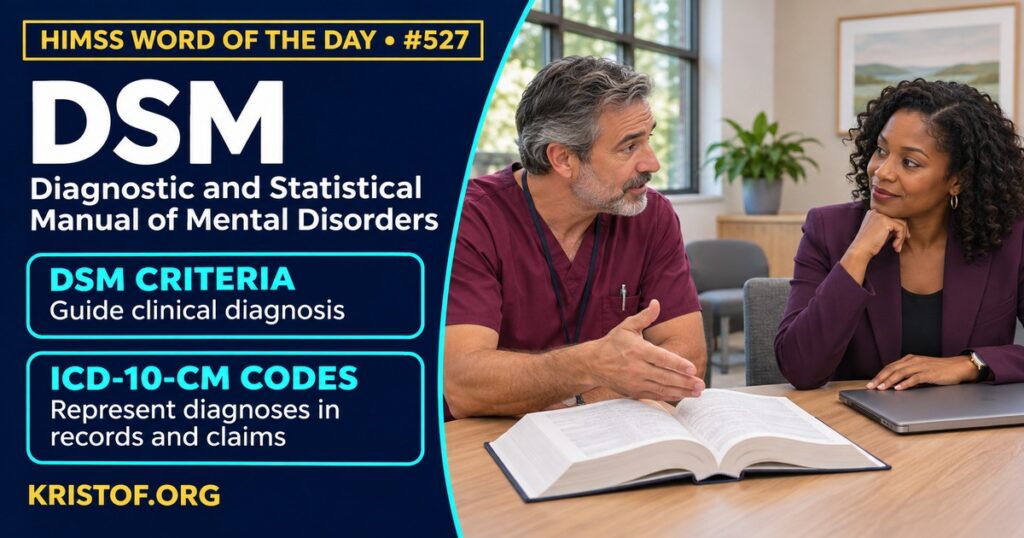
The HIMSS Dictionary describes the DSM, the Diagnostic and Statistical Manual of Mental Disorders, as the manual produced by the American Psychiatric Association (APA) for diagnosing and classifying mental disorders. Clinicians and researchers use it. Its criteria are written to be concise and explicit, so that symptom presentations can be assessed in a consistent way across many settings: inpatient, outpatient, partial hospital, consultation-liaison, private practice, and primary care.
The APA describes the current edition, DSM-5, as the standard classification of mental disorders used by mental health professionals in the United States. The DSM-5 was published in 2013, and a text revision, DSM-5-TR, has since been issued. What matters to health IT is how DSM diagnoses appear in records and claims. A clinician applies DSM criteria to make a diagnosis, but the diagnosis is then recorded and billed using an ICD-10-CM code. The APA publishes resources on ICD-10-CM coding updates for DSM-5 diagnoses, which means that code changes can affect electronic health record problem lists, order sets, quality measures, and reimbursement.
The DSM is one of two major systems for classifying mental disorders. The other is the World Health Organization’s International Classification of Diseases (ICD), whose 11th revision was approved by the World Health Assembly in 2019. The two systems share much but not everything, and the differences can change who meets criteria for a diagnosis.
Because mental health records contain some of the most sensitive information in health care, DSM-based diagnoses also raise privacy and access questions, which are handled through the same rules that apply to other health information, plus additional protections in some settings.
| Item | What it is |
|---|---|
| DSM | APA manual of criteria for diagnosing mental disorders |
| ICD-10-CM | Coding system used in US health records and claims |
| ICD-11 | WHO’s 11th revision of the International Classification of Diseases |
| Diagnostic criteria | The symptoms, duration, and impact required for a diagnosis |
| Code set | Standard codes that represent a diagnosis in records and claims |
⚠️ Exam Alert: The DSM is the APA’s manual of diagnostic criteria for mental disorders. ICD is the WHO classification that provides the codes used in US records and claims (ICD-10-CM). Do not confuse the DSM (criteria) with SNOMED CT (clinical terminology), or the DSM with DRG (a payment grouping based on diagnoses and procedures).
🌐 Why It Matters: Real-World Healthcare IT Context
Research on the DSM touches classification, harmonization with ICD, and the accuracy of the codes that represent diagnoses in data. Each source below was checked against its published abstract.
First and colleagues, in World Psychiatry (2021), compared organization and diagnostic requirements in ICD-11 and DSM-5. They found that the two systems are organized in a substantially similar way, that 19 ICD-11 disorder categories do not appear in DSM-5, and that 7 DSM-5 categories do not appear in ICD-11. For 103 diagnostic entities present in both, they rated 20 (19.4 percent) as having major differences, 42 (40.8 percent) as having minor definitional differences, 10 (9.7 percent) as having minor differences from greater specification in DSM-5, and 31 (30.1 percent) as essentially identical. They concluded the two systems are closer than at any time since ICD-8 and DSM-II. The ratings are the authors’ own comparison of text, not a study of patients.
Robinson and colleagues, in Psychological Trauma (2025), compared PTSD criteria from ICD-11 and DSM-5 in a community sample of military veterans in Northern Ireland, using validated self-report measures. DSM-5 criteria produced a higher PTSD prevalence estimate (39.26 percent) than ICD-11 (32.09 percent), and agreement between systems on caseness was moderate. The authors conclude that the choice of diagnostic framework may influence classification. The data are self-reported and come from one population.
Yen and colleagues, in the Journal of Behavioral Addictions (2022), compared ICD-11 gaming disorder criteria with DSM-5 internet gaming disorder criteria in 60 participants with gaming disorder, 45 with hazardous gaming, and 120 controls. They found good consistency (kappa 0.80, diagnostic accuracy 91.5 percent) and noted that the ICD-11 criteria set a high threshold. The sample was small and recruited for the study.
Wnorowska and colleagues, in Pediatric Emergency Care (2026), tested whether 9 ICD-10-CM billing diagnosis codes could identify pediatric emergency department visits involving agitation or aggression, compared with structured EHR review. Among 855 mental health encounters, the code set flagged 62 (7 percent), while review confirmed 118 (14 percent). Sensitivity was 40 percent and specificity 98 percent. The authors suggest methods such as natural language processing may be needed. The study took place in one academic children’s hospital over about eight months.
Wang and colleagues, in Clinical Epidemiology (2025), examined the validity of claims-based diagnostic codes for psychotic and affective disorders in Taiwan’s National Health Insurance Research Database, using chart review of 727 inpatients as the reference. Positive predictive value and sensitivity were high (0.70 or more) for common diagnoses and modest for low-prevalence ones, and validity tended to be better with ICD-10-CM than ICD-9-CM. The authors note that intensive coding training and the specific details required by ICD-10 may improve validity. The setting is one country’s insurance database and one hospital system’s charts.
Taken together, the studies show that the criteria behind a diagnosis can shift who counts as a case, and that the codes recorded in systems capture the clinical picture only partly.
Common DSM-related data problems:
- Different criteria in different classification systems, leading to different case counts
- Diagnosis codes that miss cases documented only in notes
- Coding updates that change problem lists, rules, and reports
- Low-prevalence diagnoses with weaker code accuracy
- Free-text descriptions that never become structured data
- Heightened privacy and access concerns around mental health records
What supports accurate DSM-based data:
- Clear mapping between diagnostic criteria, problem-list entries, and codes
- Training for clinicians and coders on specificity
- Periodic validation of code sets against chart review
- Natural language processing to find cases that codes miss
- Governance for code updates and the changes they trigger
- Careful privacy controls for behavioral health information
🏥 The Nurse’s Perspective: Clinical, Bedside, & Workflow
Psychiatric and behavioral health nurses work with DSM-based diagnoses daily, even when the diagnosis itself is made by another clinician.
At the Bedside
Nurses observe and document the behaviors, symptoms, and responses that inform assessment and care planning. Clear descriptions in a note, such as what happened, what preceded it, and how the patient responded, help clinicians apply criteria and help later review. Nurses in every setting also care for patients with mental health diagnoses, and consistent documentation supports safe, respectful care.
In Clinical Workflow
Nurse informaticists help shape assessment forms, problem lists, and care plans so that documented observations connect to coded diagnoses. They also support updates when codes or criteria change. Because diagnosis codes can miss cases that notes describe, flowsheet rows and structured screening tools add value alongside free text.
In EHR Implementation (Go-Live Perspective)
During an Epic Go-Live, behavioral health areas often have workflows that differ from medical-surgical units, including safety observation, restricted access to some notes, and specialized assessments. Analysts at the elbow look for places where staff cannot find the right field or where privacy settings block needed information. Resolving these early supports both care and compliance.
🎓 CAHIMS / CPHIMS & HIMSS Perspective
CAHIMS Exam Domain Mapping
The DSM links clinical criteria to standards and data:
| CAHIMS Domain | How DSM Appears |
|---|---|
| Healthcare & Technology Environments | Classification systems, standards bodies, and regulations |
| Clinical Informatics | Diagnostic criteria, problem lists, and structured assessments |
| Healthcare Information & Systems Management | Code set updates, data quality, and privacy controls |
| Management & Leadership | Behavioral health program design, training, and governance |
Key Terms to Know Alongside DSM
- ICD (International Classification of Diseases) — WHO classification that supplies diagnosis codes
- Code Set — set of codes assigned to terms for processing
- Behavioral Health — care for mental health and substance use conditions
- Diagnostic Criteria — defined symptoms and conditions required for a diagnosis
- Problem List — record section listing a patient’s active conditions
- Natural Language Processing — computer analysis of free-text clinical language
HIMSS Organizational Position
HIMSS offers education and research on health information and technology topics through its Resource Center. Members can find related information on the HIMSS Resource Center page.
🧭 More HIMSS Word of The Day Terms
Related terms in the Interoperability and Standards series:
- Application Programming Interface (API)
- Terminology (Clinical Terminology)
- Healthcare Terminology
- SNOMED CT (Systematized Nomenclature of Medicine — Clinical Terms)
Browse all Interoperability and Standards terms or the A–Z glossary.
🔗 Explore Further: External References
- First et al. (2021), World psychiatry — An organization- and category-level comparison of diagnostic requirements for mental disorders in ICD-11 and DSM-5 https://pubmed.ncbi.nlm.nih.gov/33432742/
- Robinson et al. (2025), Psychological trauma — Prevalence and concordance of International Classification of Diseases-11th Revision and Diagnostic and Statistical Manual-Fifth Edition posttraumatic stress diagnostics among Northern Irish military veterans https://pubmed.ncbi.nlm.nih.gov/38358723/
- Yen et al. (2022), Journal of behavioral addictions — Functional impairment, insight, and comparison between criteria for gaming disorder in the International Classification of Diseases, 11 Edition and internet gaming disorder in Diagnostic and Statistical Manual of Mental Disorders, Fifth Edition https://pubmed.ncbi.nlm.nih.gov/36326855/
- Wnorowska et al. (2026), Pediatric emergency care — External Validation of Diagnosis Codes to Identify Pediatric Mental Health Emergency Department Visits for Aggression https://pubmed.ncbi.nlm.nih.gov/41661220/
- Wang et al. (2025), Clinical epidemiology — Assessing the Validity of Claims-Based Diagnostic Codes for Psychotic and Affective Disorders and the Influence of the Coding Transition from the ICD-9 to the ICD-10 in Taiwan’s National Health Insurance Research Database https://pubmed.ncbi.nlm.nih.gov/40661787/
- American Psychiatric Association — Diagnostic and Statistical Manual of Mental Disorders (DSM-5) https://www.psychiatry.org/psychiatrists/practice/dsm
- HIMSS — Resource Center https://www.himss.org/resource-center
Term source: HIMSS Dictionary of Health Information and Technology Terms, Acronyms, and Organizations, 6th Edition (2025). All definitions in this series are paraphrased for editorial purposes. Readers are encouraged to consult the primary source for exact language.
Eric Andrew Kristof, RN, CAHIMS is a Healthcare IT professional and HIMSS Arkansas Chapter member based in Hot Springs Village, AR, with hands-on Epic Go-Live experience and a diverse healthcare and IT background. He writes at kristof.org at the intersection of clinical care and healthcare technology.
Leave a Reply