By Eric Andrew Kristof, RN, CAHIMS | Healthcare IT Professional | HIMSS Arkansas Chapter Member
About This Series: The HIMSS Word of the Day is a running blog series drawing from the HIMSS Dictionary of Health Information and Technology Terms, Acronyms, and Organizations, 6th Edition (2025) — the authoritative reference for healthcare IT professionals and the primary study resource for CAHIMS and CPHIMS certification. Each post paraphrases the term in plain language, grounds it in real-world healthcare IT context, and adds a bedside nursing perspective you won’t find in a textbook.
📖 The Term: Master Data Management (MDM)
Source: HIMSS Dictionary of Health Information and Technology Terms, Acronyms, and Organizations, 6th Edition (2025)
🔍 Plain-Language Definition
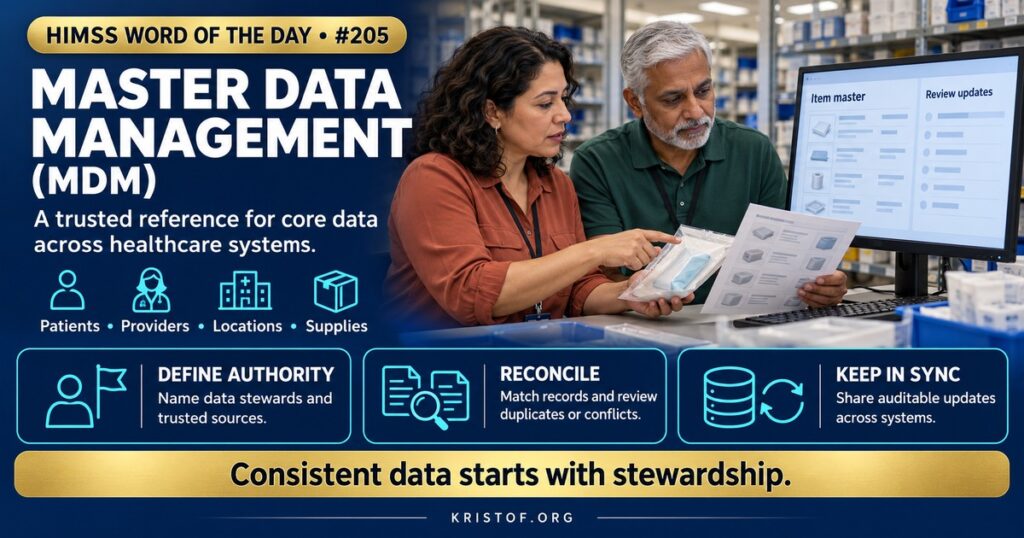
Master data management (MDM) is an enterprise approach that ties an organization’s most important data to one master record or file, giving every system a shared point of reference. Done well, it streamlines data sharing among departments and supports computing across different systems, platforms, and applications.
The HIMSS Dictionary adds that in health care, MDM tools are used by health information organizations to keep patient identity information consistent, disambiguated, and free of duplicates across many separate systems. The same discipline applies to other core entities, such as providers, locations, payers, and supplies.
| Master Data Domain | What It Covers | Example Problem If Unmanaged |
|---|---|---|
| Patient | Demographics and identifiers | Duplicate or overlaid charts |
| Provider | Clinicians, credentials, affiliations | Outdated directory and wrong referral targets |
| Location and Organization | Facilities, units, departments | Mismatched locations across systems |
| Item and Supply | Products, devices, medications, charge items | Different item numbers in purchasing and clinical systems |
| Reference Data | Codes, value sets, mappings | Local codes that do not map to standards |
| Payer and Plan | Insurance and contract details | Eligibility and billing errors |
⚠️ Exam Alert: Master data management is the practice of maintaining a trusted reference for core entities. A master patient index is one application of that idea for patients. Data governance sets the policies and roles, while MDM provides the processes and tools. The same initials, MDM, can also mean mobile device management, the tools that enroll, configure, and secure smartphones and tablets, so context matters.
🌐 Why It Matters: Real-World Healthcare IT Context
Healthcare organizations run on many systems that each hold their own copy of key entities. A patient may exist in registration, laboratory, imaging, and pharmacy systems, each with slightly different spellings or identifiers. A supply item may carry one number in purchasing and another in clinical documentation. Without a managed master, inconsistencies multiply, and every interface and report must reconcile them.
MDM addresses this by defining, for each domain, a trusted record, the rules for creating and updating it, the systems allowed to change it, and the way changes flow to others. The master may be physically centralized, a registry that cross-references identifiers in other systems, or a hybrid. What matters is that there is an agreed authority for each attribute.
Patient identity is the most visible case. Matching algorithms, manual review of potential duplicates, and merge and unmerge processes are all MDM activities, and the master patient index and its enterprise version are the tools many hospitals use. Integration profiles such as those from Integrating the Healthcare Enterprise define patterns for identifier cross-referencing and demographics queries so systems can find the same person without sharing a single database. ONC resources on patient identity and matching describe the practices and data elements that improve match rates.
Provider and location master data support referrals, directories, scheduling, credentialing, and attribution for value-based care. Reference data, including codes, value sets, and mappings between local and standard terminologies, is also master data, since errors there spread everywhere the codes are used.
Supply chain master data is often overlooked. Research on Swiss hospitals found that a material master catalogue in a large hospital can exceed 50,000 articles, and that maintenance was often manual and based on varied incoming file formats such as spreadsheets and emails. The authors proposed components for standardized updates and discussed barriers. A related case study on master data and data quality management in hospitals concluded that when data quality and master data are not properly managed, the cost and complexity of acquiring structured data may not be justified. The message is that MDM is more than software: it is a management cycle.
Governance defines success. Data stewards own definitions and quality for each domain, councils resolve disputes, and metrics track duplicates, completeness, and timeliness. DAMA International’s body of knowledge treats master and reference data as core data management functions.
Mobile device management shares only the initials, but it is also an important health care topic. Organizations use MDM tools to enroll phones and tablets, enforce passcodes and encryption, separate work and personal data, and wipe lost devices. NIST guidance on managing the security of mobile devices in the enterprise describes these practices.
Common master data problems:
- Duplicate or overlaid patient records
- Conflicting item or location identifiers across systems
- No clear authority for each data element
- Manual updates from spreadsheets and emails
- Local codes with no mapping to standards
- Stewardship roles that exist on paper only
What supports effective MDM:
- Named data stewards for each domain
- Clear rules for which system is the authority for each attribute
- Matching, merge, and unmerge processes with review
- Standard identifiers and terminologies
- Automated, auditable update flows between systems
- Metrics for duplicates, completeness, and timeliness
🏥 The Nurse’s Perspective: Clinical, Bedside, & Workflow
Nurses see the effects of master data every shift, though rarely under that name.
At the Bedside
Patient identity comes first. Two-identifier checks, careful registration, and reporting suspected duplicate or overlaid charts all protect the master patient record. A chart that contains another patient’s information is a safety event, and notifying the right team quickly allows health information management to correct it.
Supply and medication items matter too. When an item in the cabinet or on the cart does not match what appears in the system, scanning fails and workarounds begin. Reporting those mismatches helps supply chain and pharmacy teams correct the underlying record.
In Clinical Workflow
Provider and location data influence where orders, results, and messages go. An outdated provider entry or a unit that was renamed but not updated in every system can cause messages to land in the wrong inbox.
Nurses who notice repeated mismatches, such as a unit that appears under two names, can report them as data issues rather than treating each one as a one-off.
Nurse informaticists often serve as data stewards for nursing content, such as flowsheet definitions, nursing terminology mappings, and unit and role structures.
In EHR Implementation (Go-Live Perspective)
An Epic Go-Live depends on clean master data: patient records merged where appropriate, provider and location tables aligned, and supply and medication items mapped for scanning. Data validation before go-live reduces the number of first-day surprises.
At-the-elbow support analysts hear about master data problems as missing providers, duplicate patients, or items that will not scan. Logging patterns and routing them to the owners of each data domain speeds cleanup.
🎓 CAHIMS / CPHIMS & HIMSS Perspective
CAHIMS Exam Domain Mapping
Master data appears in data management, architecture, and governance questions:
| CAHIMS Domain | How MDM Appears |
|---|---|
| Healthcare & Technology Environments | Patient matching, standards, health information exchange |
| Clinical Informatics | Terminology mapping, patient identity, flowsheet definitions |
| Healthcare Information & Systems Management | Master patient index, data quality, integration, governance |
| Management & Leadership | Data stewardship, policy, ownership, metrics |
Key Terms to Know Alongside MDM
- Master Patient Index (MPI) — directory that links records belonging to the same patient
- Golden Record — the trusted, consolidated version of a master entity
- Data Steward — person responsible for the definition and quality of specific data
- Data Governance — policies and decision rights for managing data
- Reference Data — standard codes and value sets used across systems
- Mobile Device Management — tools for enrolling, configuring, and securing mobile devices
HIMSS Organizational Position
HIMSS promotes data quality, interoperability, and analytics maturity through its maturity models, education, and research. Members can find related resources through the HIMSS Resource Center.
🔗 Explore Further: External References
- Arthofer et al. (2017), Studies in Health Technology and Informatics — Data Quality- and Master Data Management: A Hospital Case https://pubmed.ncbi.nlm.nih.gov/28508805/
- Lehmann et al. (2019), Studies in Health Technology and Informatics — Components for Material Master Data Management in Swiss Hospitals https://pubmed.ncbi.nlm.nih.gov/30923272/
- ONC — Patient Identity and Patient Record Matching https://healthit.gov/standards-and-technology/patient-identity-and-patient-record-matching/
- IHE — Profiles https://www.ihe.net/resources/profiles/
- DAMA International https://dama.org/
- NIST — SP 800-124 Rev. 2, Guidelines for Managing the Security of Mobile Devices in the Enterprise https://csrc.nist.gov/pubs/sp/800/124/r2/final
Term source: HIMSS Dictionary of Health Information and Technology Terms, Acronyms, and Organizations, 6th Edition (2025). All definitions in this series are paraphrased for editorial purposes. Readers are encouraged to consult the primary source for exact language.
Eric Andrew Kristof, RN, CAHIMS is a Healthcare IT professional and HIMSS Arkansas Chapter member based in Hot Springs Village, AR, with hands-on Epic Go-Live experience and a diverse healthcare and IT background. He writes at kristof.org at the intersection of clinical care and healthcare technology.
Leave a Reply