By Eric Andrew Kristof, RN, CAHIMS | Healthcare IT Professional | HIMSS Arkansas Chapter Member
About This Series: The HIMSS Word of The Day is a running blog series drawing from the HIMSS Dictionary of Health Information and Technology Terms, Acronyms, and Organizations, 6th Edition (2025) — the authoritative reference for healthcare IT professionals and the primary study resource for CAHIMS and CPHIMS certification. Each post paraphrases the term in plain language, grounds it in real-world healthcare IT context, and adds a bedside nursing perspective you won’t find in a textbook.
📖 The Term: The Sequoia Project
Source: HIMSS Dictionary of Health Information and Technology Terms, Acronyms, and Organizations, 6th Edition (2025)
🔍 Plain-Language Definition
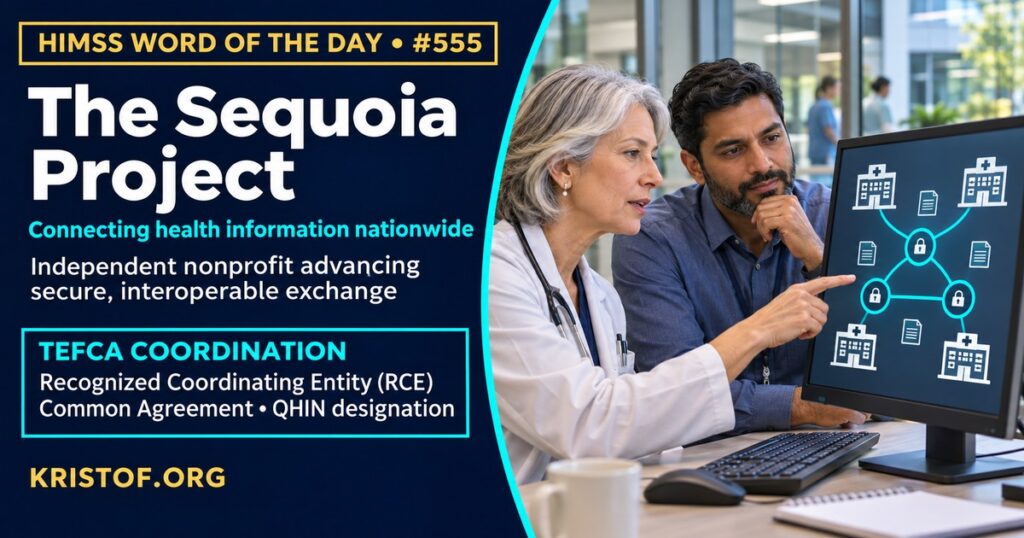
The HIMSS Dictionary lists The Sequoia Project in its organizations appendix as an independent, nonprofit, public-private collaborative formed to move forward secure, interoperable health information exchange across the country.
Sequoia describes itself on its own site as an independent, neutral advocate for nationwide health information exchange that identifies barriers to interoperability and develops practical processes to address them. It says it is a 501(c)(3) nonprofit, has more than 10 years of experience, and has more than 100 member organizations. Those figures are Sequoia’s own, so they are best read as the organization’s description of itself.
The history on Sequoia’s about page runs as follows. It says the organization was founded in 2012 and launched a federal health information network as its first initiative, then launched Carequality in 2014 and an Image Share Validation program in 2015. In 2018, it says, the federal health information network and Carequality were launched as separate organizations, and the Interoperability Matters cooperative began. The page says ONC selected Sequoia as the TEFCA Recognized Coordinating Entity (RCE) in 2019 and that membership reached 100 in 2024. The page does not name the federal health information network, so this post does not either.
| Item | Detail |
|---|---|
| Type | Independent 501(c)(3) nonprofit (Sequoia’s description) |
| Founded | 2012, per Sequoia’s about page |
| Focus | Nationwide health information exchange and interoperability |
| Role in TEFCA | Recognized Coordinating Entity, per ONC |
| Other programs | Interoperability Matters, advisory, education, and testing services, and the Data Usability Taking Root Movement |
| Related organization | Carequality, described by Sequoia as now independent |
⚠️ Exam Alert: The Sequoia Project is a nonprofit organization, and its RCE role means it coordinates TEFCA under an agreement with ONC, the federal agency. TEFCA is the framework and Common Agreement, not an organization. Carequality is a separate organization from Sequoia, and HL7 is a standards body. HIMSS offers CAHIMS and CPHIMS.
🌐 Why It Matters: Real-World Healthcare IT Context
This section draws on pages read directly for this post: Sequoia’s about page and home page, and ONC’s TEFCA page. The first two are the organization’s own statements. The ONC page is a government source. All were read in November 2026 and may change.
Role in TEFCA. ONC’s TEFCA page describes TEFCA as a nationwide framework for sharing health information electronically, created to reduce barriers among providers, patients, public health agencies, and payers. It names The Sequoia Project as the RCE. The page lists the RCE’s responsibilities: developing, updating, implementing, and maintaining the Common Agreement, reviewing applications from networks seeking Qualified Health Information Network (QHIN) status and administering their designation and monitoring, updating the QHIN Technical Framework, and engaging stakeholders through public sessions. It says ONC awarded Sequoia a five-year contract to serve as RCE in August 2023, and that the first QHINs were designated in December 2023. Sequoia’s TEFCA page says ONC awarded it the RCE role in August 2019 after an open competition, for a four-year term, and that a new five-year contract followed in August 2023. That matches the 2023 date on ONC’s page.
Programs. Sequoia’s pages list Interoperability Matters, a public-private cooperative with workgroups such as Consumer Engagement, Data Usability, Pharmacy, Privacy and Consent, and Public Health. A Payer-to-Payer API workgroup is marked inactive. The site also lists advisory, education, and testing services, and a partnership called the Data Usability Taking Root Movement. On September 11, 2026, it announced an information blocking compliance training series with AHIMA and HCPro.
Membership and governance. The pages describe corporate membership, member events, and a board of directors. Sequoia says its governance provides transparent oversight. This post does not evaluate that claim.
Status check. Both Sequoia pages were current when read. The home page shows news items dated in September 2026, and the about page shows a 2026 copyright and a last-modified date of September 21, 2026. The ONC page was last updated September 3, 2026, and still names Sequoia as the RCE. Sequoia’s TEFCA page shows a last-modified date of October 6, 2026. Nothing read suggested a rename, merger, or change in the RCE role.
What this post does not cover. It uses only what the pages said and does not assess how TEFCA performs in practice. The home page also lists two different dates for the 2027 joint annual meeting, so event details should be confirmed with the organization.
Taken together, the pages show a nonprofit that began as a convener for national exchange, split its early programs into separate organizations, and now holds a named coordinating role under a federal framework.
Common Sequoia Project mix-ups:
- Treating TEFCA and The Sequoia Project as the same thing
- Assuming Sequoia is a government agency
- Confusing Sequoia with Carequality, which Sequoia describes as independent
- Reading the 2019 and 2023 dates as conflicting, when they mark the first award and a new contract
- Mixing up Sequoia with HL7, which develops standards
- Assuming a nonprofit’s membership figures are independently audited
What The Sequoia Project offers:
- Coordination of TEFCA’s Common Agreement and QHIN designation, as the RCE
- A public-private cooperative, Interoperability Matters, with topic workgroups
- Advisory, education, and testing services
- Resources on consent, pharmacy, and payer-to-payer exchange
- Membership and events for the interoperability community
🏥 The Nurse’s Perspective: Clinical, Bedside, & Workflow
Nurses rarely see TEFCA by name, but they feel the results of exchange when an outside record is easy to find or hard to reach.
At the Bedside
A patient who arrives from another city or health system often cannot list every medication or test result. Exchange networks aim to let authorized clinicians retrieve that information. When retrieval works, nurses spend less time phoning other facilities and more time on care. When it does not, they rely on the patient, family, and paper.
In Clinical Workflow
Nurses and nurse informaticists help decide which outside information is useful and how it should appear, because a long list of retrieved documents is hard to use during a busy shift. Privacy and consent rules also shape what can be shared, which is why Sequoia’s workgroups include privacy and consent topics.
In EHR Implementation (Go-Live Perspective)
During an Epic Go-Live, analysts at the elbow field questions such as “why can I see a record from another hospital?” and “who can see ours?” Clear answers depend on the organization’s participation in exchange networks and on its consent and access policies. Analysts can help by documenting which external records appear, where, and for whom.
🎓 CAHIMS / CPHIMS & HIMSS Perspective
CAHIMS Exam Domain Mapping
The Sequoia Project connects national policy to local exchange work:
| CAHIMS Domain | How The Sequoia Project Appears |
|---|---|
| Healthcare & Technology Environments | National exchange frameworks and the organizations that coordinate them |
| Clinical Informatics | Using outside records and shared data in care |
| Healthcare Information & Systems Management | Participation in exchange networks, testing, and consent management |
| Management & Leadership | Membership, governance, and compliance with information blocking rules |
Key Terms to Know Alongside The Sequoia Project
- TEFCA (Trusted Exchange Framework and Common Agreement) — federal framework for nationwide health information exchange
- HIE (Health Information Exchange) — electronic sharing of health information among organizations
- Interoperability — ability of systems to exchange and use information
- QHIN (Qualified Health Information Network) — network designated to take part in TEFCA exchange
- ONC (Office of the National Coordinator for Health IT) — federal agency that coordinates health IT policy
- Consent — patient’s permission for use or sharing of health information
HIMSS Organizational Position
HIMSS offers education and research on health information and technology topics through its Resource Center. Members can find related information on the HIMSS Resource Center page.
🧭 More HIMSS Word of The Day Terms
Related terms in the Interoperability and Standards series:
- Fast Healthcare Interoperability Resources (FHIR)
- Foundational Interoperability
- Longitudinal Health Record
- U.S. Core Data for Interoperability (USCDI)
Browse all Interoperability and Standards terms or the A–Z glossary.
🔗 Explore Further: External References
- The Sequoia Project — About Us https://sequoiaproject.org/about-us/
- The Sequoia Project — Home page https://sequoiaproject.org/
- ONC/ASTP — Trusted Exchange Framework and Common Agreement (TEFCA) https://healthit.gov/policy/tefca/
- The Sequoia Project — TEFCA https://sequoiaproject.org/tefca/
- HIMSS — Resource Center https://www.himss.org/resource-center
Term source: HIMSS Dictionary of Health Information and Technology Terms, Acronyms, and Organizations, 6th Edition (2025). All definitions in this series are paraphrased for editorial purposes. Readers are encouraged to consult the primary source for exact language.
Eric Andrew Kristof, RN, CAHIMS is a Healthcare IT professional and HIMSS Arkansas Chapter member based in Hot Springs Village, AR, with hands-on Epic Go-Live experience and a diverse healthcare and IT background. He writes at kristof.org at the intersection of clinical care and healthcare technology.
Leave a Reply