By Eric Andrew Kristof, RN, CAHIMS | Healthcare IT Professional | HIMSS Arkansas Chapter Member
About This Series: The HIMSS Word of the Day is a running blog series drawing from the HIMSS Dictionary of Health Information and Technology Terms, Acronyms, and Organizations, 6th Edition (2025) — the authoritative reference for healthcare IT professionals and the primary study resource for CAHIMS and CPHIMS certification. Each post paraphrases the term in plain language, grounds it in real-world healthcare IT context, and adds a bedside nursing perspective you won’t find in a textbook.
📖 The Term: Alert Fatigue
Source: HIMSS Dictionary of Health Information and Technology Terms, Acronyms, and Organizations, 6th Edition (2025)
🔍 Plain-Language Definition
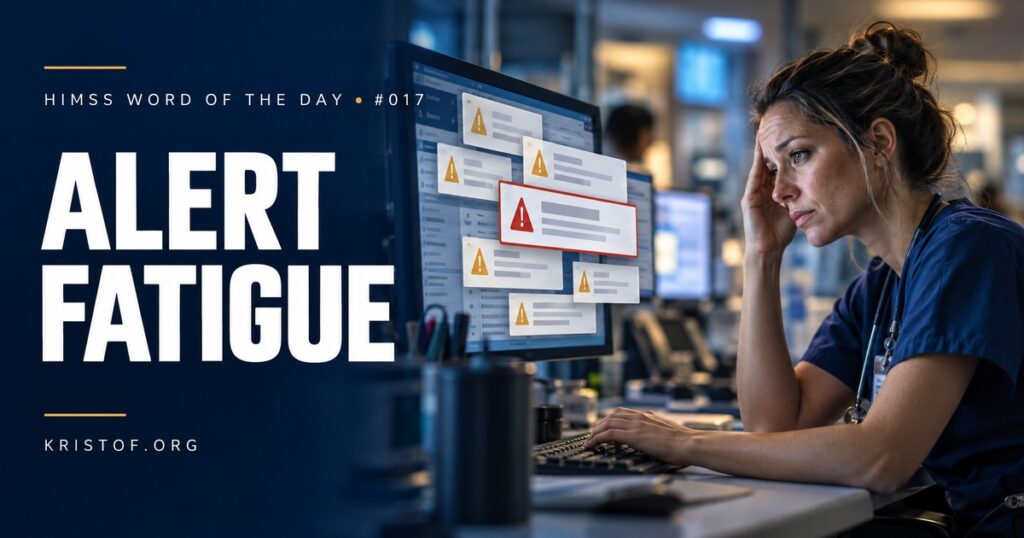
Alert fatigue is what happens when software and smart devices generate so many false or low-value warnings that the people receiving them begin to tune them out, dismiss them reflexively, or respond more slowly. The HIMSS Dictionary frames it in exactly those terms: repeated false alarms from technology that lead workers to ignore them or react late.
The danger is not the noise itself. It is that the one alert that matters arrives looking exactly like the hundred that did not.
In healthcare, two related problems share the name:
| Type | Source | Common Examples | Primary Fix |
|---|---|---|---|
| Alert Fatigue | EHR and clinical decision support software | Drug-interaction pop-ups, duplicate-order warnings, Best Practice Advisories, documentation reminders | CDS governance: retire, tier, and target alerts; measure override rates |
| Alarm Fatigue | Physiologic monitors and medical devices | Cardiac monitor, pulse oximetry, ventilator, infusion pump, and bed-exit alarms | Clinical alarm management: customize thresholds, reduce non-actionable alarms, improve escalation |
⚠️ Exam Alert: Distinguish alert fatigue (software alerts in the EHR and CDS) from alarm fatigue (device and monitor alarms), although both share the same human mechanism. Know that interruptive alerts stop the workflow and non-interruptive alerts display passively. Know that a high override rate is a key signal of a poorly tuned alert. And remember that alarm safety is a Joint Commission National Patient Safety Goal, which makes it a regulatory issue as well as a usability one.
🌐 Why It Matters: Real-World Healthcare IT Context
Alert fatigue is the most documented failure mode of clinical decision support, and it undermines the safety case for CPOE and CDS.
A widely cited 2006 systematic review in the Journal of the American Medical Informatics Association found that clinicians override drug safety alerts between 49% and 96% of the time. Most of those overrides are reasonable, because the alerts were irrelevant, already known, or clinically insignificant. That is precisely the problem: when nearly every alert is safe to ignore, the habit of ignoring alerts becomes automatic.
Device alarms follow the same pattern. Studies of monitored units have found that most alarms are false or not clinically actionable. The Joint Commission issued a Sentinel Event Alert on medical device alarm safety in 2013 and then made clinical alarm safety a National Patient Safety Goal, requiring hospitals to identify their most important alarms and manage them deliberately. ECRI has repeatedly ranked alarm hazards among its top health technology hazards.
Common causes of alert fatigue:
- Alerts with low specificity that fire for nearly every patient or order
- Drug-interaction knowledge bases left at vendor defaults with every severity level turned on
- Duplicate alerts for the same issue firing at multiple points in the workflow
- Alerts delivered to the wrong role, such as nurses receiving prescriber-level warnings
- Monitor thresholds left at factory defaults instead of being tailored to the patient
- No owner and no review cycle once an alert is built
Practices that reduce alert fatigue:
- An interdisciplinary CDS governance committee that approves, reviews, and retires alerts
- Override rates, acceptance rates, and firing volume tracked as quality metrics
- Testing new alerts in silent mode, logging when they would fire before showing them to anyone
- Tiering alerts by severity so only critical issues interrupt
- Applying the Five Rights of CDS: right information, right person, right format, right channel, and right point in the workflow
- Patient-specific alarm parameters and secondary alarm notification to the assigned nurse
The goal is not fewer alerts for its own sake. It is alerts that clinicians trust enough to read.
🏥 The Nurse’s Perspective: Clinical, Bedside, & Workflow
Nurses absorb alert and alarm fatigue from both directions at once: the EHR on the screen and the devices in the room.
At the Bedside
On a busy telemetry or step-down unit, the soundscape is constant. Monitors sound for artifact when a patient brushes their teeth, pulse oximeters alarm when a probe slips, pumps signal completed infusions, and bed-exit alarms chirp at every shift in position. Nurses learn which sounds mean danger and which mean nothing, and that learning is both a survival skill and a risk.
The safety concern is the alarm that sounds like all the others. Patient harm events tied to alarms often involve an alarm that fired correctly but was missed, silenced, or delayed because it blended into the background.
In Clinical Workflow
In the EHR, nurses encounter alerts during medication administration, documentation, and order acknowledgment. Barcode scanning warnings, overdue-task reminders, screening prompts, and Best Practice Advisories all compete for attention. Some are essential, such as a wrong-patient scan or a high-alert medication check, while others repeat information the nurse already knows.
Nurses also see the downstream effect of prescriber alert fatigue. When an ordering clinician overrides an interaction or allergy warning, the nurse at the bedside may be the next and last person positioned to question it. A culture where nurses feel empowered to pause and clarify is part of the defense against alert fatigue elsewhere in the system.
In EHR Implementation (Go-Live Perspective)
Go-Live is when alert volume is most likely to spike. New systems often launch with vendor-default alert content, broad firing criteria, and decision support configured before anyone has seen it fire against real patients.
End-user support analysts at the elbow are among the first to see which alerts are noise. Capturing specifics, such as which alert, which workflow, which patient population, and how often, gives the CDS team evidence to tune or retire it. Organizations that collect that evidence in the first weeks and act on it quickly prevent click-through habits from forming in the first place.
🎓 CAHIMS / CPHIMS & HIMSS Perspective
CAHIMS Exam Domain Mapping
Alert fatigue is a frequent CAHIMS topic, usually in a patient safety or CDS context:
| CAHIMS Domain | How Alert Fatigue Appears |
|---|---|
| Clinical Informatics | The primary domain; CDS design; override rates; Five Rights of CDS; interruptive versus non-interruptive alerts |
| Healthcare & Technology Environments | Joint Commission alarm safety goal; unintended consequences of health IT; patient safety organizations |
| Healthcare Information & Systems Management | Alert configuration and testing; knowledge base management; monitoring alert metrics |
| Management & Leadership | CDS governance committees; clinician engagement; balancing safety, usability, and liability |
Key Terms to Know Alongside Alert Fatigue
- Clinical Decision Support System (CDSS) — the software that generates most EHR alerts and reminders
- Alarm Fatigue — desensitization to physiologic monitor and device alarms
- Override Rate — the percentage of alerts dismissed without the suggested action, a key alert quality metric
- Interruptive Alert — an alert that stops the workflow until the user responds; also called a hard or soft stop
- Five Rights of CDS — the framework for delivering the right information to the right person in the right format, channel, and point in workflow
- Best Practice Advisory (BPA) — Epic’s term for a configurable decision support alert
HIMSS Organizational Position
HIMSS addresses alert fatigue as part of its broader focus on clinician burden, usability, and patient safety, including through its Nursing Informatics and Physician communities and Global Health Conference programming. Members can find CDS optimization research and case studies through the HIMSS Resource Center.
🔗 Explore Further: External References
- AHRQ PSNet — Alert Fatigue (Primer) https://psnet.ahrq.gov/primer/alert-fatigue
- van der Sijs H, et al. Overriding of Drug Safety Alerts in Computerized Physician Order Entry. JAMIA, 2006 https://pubmed.ncbi.nlm.nih.gov/16357358/
- ONC — Clinical Decision Support https://healthit.gov/clinical-quality-and-safety/clinical-decision-support/
- ONC — SAFER Guides https://healthit.gov/clinical-quality-and-safety/safer-guides/
- AHRQ PSNet — Computerized Provider Order Entry (Primer) https://psnet.ahrq.gov/primer/computerized-provider-order-entry
- HIMSS — Nursing Informatics Community https://www.himss.org/networking/communities/nursing-informatics/
Term source: HIMSS Dictionary of Health Information and Technology Terms, Acronyms, and Organizations, 6th Edition (2025). All definitions in this series are paraphrased for editorial purposes. Readers are encouraged to consult the primary source for exact language.
Eric Andrew Kristof, RN, CAHIMS is a Healthcare IT professional and HIMSS Arkansas Chapter member based in Hot Springs Village, AR, with hands-on Epic Go-Live experience and a diverse healthcare and IT background. He writes at kristof.org at the intersection of clinical care and healthcare technology.
Leave a Reply