By Eric Andrew Kristof, RN, CAHIMS | Healthcare IT Professional | HIMSS Arkansas Chapter Member
About This Series: The HIMSS Word of the Day is a running blog series drawing from the HIMSS Dictionary of Health Information and Technology Terms, Acronyms, and Organizations, 6th Edition (2025) — the authoritative reference for healthcare IT professionals and the primary study resource for CAHIMS and CPHIMS certification. Each post paraphrases the term in plain language, grounds it in real-world healthcare IT context, and adds a bedside nursing perspective you won’t find in a textbook.
📖 The Term: XML (Extensible Markup Language)
Source: HIMSS Dictionary of Health Information and Technology Terms, Acronyms, and Organizations, 6th Edition (2025)
🔍 Plain-Language Definition
XML, the Extensible Markup Language, is a general-purpose markup language for building special-purpose markup languages. The HIMSS Dictionary describes it as a simplified subset of the Standard Generalized Markup Language (SGML) that can describe many kinds of data, with sharing of data across systems, especially over the Internet, as its main aim. The specification is maintained by the World Wide Web Consortium (W3C). Its Fifth Edition of XML 1.0 was published as a W3C Recommendation in November 2008, and the specification states that its goal is to enable generic SGML to be served, received, and processed on the Web, with ease of implementation and interoperability with SGML and HTML.
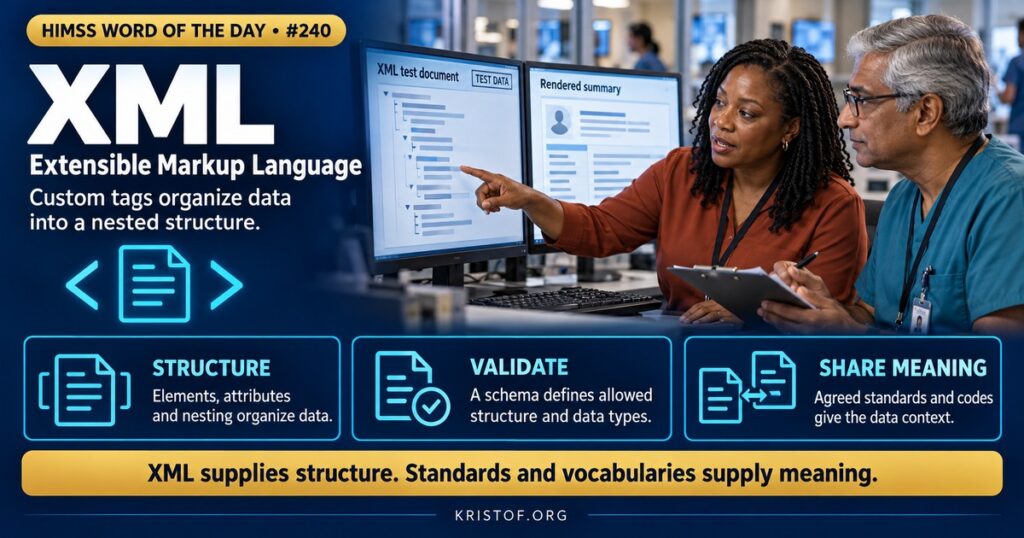
An XML document is plain text with a tree structure. Elements are written with start and end tags, attributes add properties to elements, and elements can nest inside one another. Because designers can define their own tags, XML can describe a patient, a prescription, or a claim. An XML schema, commonly written in XSD, describes which elements and attributes are allowed and what types of values they hold, so a receiving system can validate a document before using it.
| XML Feature | What It Does | Health IT Example |
|---|---|---|
| Element | Names a piece of data | A medication or allergy entry |
| Attribute | Adds detail to an element | A code and the code system it belongs to |
| Nesting | Shows hierarchy | Sections within a clinical document |
| Schema (XSD) | Defines valid structure | Validation of an exchanged document |
| Namespace | Prevents tag-name collisions | Mixing elements from different standards |
| Transformation (XSLT) | Converts XML to other formats | Rendering a document as readable text |
⚠️ Exam Alert: XML describes data structure, not meaning by itself. Meaning comes from the standard that defines the tags, such as CDA, and from coded vocabularies. HTML displays web pages with fixed tags, while XML allows custom tags. JSON is a lighter alternative commonly used by web APIs.
🌐 Why It Matters: Real-World Healthcare IT Context
XML became popular in health care because it solved a practical problem: two systems needed to share structured information without sharing software. A text format that humans can inspect and machines can validate was a good fit. Many standards are expressed in XML. HL7 CDA documents are XML, and so are CDISC Operational Data Model files used in clinical research. HL7 FHIR resources can be exchanged in XML or JSON, and the FHIR specification lists XML, JSON, and Turtle as formats for representing resources. A study on converting forms between clinical trial data capture and EHR systems described both ODM and CDA as XML-based and noted that conversion is feasible in principle but limited by differences in scope and design, including that CDA has a multilevel hierarchical structure whose nodes can contain both XML values and XML attributes.
The tradeoffs shaped the industry’s move toward newer formats. XML is verbose, with start and end tags repeating names, and parsing it can be heavy for mobile devices. JSON is more compact and maps directly to the objects in most programming languages, so it dominates modern web APIs, and FHIR implementations frequently favor it. Researchers describing the move to FHIR note that it builds on modern web technologies including HTTP, XML, and JSON. Even so, XML will remain in health care for a long time because existing document exchange, certified technology, and research standards depend on it, and migration costs are high.
Practical skills matter for informaticists. Reading a sample document to find where a medication code sits, checking whether a missing field is blank or absent, and confirming that a document validates against its schema are everyday tasks during interface testing. Understanding the difference between well-formed XML, which follows the syntax rules, and valid XML, which also follows a schema, helps teams diagnose why a file was rejected.
Security deserves attention. Parsers that process external entities or document type definitions from untrusted files can be tricked into reading local files or making network requests, an attack known as XML external entity injection. The OWASP cheat sheet on this topic recommends configuring parsers to disable these features. Documents received from outside a hospital should be handled like any other untrusted input: validated, size-limited, and parsed with safe settings. Documents also carry protected health information, so storage, logging, and transmission need the same safeguards as the EHR itself.
Common XML problems:
- Documents that are well formed but invalid under the schema
- Character encoding errors that corrupt names or symbols
- Different systems interpreting optional elements differently
- Large documents that overwhelm mobile or low-power devices
- Parsers left with external entity processing enabled
- Test files containing real patient information
What supports reliable XML exchange:
- Schema validation at both sending and receiving ends
- Agreed implementation guides and vocabularies, not only syntax
- Sample documents reviewed by clinicians and analysts
- Secure parser configuration and input limits
- De-identified test data
- A plan for supporting JSON and XML where both are needed
🏥 The Nurse’s Perspective: Clinical, Bedside, & Workflow
Nurses rarely read XML, but its structure determines what appears in outside records and shared documents.
At the Bedside
When a transfer summary arrives from another facility and a medication list looks incomplete, the cause may be a field that the sending system did not populate, or a code that the receiving system could not interpret. Nurses who describe exactly what is missing give analysts the clues needed to find the problem. A screenshot with the patient information protected is far more useful than a general complaint.
In Clinical Workflow
Nurse leaders who manage transitions of care can ask which fields are shared with partner organizations and in what form. Care managers who depend on outside documents benefit from knowing whether the data arrive as readable text only or as discrete data that the EHR can reconcile.
Nurse informaticists often take part in interface testing, comparing a sample document with the chart to confirm that allergies, medications, problems, and vitals map correctly. They also help decide which nursing content belongs in outgoing documents.
In EHR Implementation (Go-Live Perspective)
An Epic Go-Live includes testing of document exchange with outside organizations. Analysts examine sample files and rendered views side by side, and nurses validate that clinical content reads sensibly. At-the-elbow support analysts hear about odd display of outside information and report examples to interface teams, who can trace the cause back to the source document.
🎓 CAHIMS / CPHIMS & HIMSS Perspective
CAHIMS Exam Domain Mapping
XML appears in standards, data exchange, and technical foundations questions:
| CAHIMS Domain | How XML Appears |
|---|---|
| Healthcare & Technology Environments | W3C standards, HL7 CDA and FHIR formats |
| Clinical Informatics | Structured documents, coded data, document review |
| Healthcare Information & Systems Management | Parsing, schema validation, interfaces, secure handling |
| Management & Leadership | Standards selection, vendor requirements, migration planning |
Key Terms to Know Alongside XML
- SGML (Standard Generalized Markup Language) — parent markup standard from which XML is derived
- Schema (XSD) — definition of valid structure and data types for an XML document
- XSLT — language for transforming XML into other formats
- Well-Formed vs Valid — syntax correct versus conforming to a schema
- JSON — compact data format widely used by web APIs
- XXE (XML External Entity) — attack that abuses entity processing in XML parsers
HIMSS Organizational Position
HIMSS supports standards-based interoperability through its Interoperability and Health Information Exchange work, research, and education. Members can find related resources through the HIMSS Resource Center.
🔗 Explore Further: External References
- W3C — Extensible Markup Language (XML) 1.0 (Fifth Edition) https://www.w3.org/TR/xml/
- W3C — XML Technology https://www.w3.org/XML/
- HL7 — FHIR Resource Formats https://hl7.org/fhir/formats.html
- OWASP — XML External Entity Prevention Cheat Sheet https://cheatsheetseries.owasp.org/cheatsheets/XML_External_Entity_Prevention_Cheat_Sheet.html
- CDISC — Operational Data Model (ODM) https://www.cdisc.org/standards/data-exchange/odm
- Dugas (2015), BMC Medical Informatics and Decision Making — ODM2CDA and CDA2ODM: Tools to Convert Documentation Forms Between EDC and EHR Systems https://pubmed.ncbi.nlm.nih.gov/26004011/
Term source: HIMSS Dictionary of Health Information and Technology Terms, Acronyms, and Organizations, 6th Edition (2025). All definitions in this series are paraphrased for editorial purposes. Readers are encouraged to consult the primary source for exact language.
Eric Andrew Kristof, RN, CAHIMS is a Healthcare IT professional and HIMSS Arkansas Chapter member based in Hot Springs Village, AR, with hands-on Epic Go-Live experience and a diverse healthcare and IT background. He writes at kristof.org at the intersection of clinical care and healthcare technology.
Leave a Reply