By Eric Andrew Kristof, RN, CAHIMS | Healthcare IT Professional | HIMSS Arkansas Chapter Member
About This Series: The HIMSS Word of the Day is a running blog series drawing from the HIMSS Dictionary of Health Information and Technology Terms, Acronyms, and Organizations, 6th Edition (2025) — the authoritative reference for healthcare IT professionals and the primary study resource for CAHIMS and CPHIMS certification. Each post paraphrases the term in plain language, grounds it in real-world healthcare IT context, and adds a bedside nursing perspective you won’t find in a textbook.
📖 The Term: Unified Medical Language System (UMLS)
Source: HIMSS Dictionary of Health Information and Technology Terms, Acronyms, and Organizations, 6th Edition (2025)
🔍 Plain-Language Definition
The Unified Medical Language System (UMLS) is a set of resources from the National Library of Medicine (NLM) that brings together many biomedical vocabularies and provides tools for working with them. Its central idea is that different vocabularies often name the same concept in different ways, and software needs a way to know they are the same.
The HIMSS Dictionary explains that NLM produces the UMLS to help develop computer systems that behave as though they understand the language of biomedicine and health. It notes that NLM distributes the UMLS Knowledge Sources, which are databases, along with software tools that developers use to build or improve systems that create, process, retrieve, integrate, or aggregate biomedical and health information, and for informatics research.
| UMLS Component | What It Contains | How It Is Used |
|---|---|---|
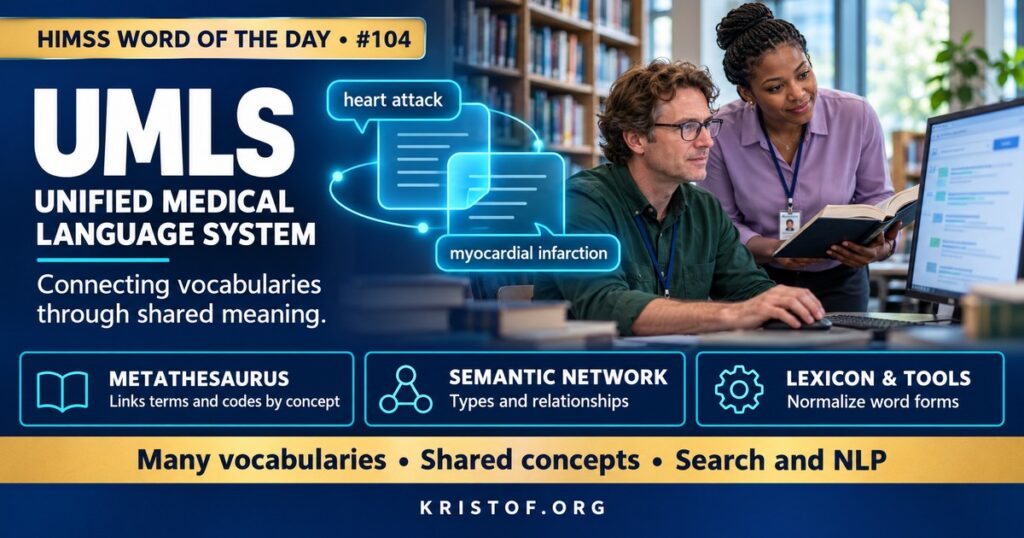
| Metathesaurus | Terms and codes from many source vocabularies, organized by concept | Linking synonyms across vocabularies, mapping, search |
| Semantic Network | Broad semantic types and the relationships among them | Categorizing concepts, such as disease or drug, for analysis |
| SPECIALIST Lexicon and Lexical Tools | English vocabulary and tools for handling word variation | Natural language processing, normalizing spelling and word forms |
| Concept Unique Identifier (CUI) | A UMLS identifier for a single concept | Recognizing that terms from different sources share one meaning |
⚠️ Exam Alert: The UMLS is a set of knowledge sources and tools that links vocabularies; it is not a single terminology used for clinical documentation. SNOMED CT, LOINC, RxNorm, and ICD-10-CM are source vocabularies included in it. RxNorm is itself produced by NLM and distributed with UMLS resources. A CUI is a UMLS concept identifier, distinct from the codes of the source vocabularies.
🌐 Why It Matters: Real-World Healthcare IT Context
Healthcare uses many vocabularies, each built for a different purpose: SNOMED CT for clinical documentation, ICD-10-CM for diagnosis classification, LOINC for lab tests, RxNorm for drugs, MeSH for indexing the biomedical literature, and many more. Systems that need to work across these vocabularies, such as search tools, research platforms, and natural language processing software, benefit from a resource that links equivalent concepts.
The Metathesaurus does that by grouping terms from different sources that mean the same thing under a single concept, while preserving each source’s own codes and relationships. A widely cited 2004 paper by Olivier Bodenreider in Nucleic Acids Research described the UMLS as a resource for integrating biomedical terminology and supporting a wide range of applications.
The UMLS is especially important for natural language processing. Clinical NLP tools often map words and phrases found in notes to UMLS concepts, then use semantic types to decide whether a concept is a disease, a drug, or a procedure. The Lexical Tools help normalize spelling variations and word forms so different ways of writing the same term can be recognized.
The UMLS also supports software developers through application programming interfaces and terminology services. Developers can look up concepts, retrieve synonyms, and navigate relationships without building their own copies of every vocabulary. Many EHR vendors and terminology service providers use UMLS content, along with other NLM resources such as RxNorm, as part of the reference data that powers search and mapping in clinical systems.
Access requires a free UMLS license from NLM, because some source vocabularies carry their own license terms. Users are responsible for complying with the restrictions of the sources they use, including SNOMED CT’s licensing in different countries.
What the UMLS is good for:
- Finding synonyms and equivalent concepts across vocabularies
- Supporting terminology mapping projects
- Powering clinical NLP and information retrieval
- Categorizing concepts with semantic types for research
- Building search tools for clinicians and researchers
- Exploring relationships among biomedical concepts
Limitations to keep in mind:
- Concept groupings are not perfect clinical maps for every purpose
- Source vocabularies differ in scope, granularity, and update cycles
- License obligations vary by source vocabulary
- It is not intended as a documentation terminology for clinicians
- Mappings for billing or quality reporting need purpose-built tools and review
- Regular updates require systems to refresh their UMLS data
🏥 The Nurse’s Perspective: Clinical, Bedside, & Workflow
Nurses rarely interact with the UMLS directly, but it influences tools that read and organize clinical information.
At the Bedside
Search features in clinical systems may rely on synonym data so that a nurse searching for “heart attack” also finds results coded as myocardial infarction. When a search returns unexpected or missing results, reporting the search terms helps teams improve synonym lists.
Natural language processing tools that summarize notes or flag conditions mentioned in text often use UMLS concepts behind the scenes. Nurses reviewing AI-generated summaries should remember that these tools can misinterpret abbreviations or context, such as negation.
Literature searches benefit from the same idea. MeSH, the vocabulary used to index biomedical literature, is one of the UMLS source vocabularies, and understanding how concepts are organized can help nurses run more effective evidence searches.
In Clinical Workflow
Nursing terminologies are part of the broader terminology landscape that resources like the UMLS help connect. Including standardized nursing terms in shared resources makes nursing concepts more visible in research and analytics that span disciplines.
Nurse researchers and informaticists may use UMLS resources directly when designing studies, building search strategies, or mapping local nursing documentation to standard concepts.
Research nurses who build cohorts from EHR data may also use UMLS-based tools to identify all the codes that represent a condition, helping studies capture patients consistently across vocabularies.
In EHR Implementation (Go-Live Perspective)
During an Epic implementation, terminology teams may use UMLS and related NLM resources when mapping legacy local terms to standard vocabularies, especially for problems, allergies, and medications. Accurate mapping preserves the meaning of historical data in the new system.
At-the-elbow support analysts may hear that a search term does not find an expected diagnosis or problem. Capturing the exact words users typed helps terminology teams add synonyms so future searches succeed.
🎓 CAHIMS / CPHIMS & HIMSS Perspective
CAHIMS Exam Domain Mapping
The UMLS appears in terminology and standards questions:
| CAHIMS Domain | How the UMLS Appears |
|---|---|
| Healthcare & Technology Environments | National Library of Medicine resources; terminology landscape |
| Clinical Informatics | Search, NLP, and terminology support for clinical tools |
| Healthcare Information & Systems Management | Metathesaurus, CUIs, semantic types, mapping, licensing |
| Management & Leadership | Terminology strategy, licensing compliance, research infrastructure |
Key Terms to Know Alongside UMLS
- Metathesaurus — the UMLS component that links terms and codes from many vocabularies by concept
- Semantic Network — the UMLS set of broad semantic types and relationships
- SPECIALIST Lexicon — an English lexicon with tools to normalize word forms for language processing
- Concept Unique Identifier (CUI) — the UMLS identifier for a single meaning shared across vocabularies
- Source Vocabulary — an individual terminology or code set included in the UMLS
- RxNorm — NLM’s normalized naming system for clinical drugs
HIMSS Organizational Position
HIMSS supports the use of standard terminologies and the resources that connect them as a foundation for semantic interoperability, analytics, and AI. Members can find related education and research through the HIMSS Resource Center.
🔗 Explore Further: External References
- NLM — Unified Medical Language System (UMLS) https://www.nlm.nih.gov/research/umls/index.html
- NLM — UMLS Metathesaurus https://www.nlm.nih.gov/research/umls/knowledge_sources/metathesaurus/index.html
- NLM — UMLS Source Vocabulary Documentation https://www.nlm.nih.gov/research/umls/sourcereleasedocs/index.html
- NLM — Lexical Tools https://lhncbc.nlm.nih.gov/LSG/Projects/lvg/current/web/index.html
- Bodenreider (2004), Nucleic Acids Research — The Unified Medical Language System (UMLS): Integrating Biomedical Terminology https://pubmed.ncbi.nlm.nih.gov/14681409/
- NLM — RxNorm https://www.nlm.nih.gov/research/umls/rxnorm/index.html
Term source: HIMSS Dictionary of Health Information and Technology Terms, Acronyms, and Organizations, 6th Edition (2025). All definitions in this series are paraphrased for editorial purposes. Readers are encouraged to consult the primary source for exact language.
Eric Andrew Kristof, RN, CAHIMS is a Healthcare IT professional and HIMSS Arkansas Chapter member based in Hot Springs Village, AR, with hands-on Epic Go-Live experience and a diverse healthcare and IT background. He writes at kristof.org at the intersection of clinical care and healthcare technology.
Leave a Reply