By Eric Andrew Kristof, RN, CAHIMS | Healthcare IT Professional | HIMSS Arkansas Chapter Member
About This Series: The HIMSS Word of the Day is a running blog series drawing from the HIMSS Dictionary of Health Information and Technology Terms, Acronyms, and Organizations, 6th Edition (2025) — the authoritative reference for healthcare IT professionals and the primary study resource for CAHIMS and CPHIMS certification. Each post paraphrases the term in plain language, grounds it in real-world healthcare IT context, and adds a bedside nursing perspective you won’t find in a textbook.
📖 The Term: UMDNS (Universal Medical Device Nomenclature System)
Source: HIMSS Dictionary of Health Information and Technology Terms, Acronyms, and Organizations, 6th Edition (2025)
🔍 Plain-Language Definition
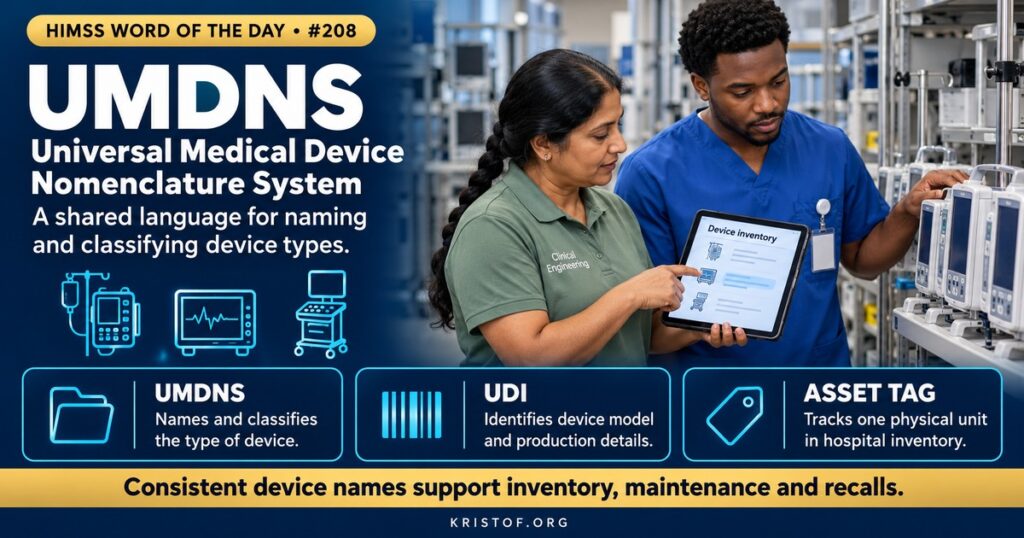
The Universal Medical Device Nomenclature System (UMDNS) is a standard terminology for naming and classifying medical devices. According to the HIMSS Dictionary, its purpose is to make it easier to identify, process, file, store, retrieve, transfer, and communicate data about medical devices.
The dictionary notes that the nomenclature is used across a wide range of applications, from hospital inventory and work order control to national medical device regulatory systems, and from electronic commerce and procurement to device databases. UMDNS is maintained by ECRI, and the National Library of Medicine includes it as one of the source vocabularies in the Unified Medical Language System.
| Device Identification Concept | What It Provides | Example |
|---|---|---|
| Device Nomenclature (UMDNS, GMDN) | A standard name and code for a type of device | “Pumps, Infusion” as a category of device |
| Unique Device Identifier (UDI) | Identifier for a specific device model and production data | Barcode on a device label |
| Manufacturer Model Number | Vendor’s product identification | A catalog or model number |
| Asset Tag | Hospital’s own number for a physical unit | Biomedical engineering inventory number |
| FDA Product Code | Regulatory classification used by the FDA | Classification for premarket review |
⚠️ Exam Alert: A nomenclature such as UMDNS names types of devices. A UDI identifies a specific device model and its production details. An asset tag identifies one physical item in a hospital. All three can appear on the same pump, each answering a different question.
🌐 Why It Matters: Real-World Healthcare IT Context
Medical devices are everywhere in a hospital, and the same device can be called many things. One department’s “IV pump” is another’s “infusion pump” or “volumetric pump,” and a supplier may use a third name. Without a shared language, inventory counts mislead, recalls are hard to match to equipment, and data from different sources cannot be combined.
A nomenclature fixes this by defining preferred names, synonyms, and codes for device types in a structured way. UMDNS was created to support exactly that, and it has been used by clinical engineering departments, regulators, purchasing organizations, and device databases. Because the National Library of Medicine includes UMDNS as a source vocabulary in the Unified Medical Language System, researchers and developers can also connect device terms to other biomedical vocabularies.
UMDNS is one of several systems. The Global Medical Device Nomenclature (GMDN) is based on the international standard ISO 15225, and UMDNS was among the nomenclatures that informed its development. The two overlap in history but are separate systems with different maintainers, and some regulators and databases favor one or the other. Organizations that buy, track, or report on devices across borders often need mappings between nomenclatures.
A 2025 paper on Indonesia’s device nomenclature work illustrates the practical challenge. The authors compared national standards with the World Health Organization’s MeDevIS platform, which incorporates GMDN and the European Medical Device Nomenclature, and found gaps in metadata coverage, such as whether a device is reusable or single use and what population it is meant for. They concluded that a unified, standardized nomenclature would improve device identification across the device lifecycle. The same argument applies to any health system with several naming conventions.
Device identification in the United States also relies on the Unique Device Identifier system, in which labelers submit device information to the FDA’s Global Unique Device Identification Database, accessible to the public through AccessGUDID. Nomenclatures and UDI complement each other: a nomenclature describes what kind of device something is, while UDI identifies a specific model and its production attributes.
Common uses include equipment inventory and asset management, preventive maintenance scheduling, work order tracking, recall and safety alert matching, procurement and contracting comparisons, cost and utilization analysis, and reporting of device-related adverse events. Clinical engineering teams typically manage these processes, and informatics teams help connect device data to clinical systems.
Adopting a nomenclature takes governance. Organizations choose a standard, map existing inventory to it, keep it current as new devices arrive, and train staff to enter data consistently.
Common device identification problems:
- Different names for the same device across departments
- Inventory records that cannot be matched to recall notices
- No mapping between nomenclatures used by different partners
- Free-text device names in procurement systems
- Confusion between device type, model, and individual unit
- Outdated mappings after new products arrive
What supports reliable device identification:
- A chosen standard nomenclature with mappings
- UDI capture alongside asset tags
- Shared definitions between clinical engineering, supply chain, and informatics
- Recall workflows linked to the inventory
- Governance for adding new device types
- Staff training on consistent naming
🏥 The Nurse’s Perspective: Clinical, Bedside, & Workflow
Nurses do not code devices, yet standard device names affect safety and workflow in several ways.
At the Bedside
When a recall or safety alert arrives, clinical engineering must find affected devices quickly. Accurate, consistent inventory records make that possible. Nurses help by reporting device problems with the asset tag, model, and location rather than informal names.
Labels and barcodes on devices, including UDI, help staff and systems identify exactly what is in use, especially for implants and single-use items.
In Clinical Workflow
Equipment searches and requests, such as asking for a specific type of pump, work better when systems and departments share names. Location tags and equipment tracking tools depend on those names too.
Device-related events should be reported with enough detail for clinical engineering to link them to a device type and model, which supports trending and regulatory reporting.
Nurse informaticists contribute by reviewing how devices appear in clinical systems, such as device lists in documentation, and by making sure terminology matches what clinicians use and what equipment inventory records contain.
In EHR Implementation (Go-Live Perspective)
An Epic Go-Live involves integrating monitors, pumps, ventilators, and other devices, and building lists of equipment used in documentation. Consistent device naming helps analysts map each device type to the correct interface and flowsheet.
At-the-elbow support analysts help nurses with device-related documentation, and they pass along device identification problems to clinical engineering so records can be corrected.
🎓 CAHIMS / CPHIMS & HIMSS Perspective
CAHIMS Exam Domain Mapping
Device nomenclature appears in standards, infrastructure, and management questions:
| CAHIMS Domain | How UMDNS Appears |
|---|---|
| Healthcare & Technology Environments | Terminology standards, regulatory identification of devices |
| Clinical Informatics | Device data in clinical systems, safety event reporting |
| Healthcare Information & Systems Management | Asset management, inventory systems, mappings between nomenclatures |
| Management & Leadership | Procurement, recalls, lifecycle management, vendor requirements |
Key Terms to Know Alongside UMDNS
- GMDN — Global Medical Device Nomenclature, based on ISO 15225
- Unique Device Identifier (UDI) — identifier system for medical device models and production information
- AccessGUDID — public access to FDA’s Global Unique Device Identification Database
- Clinical Engineering — department that manages, maintains, and secures medical technology
- Unified Medical Language System (UMLS) — NLM resource that links biomedical vocabularies
- Recall — action to remove or correct a device that poses a risk
HIMSS Organizational Position
HIMSS supports standards-based identification and exchange of health information, including device data, through its education, interoperability work, and communities. Members can find related resources through the HIMSS Resource Center.
🔗 Explore Further: External References
- NLM — UMLS Source Vocabulary Documentation: UMDNS https://www.nlm.nih.gov/research/umls/sourcereleasedocs/current/UMD/index.html
- ECRI https://www.ecri.org/
- GMDN Agency https://www.gmdnagency.org/
- FDA — Unique Device Identification System https://www.fda.gov/medical-devices/device-advice-comprehensive-regulatory-assistance/unique-device-identification-system-udi-system
- NLM — AccessGUDID https://accessgudid.nlm.nih.gov/
- Prasetyawati et al. (2025), Studies in Health Technology and Informatics — Indonesia’s Initiatives in Implementing Medical Device Nomenclature Standards: Current Gaps with Global Standards https://pubmed.ncbi.nlm.nih.gov/40775822/
Term source: HIMSS Dictionary of Health Information and Technology Terms, Acronyms, and Organizations, 6th Edition (2025). All definitions in this series are paraphrased for editorial purposes. Readers are encouraged to consult the primary source for exact language.
Eric Andrew Kristof, RN, CAHIMS is a Healthcare IT professional and HIMSS Arkansas Chapter member based in Hot Springs Village, AR, with hands-on Epic Go-Live experience and a diverse healthcare and IT background. He writes at kristof.org at the intersection of clinical care and healthcare technology.
Leave a Reply