By Eric Andrew Kristof, RN, CAHIMS | Healthcare IT Professional | HIMSS Arkansas Chapter Member
About This Series: The HIMSS Word of The Day is a running blog series drawing from the HIMSS Dictionary of Health Information and Technology Terms, Acronyms, and Organizations, 6th Edition (2025) — the authoritative reference for healthcare IT professionals and the primary study resource for CAHIMS and CPHIMS certification. Each post paraphrases the term in plain language, grounds it in real-world healthcare IT context, and adds a bedside nursing perspective you won’t find in a textbook.
📖 The Term: Nomophobia
Source: HIMSS Dictionary of Health Information and Technology Terms, Acronyms, and Organizations, 6th Edition (2025)
🔍 Plain-Language Definition
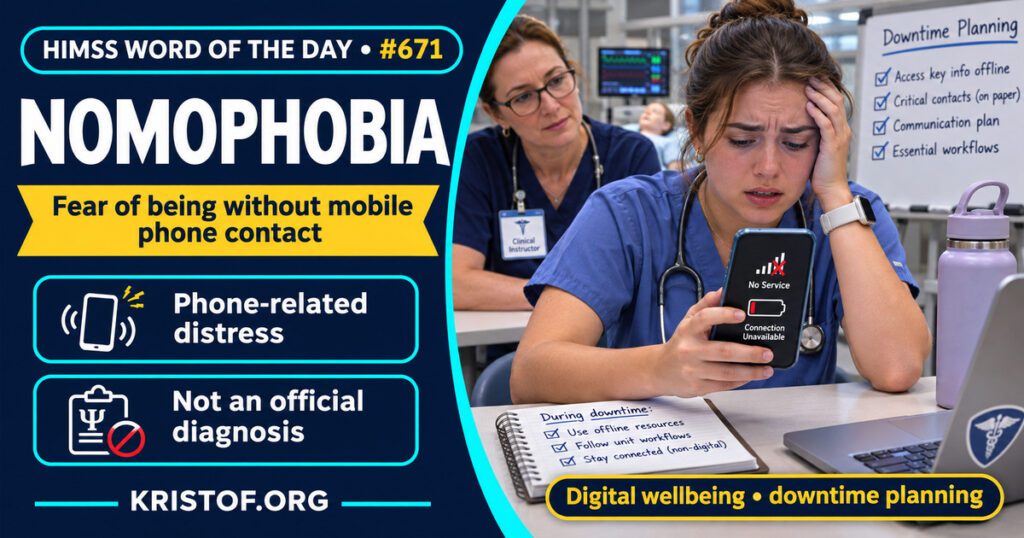
The HIMSS Dictionary describes nomophobia as a psychological syndrome involving fear of being out of mobile phone contact. The name is a shortened form of “no mobile phone phobia.” The dictionary says the word came out of a research study on the psychological effects and stress of mobile phone use, and that it describes how much fear a person feels when unable to communicate by phone.
The research literature is more cautious about the label. Al-Mamun and colleagues (2025) describe nomophobia as discomfort or anxiety experienced when people cannot use or access their mobile phones, state that it is not formally recognized in the DSM-5 or ICD-11, and note ongoing debate about whether it is an anxiety disorder. I could not verify the dictionary’s account of how the word was coined, and a 2021 review says only that the term was coined in the first decade of the 21st century.
| Element | What it means | Source |
|---|---|---|
| Trigger | Being unable to use or reach a mobile phone | Dictionary and Al-Mamun et al. |
| Measurement | Self-report scales, mainly the Nomophobia Questionnaire (NMP-Q) | Rodriguez-Garcia et al. and Al-Mamun et al. |
| Status | Not formally recognized in the DSM-5 or ICD-11 | Al-Mamun et al. |
| Related term | Phubbing, using a phone in situations where it is not appropriate | Sahin Karaduman et al. |
⚠️ Exam Alert: Nomophobia is a descriptive term for phone-related distress, not an official diagnosis. Keep it separate from phubbing (using a phone inappropriately in a social setting) and from clinical anxiety disorders. Scores on a questionnaire reflect self-reported distress, not a clinical diagnosis.
🌐 Why It Matters: Real-World Healthcare IT Context
How common is it? Al-Mamun and colleagues (2025) meta-analyzed 43 studies with 36,656 participants from 18 countries, including only studies that used validated self-report instruments, mainly the NMP-Q. They report that 26 percent of participants had mild symptoms, 51 percent moderate, and 21 percent severe, that prevalence was higher among university students and young adults, and that results varied widely across regions and instruments. They stress that these figures reflect self-reported distress, not clinical diagnoses. Leon-Mejia and colleagues (2021) systematically reviewed 108 studies and found enormous disparity: the share of participants classed as at risk ranged from 13 to 79 percent, and those described as suffering from it from 6 to 73 percent, which they attribute to differences in assessment criteria. They report that women and younger people appeared more vulnerable, but that methodological differences make firm conclusions difficult.
What kind of evidence is it? Rodriguez-Garcia and colleagues (2020) reviewed 42 studies and found that research was in an exploratory phase, mostly descriptive, nonexperimental, and cross-sectional, with adolescents and university students most often studied. The review concludes that nomophobia negatively affects personality, self-esteem, anxiety, stress, and academic performance. Cross-sectional studies can show association but not cause, so that conclusion goes further than the study designs it describes.
Nursing students. Aslani and colleagues (2025) surveyed 407 nursing students in Hamedan Province, Iran, using the NMP-Q, with convenience sampling. The mean score was 73.8 out of 140, and 72 percent had moderate to severe nomophobia. Severity was associated with educational level, grade point average, and smartphone checking frequency. Sahin Karaduman and colleagues (2024) studied 446 nursing students in Turkey, Portugal, and the United States and found moderate mean scores in all three countries, with mean totals of 80.15, 72.29, and 99.65 respectively, and phubbing scores below the level indicating addiction. The abstract does not give per-country sample sizes, so I would not compare the countries closely. Guillari and colleagues (2026) conducted an integrative review of 22 studies on nursing students, 19 of them cross-sectional, and report that 50 to 90 percent of students had moderate to severe levels, with correlates including anxiety, depression, stress, insomnia, and impaired academic performance. They note significant gaps in longitudinal and intervention evidence.
What I could not confirm. I did not find studies of practicing nurses or of nomophobia in clinical workflow, so the nursing findings concern students. I could not verify the dictionary’s account of where the term came from. The studies rely on self-report questionnaires and mostly on convenience samples, so prevalence figures depend on the cutoffs used. I read abstracts only, and none of them reports whether any intervention reduces nomophobia.
Common nomophobia problems:
- Treating nomophobia as an official diagnosis
- Reading a questionnaire score as a clinical assessment
- Comparing prevalence across studies that used different scales and cutoffs
- Assuming student findings apply to practicing clinicians
- Reading association as cause
What supports sound use of the term:
- Stating that it describes self-reported distress
- Naming the instrument and cutoffs used
- Separating nomophobia from phubbing and from anxiety disorders
- Using longitudinal and intervention studies, when they exist, before drawing conclusions
- Reporting the population studied
🏥 The Nurse’s Perspective: Clinical, Bedside, & Workflow
The evidence concerns nursing students, so what follows is about education and about policy, not about practicing nurses.
At the Bedside
None of the studies reviewed examined bedside nursing practice. Organizations set their own rules on personal phone use during care. The research does not say what those rules should be.
In Clinical Workflow
Guillari and colleagues (2026) link nomophobia in nursing students with impaired academic and clinical performance in the studies they reviewed, based mostly on cross-sectional data. Nurse educators and managers can read this as a reason to ask about phone use in learning environments, while recognizing that the evidence shows association, not cause.
In EHR Implementation (Go-Live Perspective)
During an Epic Go-Live, mobile devices become part of the workflow for some roles. Analysts and at-the-elbow support staff may see strong reactions when a device is unavailable or fails. That is a workflow observation, and no study reviewed here measures it. Planning for device failures is a sensible precaution, though these studies did not test it.
🎓 CAHIMS / CPHIMS & HIMSS Perspective
CAHIMS Exam Domain Mapping
Nomophobia appears at the edge of mobile technology and user wellbeing:
| CAHIMS Domain | How Nomophobia Appears |
|---|---|
| Healthcare & Technology Environments | Mobile devices and their role in daily work and learning |
| Clinical Informatics | Mobile health tools, patient-facing apps, and user behavior |
| Healthcare Information & Systems Management | Device policy, mobile device management, and downtime planning |
| Management & Leadership | Workforce wellbeing, education, and technology use policy |
Key Terms to Know Alongside Nomophobia
- Phubbing — using a smartphone in situations where doing so is not appropriate for the time and place
- Nomophobia Questionnaire (NMP-Q) — a self-report scale commonly used to measure nomophobia
- Mobile health (mHealth) — the use of mobile devices to support health care and public health
- Mobile device management — tools and policies for administering organization-managed mobile devices
- Digital wellbeing — the effect of technology use on a person’s health and balance
- Downtime procedures — plans for continuing work when systems or devices are unavailable
HIMSS Organizational Position
HIMSS offers education and research on health information and technology topics through its Resource Center. Members can find related information on the HIMSS Resource Center page.
🧭 More HIMSS Word of The Day Terms
Related terms in the Connected Health series:
Browse all Connected Health terms or the A–Z glossary.
🔗 Explore Further: External References
- Al-Mamun et al. (2025), Psychiatry Research — The prevalence of nomophobia: A systematic review and meta-analysis https://pubmed.ncbi.nlm.nih.gov/40334351/
- Leon-Mejia et al. (2021), PLoS One — A systematic review on nomophobia prevalence: Surfacing results and standard guidelines for future research https://pubmed.ncbi.nlm.nih.gov/34003860/
- Rodriguez-Garcia et al. (2020), International Journal of Environmental Research and Public Health — Nomophobia: An Individual’s Growing Fear of Being without a Smartphone-A Systematic Literature Review https://pubmed.ncbi.nlm.nih.gov/31963208/
- Aslani et al. (2025), Scientific Reports — Nomophobia among nursing students: prevalence and associated factors https://pubmed.ncbi.nlm.nih.gov/39747335/
- Sahin Karaduman et al. (2024), Computers, Informatics, Nursing — Nomophobia and Phubbing Levels of Nursing Students: A Multicenter Study https://pubmed.ncbi.nlm.nih.gov/38832877/
- Guillari et al. (2026), Healthcare — Nomophobia in Nursing Students: Psychological, Academic, and Clinical Impacts-An Integrative Review https://pubmed.ncbi.nlm.nih.gov/41975832/
- HIMSS — Resource Center https://www.himss.org/resource-center
Term source: HIMSS Dictionary of Health Information and Technology Terms, Acronyms, and Organizations, 6th Edition (2025). All definitions in this series are paraphrased for editorial purposes. Readers are encouraged to consult the primary source for exact language.
Eric Andrew Kristof, RN, CAHIMS is a Healthcare IT professional and HIMSS Arkansas Chapter member based in Hot Springs Village, AR, with hands-on Epic Go-Live experience and a diverse healthcare and IT background. He writes at kristof.org at the intersection of clinical care and healthcare technology.
Leave a Reply