By Eric Andrew Kristof, RN, CAHIMS | Healthcare IT Professional | HIMSS Arkansas Chapter Member
About This Series: The HIMSS Word of the Day is a running blog series drawing from the HIMSS Dictionary of Health Information and Technology Terms, Acronyms, and Organizations, 6th Edition (2025) — the authoritative reference for healthcare IT professionals and the primary study resource for CAHIMS and CPHIMS certification. Each post paraphrases the term in plain language, grounds it in real-world healthcare IT context, and adds a bedside nursing perspective you won’t find in a textbook.
📖 The Term: Administrative Safeguards (HIPAA)
Source: HIMSS Dictionary of Health Information and Technology Terms, Acronyms, and Organizations, 6th Edition (2025)
🔍 Plain-Language Definition
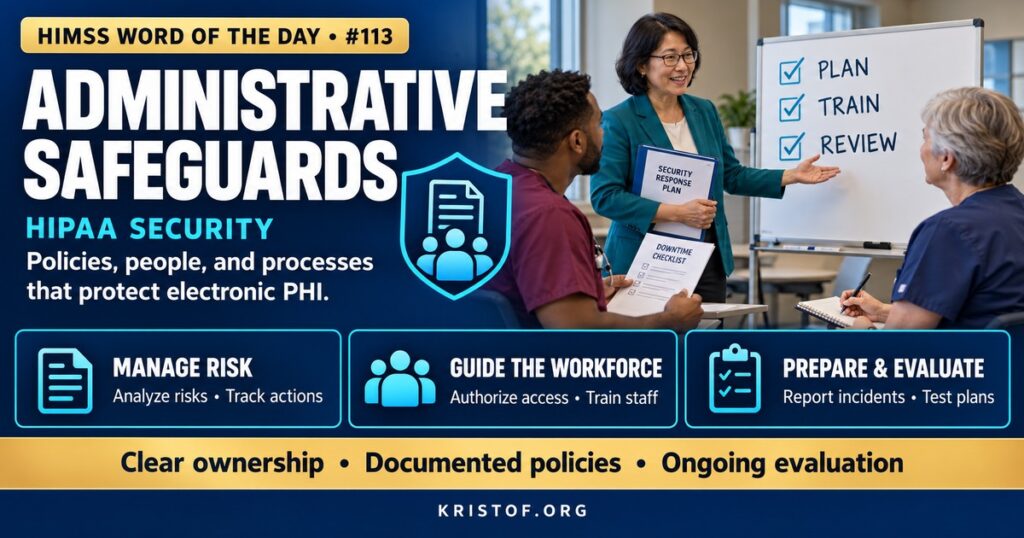
Administrative safeguards are the management actions, policies, and procedures that the HIPAA Security Rule requires to protect electronic protected health information (ePHI). They cover how an organization selects and maintains security measures and how it manages its workforce’s conduct in protecting that information.
The HIMSS Dictionary describes administrative safeguards as the actions, policies, and procedures used to choose, build, put in place, and keep up the security measures protecting ePHI, and to manage the conduct of a workforce of a covered entity or business associate in protecting that information.
The Security Rule organizes administrative safeguards into standards, each with implementation specifications:
| Standard | What It Requires | Examples of Specifications |
|---|---|---|
| Security Management Process | Prevent, detect, contain, and correct security violations | Risk analysis, risk management, sanction policy, information system activity review |
| Assigned Security Responsibility | Designate a security official | A named security officer |
| Workforce Security | Ensure appropriate workforce access | Authorization and supervision, clearance procedures, termination procedures |
| Information Access Management | Authorize access to ePHI | Access authorization, establishment, and modification |
| Security Awareness and Training | Train the workforce | Security reminders, malware protection, log-in monitoring, password management |
| Security Incident Procedures | Identify and respond to incidents | Response and reporting |
| Contingency Plan | Prepare for emergencies | Data backup, disaster recovery, emergency mode operation, testing, criticality analysis |
| Evaluation | Periodically evaluate security | Technical and nontechnical evaluations |
| Business Associate Contracts | Obtain assurances from vendors | Written contracts or other arrangements |
⚠️ Exam Alert: HIPAA’s Security Rule has three safeguard categories: administrative, physical, and technical. Administrative safeguards are the largest group and start with the risk analysis. Implementation specifications are either required or addressable; addressable does not mean optional, it means the organization must assess whether the specification is reasonable and appropriate, implement it or an equivalent alternative, and document the decision.
🌐 Why It Matters: Real-World Healthcare IT Context
Administrative safeguards are the foundation for everything else in HIPAA security. The risk analysis identifies threats and vulnerabilities to ePHI, which drives decisions about technical controls, physical protections, and policies. Without an accurate, current risk analysis, organizations cannot show that their safeguards are reasonable.
Enforcement reflects that. HHS resolution agreements and penalties frequently cite failures to conduct an accurate and thorough risk analysis, to implement risk management, or to review system activity. HHS provides guidance on risk analysis, and NIST’s SP 800-66 offers detailed implementation guidance for the Security Rule.
Workforce safeguards address the human side of security. Access should be authorized based on job need, modified when roles change, and terminated promptly when people leave. Sanction policies apply consequences to workforce members who violate policies. Training and reminders help staff recognize phishing, protect passwords, and report incidents.
Evaluation keeps safeguards current. The Security Rule requires periodic technical and nontechnical evaluations to confirm that policies and controls still meet requirements, particularly after environmental or operational changes such as new systems, mergers, or major workflow changes. Many organizations combine internal audits with third-party assessments to provide an independent view of their security posture.
Contingency planning connects HIPAA to business continuity. Organizations must be able to back up and restore ePHI, operate in emergency mode, and test their plans, lessons that ransomware attacks have made painfully clear.
The Security Rule has remained largely stable since its original publication, but HHS proposed significant updates in early 2025, including changes to how addressable specifications are treated and more specific requirements for risk analysis and asset inventories. Organizations should follow the current regulatory status closely.
Common administrative safeguard gaps:
- Risk analyses that are outdated, incomplete, or never performed
- Risk management plans that are not carried out
- Access not removed promptly when staff leave
- Training that is generic and infrequent
- Incident procedures staff do not know how to use
- Contingency plans that have never been tested
Practices that strengthen administrative safeguards:
- An enterprise-wide risk analysis updated regularly and after major changes
- A tracked risk management plan with owners and deadlines
- Automated provisioning and deprovisioning tied to HR systems
- Role-specific, recurring security training and phishing exercises
- Clear, easy incident reporting channels
- Regular contingency plan testing and documented evaluations
🏥 The Nurse’s Perspective: Clinical, Bedside, & Workflow
Nurses participate in administrative safeguards through training, access, incident reporting, and downtime readiness.
At the Bedside
Annual security and privacy training, phishing simulations, and security reminders are administrative safeguards in action. They help nurses recognize suspicious emails, protect their credentials, and avoid risky practices such as sharing logins or using personal devices for patient information.
When something seems wrong, such as a suspicious message, a lost device, or a chart accessed by mistake, reporting it promptly through the incident process allows the organization to investigate and respond.
Sanction policies apply to everyone. When workforce members violate privacy or security policies, such as snooping in records or sharing passwords, organizations must apply consistent consequences, which reinforces that safeguards are taken seriously.
Security awareness reminders, such as periodic messages about phishing or password practices, are part of the training standard. Short, relevant reminders tied to real incidents tend to stick better than annual modules alone.
In Clinical Workflow
Access changes when nurses change roles, units, or employers. Prompt removal of access when a nurse leaves, and adjustment when duties change, protects patients and the nurse. Managers often confirm access during periodic reviews.
Downtime procedures are part of the contingency plan. Knowing how to access downtime reports, use paper forms, and recover documentation afterward ensures care continues safely when systems are unavailable.
In EHR Implementation (Go-Live Perspective)
During an Epic Go-Live, administrative safeguards appear as security training, access provisioning, updated policies, and refreshed downtime procedures. A risk analysis update is typically warranted when a major system changes.
At-the-elbow support analysts reinforce these safeguards by never sharing credentials, routing access requests through proper channels, and directing users to report suspected incidents. Their example helps establish secure habits from the first day.
🎓 CAHIMS / CPHIMS & HIMSS Perspective
CAHIMS Exam Domain Mapping
Administrative safeguards are a core HIPAA security topic:
| CAHIMS Domain | How Administrative Safeguards Appear |
|---|---|
| Healthcare & Technology Environments | HIPAA Security Rule structure; enforcement trends; proposed updates |
| Clinical Informatics | Workforce training, access practices, downtime procedures |
| Healthcare Information & Systems Management | Risk analysis, activity review, incident response, contingency planning |
| Management & Leadership | Security official role, sanction policies, evaluations, business associate oversight |
Key Terms to Know Alongside Administrative Safeguards
- Risk Analysis — an accurate and thorough assessment of risks and vulnerabilities to ePHI
- Physical Safeguards — measures protecting facilities, workstations, and devices
- Technical Safeguards — technology controls such as access control, audit controls, and encryption
- Addressable Specification — a requirement the organization must assess and implement or document an equivalent alternative
- Sanction Policy — consequences applied to workforce members who violate security policies
- Contingency Plan — procedures for responding to emergencies that damage systems containing ePHI
HIMSS Organizational Position
HIMSS addresses administrative safeguards through its cybersecurity and privacy work, including its Healthcare Cybersecurity Community, and engages on HIPAA Security Rule policy through its public policy efforts. Members can find related education and research through the HIMSS Resource Center.
🔗 Explore Further: External References
- eCFR — 45 CFR 164.308, Administrative Safeguards https://www.ecfr.gov/current/title-45/subtitle-A/subchapter-C/part-164/subpart-C/section-164.308
- HHS — Summary of the HIPAA Security Rule https://www.hhs.gov/hipaa/for-professionals/security/laws-regulations/index.html
- HHS — Guidance on Risk Analysis https://www.hhs.gov/hipaa/for-professionals/security/guidance/guidance-risk-analysis/index.html
- NIST — SP 800-66 Rev. 2, Implementing the HIPAA Security Rule https://csrc.nist.gov/pubs/sp/800/66/r2/final
- HHS — Resolution Agreements https://www.hhs.gov/hipaa/for-professionals/compliance-enforcement/agreements/index.html
- HHS 405(d) Program — Health Industry Cybersecurity Practices https://405d.hhs.gov/
Term source: HIMSS Dictionary of Health Information and Technology Terms, Acronyms, and Organizations, 6th Edition (2025). All definitions in this series are paraphrased for editorial purposes. Readers are encouraged to consult the primary source for exact language.
Eric Andrew Kristof, RN, CAHIMS is a Healthcare IT professional and HIMSS Arkansas Chapter member based in Hot Springs Village, AR, with hands-on Epic Go-Live experience and a diverse healthcare and IT background. He writes at kristof.org at the intersection of clinical care and healthcare technology.
Leave a Reply