By Eric Andrew Kristof, RN, CAHIMS | Healthcare IT Professional | HIMSS Arkansas Chapter Member
About This Series: The HIMSS Word of the Day is a running blog series drawing from the HIMSS Dictionary of Health Information and Technology Terms, Acronyms, and Organizations, 6th Edition (2025) — the authoritative reference for healthcare IT professionals and the primary study resource for CAHIMS and CPHIMS certification. Each post paraphrases the term in plain language, grounds it in real-world healthcare IT context, and adds a bedside nursing perspective you won’t find in a textbook.
📖 The Term: Consent (HIPAA)
Source: HIMSS Dictionary of Health Information and Technology Terms, Acronyms, and Organizations, 6th Edition (2025)
🔍 Plain-Language Definition
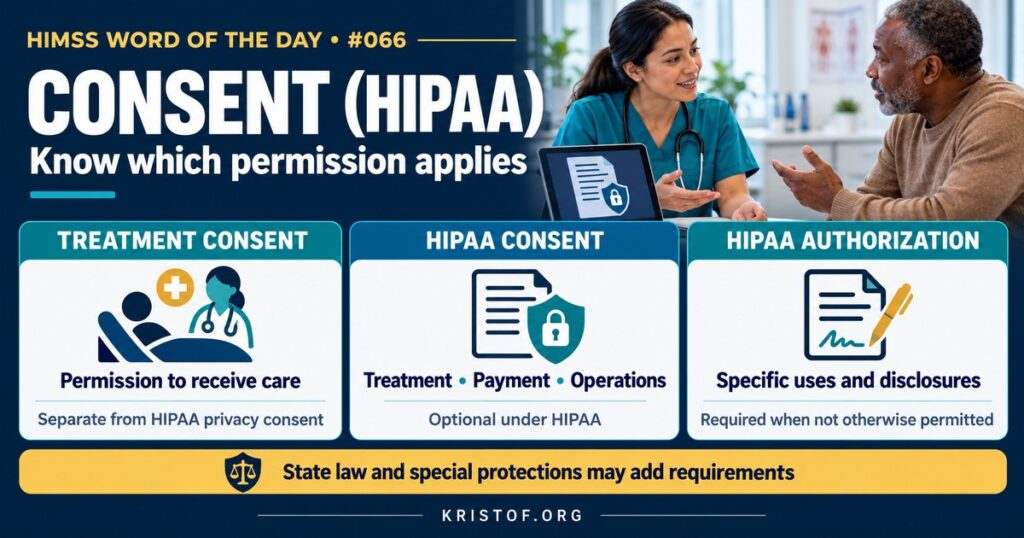
In health information privacy, consent is a patient’s permission for a healthcare organization to use and share their health information. Under HIPAA, the term has a specific and somewhat surprising meaning.
The HIMSS Dictionary explains that, under the HIPAA Privacy Rule, consent is a person’s permission for a covered entity to use or share identifiable information solely for treatment, payment, and health care operations. It distinguishes this from consent for treatment, the permission patients give to receive care, and cautions against confusing the two. The Dictionary adds that HIPAA makes this kind of privacy consent optional, although state law may require it, and the two may be bundled into one form unless another law forbids it.
HHS guidance confirms the key point: the Privacy Rule permits, but does not require, covered entities to obtain consent for treatment, payment, and health care operations. By contrast, an authorization is required for uses and disclosures that the rule does not otherwise permit.
| Document | What It Covers | Required by HIPAA? |
|---|---|---|
| Consent for Treatment | Permission to receive care, procedures, or services | No; governed by medical and state law |
| HIPAA Consent (TPO) | Permission to use and disclose information for treatment, payment, and health care operations | No; optional, but may be required by state law |
| Notice of Privacy Practices Acknowledgment | Confirms the patient received the notice describing privacy practices | Providers must make a good-faith effort to obtain it |
| HIPAA Authorization | Permission for uses and disclosures not otherwise permitted, such as most marketing | Yes, when the use or disclosure requires it |
| 42 CFR Part 2 Consent | Permission to disclose certain substance use disorder treatment records | Yes, under the Part 2 regulations |
⚠️ Exam Alert: Under HIPAA, consent for treatment, payment, and operations is optional, while an authorization is required for disclosures not otherwise permitted. An authorization has specific required elements, such as a description of the information, the recipient, an expiration date or event, and the patient’s signature. Consent for treatment is a clinical and legal concept separate from HIPAA. Exam questions frequently test this distinction.
🌐 Why It Matters: Real-World Healthcare IT Context
Consent determines how information can move. HIPAA allows covered entities to use and share information for treatment, payment, and health care operations without written permission, which makes ordinary care and billing possible. Many states, however, add stricter rules for specific categories of information, such as mental health, HIV status, reproductive health, or genetic testing, and some require consent for participation in health information exchange.
Substance use disorder records have their own federal framework. Records from federally assisted treatment programs covered by 42 CFR Part 2 historically required specific written consent for most disclosures. HHS’s final rule revising Part 2 allows a single consent for all future uses and disclosures for treatment, payment, and health care operations, and allows HIPAA covered entities and business associates that receive records under that consent to redisclose them as HIPAA permits.
Health IT must represent these choices accurately. A consent directive records a patient’s privacy preferences in a form systems can act on, such as opting out of an HIE or restricting certain information. When consent is captured only as a scanned image, systems cannot automatically enforce it or check it against other preferences. Standards such as the HL7 FHIR Consent resource and data segmentation approaches help systems record and honor consent electronically.
Patients also have rights that interact with consent. They may request restrictions on certain disclosures and, when they pay in full out of pocket, can require that information about that service not be disclosed to their health plan for payment or operations, subject to the rule’s conditions.
Common consent challenges:
- Registration packets that blur treatment consent, privacy notices, and authorizations
- Scanned consent forms that systems cannot interpret or enforce
- State-specific rules that vary for sensitive categories of information
- HIE opt-in or opt-out preferences that do not flow to every system
- Part 2 records mixed with general records without proper labeling
- Staff unsure which form applies to which situation
Characteristics of strong consent management:
- Clear, separate documents for treatment consent, privacy notice acknowledgment, and authorizations
- Structured capture of consent preferences in the EHR
- Policies that reflect federal and state rules for sensitive information
- Data labeling or segmentation for information with special protections
- Consistent communication of HIE participation choices
- Training for registration, nursing, and HIM staff on which form to use
🏥 The Nurse’s Perspective: Clinical, Bedside, & Workflow
Nurses encounter consent in several forms, and keeping them straight protects both patients and clinicians.
At the Bedside
Consent for treatment is the form nurses deal with most. Before procedures, nurses often confirm that the informed consent document is signed, matches the planned procedure, and reflects a discussion the provider has had with the patient. That clinical consent is separate from any HIPAA privacy consent the patient signed at registration.
Patients may ask nurses who can see their information or whether it will be shared with family. Nurses can explain the basics of the organization’s privacy practices and direct detailed questions to the privacy office. When a patient asks that information not be shared with a particular person, that preference should be documented where the whole team can see it.
In Clinical Workflow
Sensitive information requires extra care. Substance use disorder treatment records, certain mental health notes, and other protected categories may display with special labels or restrictions in the EHR. Nurses should follow those indicators and avoid copying protected information into general notes or messages where the restriction might be lost.
Disclosures to family and friends follow their own rules. HIPAA generally allows clinicians to share relevant information with people involved in a patient’s care when the patient agrees or does not object, or when professional judgment supports it in the patient’s best interest.
In EHR Implementation (Go-Live Perspective)
During an Epic Go-Live, registration and consent workflows change along with everything else. Teams configure where consent forms are scanned, how HIE participation preferences are recorded, and how sensitive information is flagged. Testing should confirm that preferences actually change what other systems receive.
At-the-elbow support analysts often help nurses and registration staff find signed consent forms, attach scanned documents to the correct encounter, and understand restriction indicators. Clear tip sheets for these tasks reduce confusion during the first weeks.
🎓 CAHIMS / CPHIMS & HIMSS Perspective
CAHIMS Exam Domain Mapping
Consent is a core privacy topic on the CAHIMS exam:
| CAHIMS Domain | How Consent Appears |
|---|---|
| Healthcare & Technology Environments | HIPAA Privacy Rule; 42 CFR Part 2; state privacy laws; patient rights |
| Clinical Informatics | Informed consent workflows; sensitive information handling; family disclosures |
| Healthcare Information & Systems Management | Consent directives, FHIR Consent, data segmentation, HIE participation settings |
| Management & Leadership | Privacy policy, compliance programs, staff training, documentation standards |
Key Terms to Know Alongside Consent
- Authorization — written permission required by HIPAA for uses and disclosures not otherwise permitted
- Treatment, Payment, and Health Care Operations (TPO) — the core purposes for which HIPAA permits use and disclosure without authorization
- Consent Directive — a record of a patient’s privacy preferences that systems can act on
- 42 CFR Part 2 — federal regulations protecting certain substance use disorder treatment records
- Notice of Privacy Practices — the document describing how a covered entity may use and disclose health information
- Informed Consent — a patient’s agreement to a treatment or procedure after understanding its risks, benefits, and alternatives
HIMSS Organizational Position
HIMSS engages on privacy policy, including consent management, sensitive data, and the alignment of 42 CFR Part 2 with HIPAA, through its public policy work, and supports standards that let consent preferences be exchanged electronically. Members can find related education and research through the HIMSS Resource Center.
🔗 Explore Further: External References
- HHS — What Is the Difference Between Consent and Authorization Under the HIPAA Privacy Rule? https://www.hhs.gov/hipaa/for-professionals/faq/what-is-the-difference-between-consent-and-authorization/index.html
- HHS — Uses and Disclosures for Treatment, Payment, and Health Care Operations https://www.hhs.gov/hipaa/for-professionals/privacy/guidance/disclosures-treatment-payment-health-care-operations/index.html
- HHS — Fact Sheet: 42 CFR Part 2 Final Rule https://www.hhs.gov/hipaa/for-professionals/regulatory-initiatives/fact-sheet-42-cfr-part-2-final-rule/index.html
- eCFR — 45 CFR 164.506, Uses and Disclosures to Carry Out Treatment, Payment, or Health Care Operations https://www.ecfr.gov/current/title-45/subtitle-A/subchapter-C/part-164/subpart-E/section-164.506
- HL7 — FHIR Consent Resource https://hl7.org/fhir/consent.html
- HHS — Summary of the HIPAA Privacy Rule https://www.hhs.gov/hipaa/for-professionals/privacy/laws-regulations/index.html
Term source: HIMSS Dictionary of Health Information and Technology Terms, Acronyms, and Organizations, 6th Edition (2025). All definitions in this series are paraphrased for editorial purposes. Readers are encouraged to consult the primary source for exact language.
Eric Andrew Kristof, RN, CAHIMS is a Healthcare IT professional and HIMSS Arkansas Chapter member based in Hot Springs Village, AR, with hands-on Epic Go-Live experience and a diverse healthcare and IT background. He writes at kristof.org at the intersection of clinical care and healthcare technology.
Leave a Reply