By Eric Andrew Kristof, RN, CAHIMS | Healthcare IT Professional | HIMSS Arkansas Chapter Member
About This Series: The HIMSS Word of the Day is a running blog series drawing from the HIMSS Dictionary of Health Information and Technology Terms, Acronyms, and Organizations, 6th Edition (2025) — the authoritative reference for healthcare IT professionals and the primary study resource for CAHIMS and CPHIMS certification. Each post paraphrases the term in plain language, grounds it in real-world healthcare IT context, and adds a bedside nursing perspective you won’t find in a textbook.
📖 The Term: Current Procedural Terminology (CPT)
Source: HIMSS Dictionary of Health Information and Technology Terms, Acronyms, and Organizations, 6th Edition (2025)
🔍 Plain-Language Definition
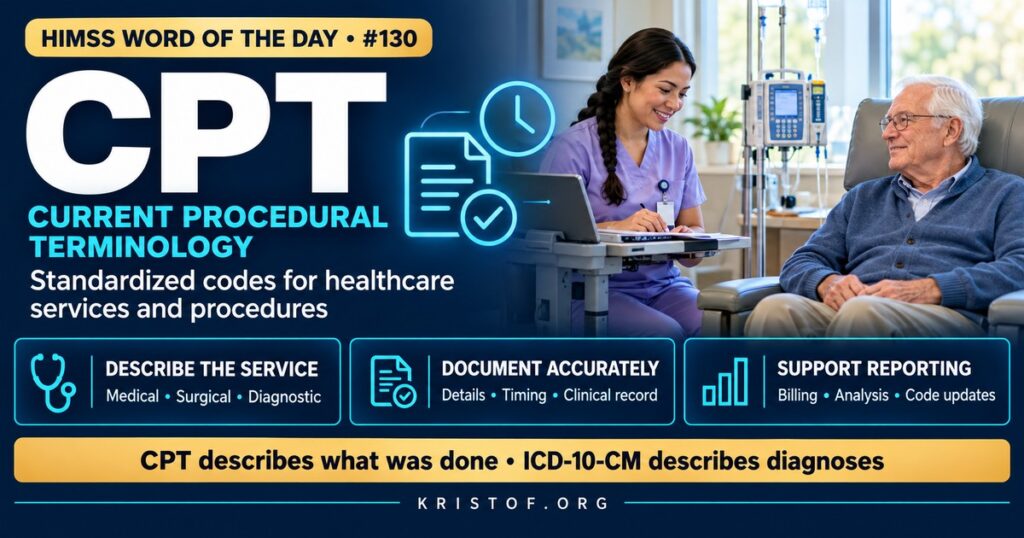
Current Procedural Terminology (CPT) is a standardized code set, maintained by the American Medical Association (AMA), that describes medical, surgical, diagnostic, and other services performed by physicians and other healthcare professionals. CPT codes are used for billing, reporting, and analysis.
The HIMSS Dictionary describes CPT in two ways: as the official system physicians use to report professional services and procedures to payers, published by the AMA, and as an AMA-maintained, copyrighted code set adopted under HIPAA for professional transactions that are not institutional or dental.
| CPT Category | Purpose | Example |
|---|---|---|
| Category I | Established services and procedures | Office visits, surgeries, laboratory tests, imaging |
| Category II | Supplemental tracking codes for performance measurement | Reporting that a blood pressure was measured and controlled |
| Category III | Temporary codes for emerging technologies and services | New procedures being evaluated for broader use |
| Modifiers | Two-character additions that add detail | Indicating a bilateral procedure or a distinct service |
| PLA Codes | Proprietary laboratory analyses | Specific branded laboratory tests |
⚠️ Exam Alert: CPT describes what was done (services and procedures). ICD-10-CM describes why (diagnoses). ICD-10-PCS codes inpatient hospital procedures. HCPCS Level I is CPT; HCPCS Level II, maintained by CMS, covers items such as supplies, drugs, and equipment. CPT is owned and licensed by the AMA.
🌐 Why It Matters: Real-World Healthcare IT Context
CPT codes connect clinical work to payment. When a clinician sees a patient, performs a procedure, or orders a test, the documentation is translated into CPT codes on a claim, paired with ICD-10-CM diagnosis codes that explain medical necessity. Payers use these codes to decide what to pay.
HIPAA designated CPT as a standard code set for professional services in electronic transactions, which made it a common language among providers, payers, and clearinghouses. Combined with HCPCS Level II, it forms the Healthcare Common Procedure Coding System that CMS uses for Medicare billing.
CPT changes every year. The AMA’s CPT Editorial Panel reviews proposals for new, revised, and deleted codes, and updates typically take effect at the start of each calendar year. Health IT systems, charge masters, order catalogs, and payer rules must be updated to match, which requires annual testing and coordination.
Documentation drives coding. Evaluation and management codes for office visits, for example, are selected based on medical decision making or time, under guidelines the AMA revised in recent years to reduce documentation burden. Procedures require documentation of what was performed, by whom, and with what findings. Incomplete documentation can lead to undercoding, denials, or compliance risk.
CPT also supports data analysis beyond billing. Researchers, quality programs, and organizations use procedure codes to study utilization, outcomes, and costs, although claims data reflects what was billed rather than everything clinically relevant.
Codes increasingly describe care beyond face-to-face visits. CPT includes codes for chronic care management, transitional care management, remote physiologic monitoring, and telehealth-related services, which has encouraged organizations to build programs, often nurse-led, around these services.
Compliance oversight follows the codes. Payers and government auditors review whether billed services match documentation, and patterns such as consistently billing the highest-level visit can trigger audits. Organizations run internal coding audits, track denial trends, and educate clinicians to keep billing accurate, which protects both revenue and reputation. Errors in either direction matter: overcoding creates compliance risk, while undercoding leaves legitimate revenue uncollected.
Licensing is a practical consideration. Because CPT is copyrighted, software vendors and organizations that use CPT descriptions in their systems typically need AMA licenses, which adds to health IT costs.
Price transparency rules have also made procedure codes more visible to consumers. Hospitals publish standard charges and shoppable services, often organized by CPT and HCPCS codes, so accurate code mapping affects what patients see when comparing costs.
Common CPT-related problems:
- Documentation that does not support the code billed
- Outdated codes after annual updates
- Missed charges for services not captured in workflow
- Incorrect modifiers leading to denials
- Mismatch between procedure and diagnosis codes
- Confusion between CPT and HCPCS Level II codes
What supports accurate CPT coding:
- Clear documentation templates aligned with coding requirements
- Annual code update processes and testing
- Charge capture built into clinical workflow
- Coding education for clinicians and staff
- Claim scrubbers and denial analysis
- Collaboration between clinical, coding, and revenue cycle teams
🏥 The Nurse’s Perspective: Clinical, Bedside, & Workflow
CPT may seem like a billing concern, but nursing documentation and workflow often determine whether services are captured accurately.
At the Bedside
In outpatient settings, nursing activities such as injections, immunization administration, wound care, and certain procedures may be billed using CPT codes. Accurate documentation of what was done, including medication, dose, route, site, and time, supports both safe care and correct billing.
Infusion services provide a clear example. Start and stop times documented by nurses can affect which codes apply, so precise timing in the record matters for both care and reimbursement.
In Clinical Workflow
Many care management programs depend on CPT codes that recognize non-face-to-face work. Chronic care management, transitional care management, and remote physiologic monitoring codes often involve nurses who call patients, review data, and coordinate care under a billing practitioner’s supervision. Documenting time spent and activities performed is essential.
Nurses in procedural areas help ensure that procedures, supplies, and implants are captured. Charge capture built into nursing documentation reduces missed charges and manual reconciliation.
When codes or documentation requirements change, nurses benefit from concise updates that explain what to document and why, rather than lists of codes.
Nurse-led telephone and portal work, such as reviewing remote monitoring readings, may count toward monthly time thresholds for certain codes. Logging that time consistently in the designated place helps practices bill appropriately and demonstrates the value of nursing work.
In EHR Implementation (Go-Live Perspective)
During an Epic Go-Live, revenue cycle teams build charge capture, order-to-charge links, and documentation tools that drive CPT codes. Testing with real scenarios ensures that nursing documentation produces correct charges.
At-the-elbow support analysts often see charge-related issues surface as workflow questions, such as where to document an injection or how to complete a procedure record. Routing these issues to revenue cycle teams quickly prevents lost revenue and claim errors.
🎓 CAHIMS / CPHIMS & HIMSS Perspective
CAHIMS Exam Domain Mapping
CPT appears in coding, data, and revenue cycle questions:
| CAHIMS Domain | How CPT Appears |
|---|---|
| Healthcare & Technology Environments | HIPAA code sets; Medicare billing; AMA ownership |
| Clinical Informatics | Documentation requirements, charge capture in clinical workflow |
| Healthcare Information & Systems Management | Code set maintenance, annual updates, claims data, analytics |
| Management & Leadership | Revenue cycle, compliance, licensing costs |
Key Terms to Know Alongside CPT
- ICD-10-CM — the U.S. diagnosis code set used across care settings
- ICD-10-PCS — the code set for inpatient hospital procedures
- HCPCS Level II — CMS-maintained codes for supplies, drugs, equipment, and certain services
- Evaluation and Management (E/M) — CPT codes for visits and consultations
- Modifier — a code addition that provides more detail about a service
- Charge Capture — recording billable services so they reach the claim
HIMSS Organizational Position
HIMSS supports standardized coding and data as foundations for interoperability, analytics, and revenue cycle management through its education and policy work. Members can find related education and research through the HIMSS Resource Center.
🔗 Explore Further: External References
- American Medical Association — CPT https://www.ama-assn.org/practice-management/cpt
- American Medical Association — CPT Editorial Panel https://www.ama-assn.org/about/cpt-editorial-panel
- CMS — Healthcare Common Procedure Coding System (HCPCS) https://www.cms.gov/medicare/coding-billing/healthcare-common-procedure-system
- CMS — Administrative Simplification https://www.cms.gov/priorities/key-initiatives/burden-reduction/administrative-simplification
- CMS — Care Management Services https://www.cms.gov/medicare/payment/fee-schedules/physician/care-management
- HIMSS — Public Policy & Advocacy https://www.himss.org/public-policy-advocacy-overview
Term source: HIMSS Dictionary of Health Information and Technology Terms, Acronyms, and Organizations, 6th Edition (2025). All definitions in this series are paraphrased for editorial purposes. Readers are encouraged to consult the primary source for exact language.
Eric Andrew Kristof, RN, CAHIMS is a Healthcare IT professional and HIMSS Arkansas Chapter member based in Hot Springs Village, AR, with hands-on Epic Go-Live experience and a diverse healthcare and IT background. He writes at kristof.org at the intersection of clinical care and healthcare technology.
Leave a Reply