By Eric Andrew Kristof, RN, CAHIMS | Healthcare IT Professional | HIMSS Arkansas Chapter Member
About This Series: The HIMSS Word of the Day is a running blog series drawing from the HIMSS Dictionary of Health Information and Technology Terms, Acronyms, and Organizations, 6th Edition (2025) — the authoritative reference for healthcare IT professionals and the primary study resource for CAHIMS and CPHIMS certification. Each post paraphrases the term in plain language, grounds it in real-world healthcare IT context, and adds a bedside nursing perspective you won’t find in a textbook.
📖 The Term: SBAR (Situation, Background, Assessment, Recommendation)
Source: HIMSS Dictionary of Health Information and Technology Terms, Acronyms, and Organizations, 6th Edition (2025)
🔍 Plain-Language Definition
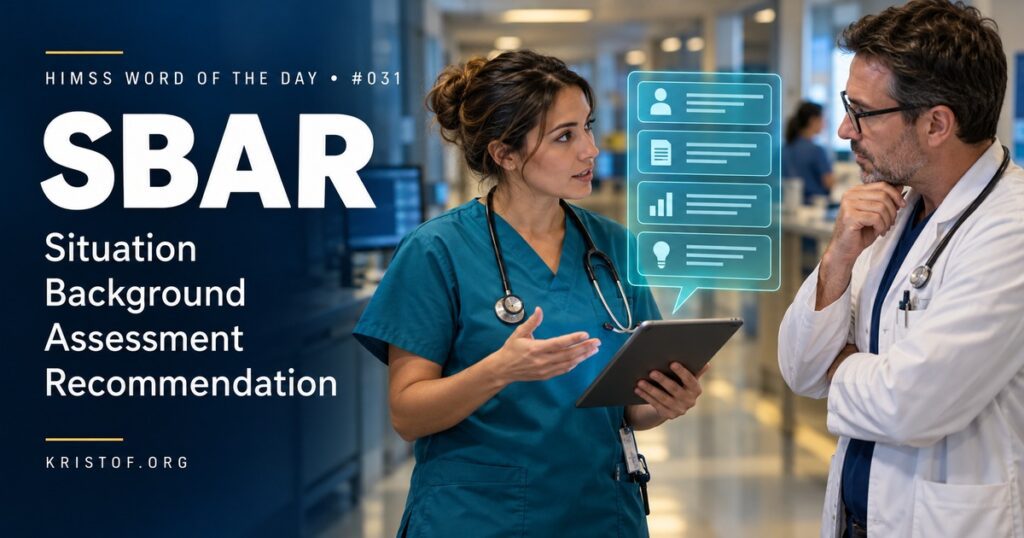
SBAR is a simple, structured way for clinicians to tell each other what is happening with a patient and what needs to happen next. The letters stand for Situation, Background, Assessment, and Recommendation.
The HIMSS Dictionary identifies SBAR as a technique promoted by the Institute for Healthcare Improvement (IHI) that gives care team members a shared framework for communicating about a patient’s condition. IHI credits Dr. Michael Leonard and colleagues at Kaiser Permanente of Colorado with developing it for healthcare.
The value of SBAR is predictability. When everyone organizes information the same way, the listener knows what is coming, the speaker is less likely to leave something out, and the conversation ends with a clear request rather than a vague concern.
| Element | What It Answers | Example (Nurse Calling a Provider) |
|---|---|---|
| S — Situation | What is happening right now? | “Room 412’s patient is short of breath, and oxygen saturation has dropped to 88% on 2 liters.” |
| B — Background | What context does the listener need? | “Post-op day two after hip surgery, history of heart failure, received two liters of IV fluid overnight.” |
| A — Assessment | What does the speaker think is going on? | “Crackles in both lower lobes and new leg edema. Concerned about fluid overload.” |
| R — Recommendation | What is being asked for, and by when? | “Requesting an evaluation within 30 minutes, a chest x-ray, and an order for a diuretic.” |
Common variations add letters, such as ISBAR (adding Identify at the start) or ISBARR (adding Read-back at the end).
⚠️ Exam Alert: SBAR is a communication framework, not a software product or a data standard. Don’t confuse it with I-PASS, a handoff bundle designed mainly for shift-to-shift handoffs, or with closed-loop communication, in which the receiver repeats back an instruction and the sender confirms it. All three support patient safety, but SBAR is the one most associated with escalating a concern about a patient’s condition.
🌐 Why It Matters: Real-World Healthcare IT Context
Communication failures are a recurring theme in patient safety. A message that is incomplete, disorganized, or missing a clear request can delay treatment as surely as a missing order. SBAR gives teams a common pattern, and that pattern can be built into the tools clinicians already use.
One widely cited case report from OSF St. Joseph Medical Center described a patient on warfarin whose elevated INR result, phoned in by the lab, was not written down; the dose was increased based on older results, and a dangerously high INR followed. The hospital responded by spreading SBAR through training, pocket cards, and orientation. A 2018 systematic review in BMJ Open found moderate evidence that SBAR improves patient safety, especially when it structures telephone communication, while noting a lack of high-quality studies. Related research supports structured handoffs more broadly: a multicenter study of the I-PASS handoff program found a 23% drop in medical errors and a 30% drop in preventable adverse events after implementation.
SBAR is also part of AHRQ’s TeamSTEPPS curriculum, which teaches teamwork and communication skills across professions.
For health IT teams, SBAR is a design pattern. It shapes handoff reports, nurse-to-provider secure messaging templates, rapid response documentation, and transfer summaries.
Where structured communication breaks down:
- Long, unstructured messages that bury the actual request
- Secure chat messages sent without patient context, vital signs, or urgency
- Handoff tools that require duplicate typing, so clinicians skip them
- Recommendations that are implied rather than stated
- No read-back or confirmation for critical information
- Templates that differ by unit, so the structure is not truly shared
What good support looks like:
- Handoff and messaging templates organized around Situation, Background, Assessment, and Recommendation
- Background fields that pull current vitals, labs, and medications from the chart automatically
- A required, clearly labeled request or recommendation field
- Urgency settings and escalation paths built into secure messaging
- Consistent use across nursing, medicine, therapy, and pharmacy
🏥 The Nurse’s Perspective: Clinical, Bedside, & Workflow
Nurses learn SBAR early, and it quickly becomes the backbone of how they escalate concerns.
At the Bedside
The classic SBAR moment is the overnight call to a provider. The nurse has noticed a change, such as a drop in blood pressure, new confusion, or a worrying lab value, and has a few seconds to convey it clearly. SBAR helps the nurse gather vitals, recent medications, and relevant history before dialing, and it ends the call with a specific request instead of hoping the provider infers one.
SBAR also supports rapid response and code situations. When the rapid response team arrives, the bedside nurse is often expected to give a short SBAR summary while the team begins its assessment.
In Clinical Workflow
Shift handoff, transfer from the emergency department to an inpatient unit, and transfer to a procedural area are all points where information can be lost. Many units build their handoff reports around SBAR or a related structure, and many nurses carry SBAR into the way they write progress notes and secure chat messages.
Secure messaging has changed the format but not the need. A text-style message reading “pt in 412 BP low” forces a callback. A message with the situation, the latest vitals, a short assessment, and a clear request can often be answered without one.
In EHR Implementation (Go-Live Perspective)
During an Epic Go-Live, nurses and providers meet new handoff tools, sticky notes, secure chat, and patient summary reports all at once. At-the-elbow support analysts often see that the tools adopted fastest are the ones that mirror the communication structure nurses already use. A handoff report organized around SBAR, with background data pulled forward automatically, saves time on the first day.
Build teams can also use SBAR to review their own templates. If a secure chat template has no place for a recommendation, or a transfer summary hides the assessment several screens down, the tool is working against good communication. Small changes, such as adding a required request field or a quick-pick for urgency, can make structured communication the path of least resistance.
🎓 CAHIMS / CPHIMS & HIMSS Perspective
CAHIMS Exam Domain Mapping
SBAR appears in questions about patient safety, workflow, and communication technology:
| CAHIMS Domain | How SBAR Appears |
|---|---|
| Healthcare & Technology Environments | Patient safety culture; IHI and AHRQ resources; teamwork and communication standards |
| Clinical Informatics | Handoff tools, secure messaging templates, rapid response documentation, workflow design |
| Healthcare Information & Systems Management | Template build in the EHR and messaging platforms; pulling chart data into structured reports |
| Management & Leadership | Training and adoption, standardizing communication across units, measuring safety outcomes |
Key Terms to Know Alongside SBAR
- Handoff — the transfer of responsibility and information about a patient from one clinician or team to another
- I-PASS — a structured handoff bundle that includes illness severity, patient summary, action list, situation awareness, and synthesis by the receiver
- Closed-Loop Communication — a message is sent, repeated back by the receiver, and confirmed by the sender
- TeamSTEPPS — an evidence-based AHRQ program for teamwork and communication in healthcare
- Read-Back — repeating an order or critical result back to the sender to confirm accuracy
- Secure Messaging — encrypted, auditable messaging used by care teams in place of pagers and personal texts
HIMSS Organizational Position
HIMSS approaches structured communication as part of clinical workflow and patient safety. Its Nursing Informatics Community focuses on how technology supports nursing practice, including documentation and care coordination tools that carry SBAR-style communication. Members can find related education and research through the HIMSS Resource Center.
🔗 Explore Further: External References
- Institute for Healthcare Improvement — SBAR Tool https://www.ihi.org/library/tools/sbar-tool-situation-background-assessment-recommendation
- AHRQ — TeamSTEPPS https://www.ahrq.gov/teamstepps-program/index.html
- AHRQ PSNet — Handoffs Primer https://psnet.ahrq.gov/primer/handoffs
- Haig, Sutton, and Whittington (2006), Joint Commission Journal on Quality and Patient Safety — SBAR: A Shared Mental Model https://pubmed.ncbi.nlm.nih.gov/16617948/
- Müller et al. (2018), BMJ Open — Impact of SBAR on Patient Safety: A Systematic Review https://pubmed.ncbi.nlm.nih.gov/30139905/
- Starmer et al. (2014), New England Journal of Medicine — Changes in Medical Errors After Implementation of a Handoff Program https://pubmed.ncbi.nlm.nih.gov/25372088/
Term source: HIMSS Dictionary of Health Information and Technology Terms, Acronyms, and Organizations, 6th Edition (2025). All definitions in this series are paraphrased for editorial purposes. Readers are encouraged to consult the primary source for exact language.
Eric Andrew Kristof, RN, CAHIMS is a Healthcare IT professional and HIMSS Arkansas Chapter member based in Hot Springs Village, AR, with hands-on Epic Go-Live experience and a diverse healthcare and IT background. He writes at kristof.org at the intersection of clinical care and healthcare technology.
Leave a Reply