By Eric Andrew Kristof, RN, CAHIMS | Healthcare IT Professional | HIMSS Arkansas Chapter Member
About This Series: The HIMSS Word of the Day is a running blog series drawing from the HIMSS Dictionary of Health Information and Technology Terms, Acronyms, and Organizations, 6th Edition (2025) — the authoritative reference for healthcare IT professionals and the primary study resource for CAHIMS and CPHIMS certification. Each post paraphrases the term in plain language, grounds it in real-world healthcare IT context, and adds a bedside nursing perspective you won’t find in a textbook.
📖 The Term: Data Integrity
Source: HIMSS Dictionary of Health Information and Technology Terms, Acronyms, and Organizations, 6th Edition (2025)
🔍 Plain-Language Definition
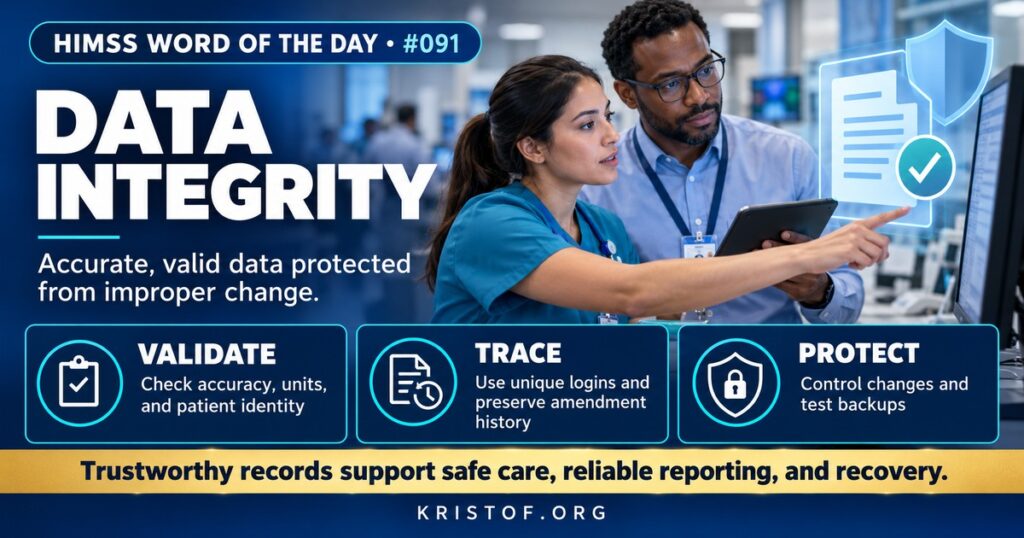
Data integrity is the trustworthiness of data: confidence that it is accurate and valid, and that it has not been changed, corrupted, or destroyed in ways that should not have happened.
The HIMSS Dictionary describes two related meanings. The first is assurance that data is accurate, correct, or valid, established by checking it against defined validation criteria. The second is a security property: data has not been altered or destroyed without authorization, or improperly by authorized users, and is protected from modification or corruption, whether malicious or accidental.
In practice, both meanings matter in healthcare:
| Dimension | Question It Answers | Healthcare Example |
|---|---|---|
| Accuracy and Validity | Does the data correctly reflect reality and meet defined rules? | A weight entered in the right units, within a plausible range |
| Protection From Improper Change | Has the data been altered only through authorized, traceable actions? | A signed note amended through a proper addendum, not overwritten |
| Completeness Over Time | Is anything missing or lost? | Results that did not file because of an interface error |
| Attribution | Can each entry be tied to the person or system that created it? | Documentation under a unique login, not a shared account |
| Recoverability | Can data be restored accurately after loss or attack? | Clean backups after a ransomware event |
⚠️ Exam Alert: Data integrity focuses on accuracy and protection from improper change. Data quality is broader, covering whether data is fit for its purpose, including completeness and timeliness. In the security triad, integrity sits alongside confidentiality and availability. The HIPAA Security Rule includes an integrity standard requiring protection of electronic PHI from improper alteration or destruction.
🌐 Why It Matters: Real-World Healthcare IT Context
Clinical decisions assume that the record is right. If an allergy disappears, a dose is changed without explanation, or a result files to the wrong patient, the care that follows may be unsafe. Data integrity failures can also undermine billing, quality reporting, research, and legal defense, because each depends on a record that can be trusted.
The HIPAA Security Rule addresses integrity directly. Its technical safeguards require covered entities and business associates to implement policies and procedures that protect electronic protected health information from improper alteration or destruction, and to consider mechanisms that confirm data has not been changed without authorization. Audit controls, access controls, and person or entity authentication support the same goal.
Regulated industries have formalized integrity principles. FDA guidance for drug manufacturing, for example, describes data that should be attributable, legible, contemporaneous, original, and accurate, often summarized as ALCOA. Those principles translate well to clinical documentation: know who recorded it, make it readable, record it when it happens, keep the original, and make it correct.
Integrity also matters across organizations. When records are exchanged, receiving systems need confidence that the data was not altered in transit and came from the claimed source. Encryption in transit, digital signatures, and authenticated interfaces protect integrity during exchange, while consistent patient matching ensures that received data lands in the right chart.
Threats come from many directions. Wrong-patient documentation, copy-and-paste of outdated findings, duplicate records, interface mapping errors, unauthorized changes, and malicious attacks all damage integrity. Ransomware is a particular concern, because attackers may encrypt or alter data, and recovery depends on clean, tested backups.
Common threats to data integrity:
- Documentation in the wrong patient’s chart
- Copy-forward text that no longer reflects the patient
- Interface or conversion errors that change values or units
- Shared logins that hide who made an entry
- Edits to signed documentation without a proper amendment trail
- Malware or ransomware that alters or encrypts records
Controls that protect integrity:
- Validation rules and plausibility checks at data entry
- Unique user IDs, role-based access, and audit trails
- Formal amendment and correction processes
- Interface testing and monitoring
- Patient identification safeguards and duplicate record management
- Protected, tested backups and recovery procedures
🏥 The Nurse’s Perspective: Clinical, Bedside, & Workflow
Nurses protect data integrity with every entry they make and every chart they open.
At the Bedside
Confirming the patient before documenting is the first integrity safeguard. On busy units with several charts open, it is easy to document an assessment or medication in the wrong patient’s record. Checking the patient header, closing charts when finished, and scanning wristbands where supported all reduce that risk.
Documenting at the time of care supports integrity too. Entries made long after the fact, from memory, are more likely to contain errors, and the audit trail will show the delay. Late entries should be labeled clearly according to policy.
Shared logins are a quiet integrity threat. When one nurse documents under another’s session, the record attributes care to the wrong person, which can mislead reviewers and complicate investigations. Logging out or locking the screen every time protects both the patient record and the clinician.
In Clinical Workflow
Corrections must follow the right process. If a nurse discovers an error in a documented value or note, the correction should use the system’s amendment or error-correction functions, which preserve the original entry and show what changed, by whom, and when. Deleting or overwriting information without a trail undermines both integrity and legal defensibility.
Copy-forward and templates deserve caution. Carrying forward a prior assessment can save time, but only if every element is reviewed and updated. A note that repeats yesterday’s findings for a patient whose condition changed overnight misleads the next clinician.
In EHR Implementation (Go-Live Perspective)
During an Epic Go-Live, data conversion is a major integrity risk. Allergies, medications, problems, and historical results must be converted accurately, and validation teams compare samples between the old and new systems. Nurses who notice discrepancies in converted data should report them rather than simply correcting individual charts, because the same problem may affect many patients.
At-the-elbow support analysts help nurses use correction and amendment functions properly in the new system and reinforce unique login practices. They also escalate suspected interface or conversion problems quickly so integrity issues can be fixed at the source.
🎓 CAHIMS / CPHIMS & HIMSS Perspective
CAHIMS Exam Domain Mapping
Data integrity appears in security, documentation, and data management questions:
| CAHIMS Domain | How Data Integrity Appears |
|---|---|
| Healthcare & Technology Environments | HIPAA Security Rule integrity standard; regulatory expectations for records |
| Clinical Informatics | Documentation practices, amendments, copy-forward, wrong-patient errors |
| Healthcare Information & Systems Management | Validation rules, interfaces, conversion, audit trails, backups |
| Management & Leadership | Policies, compliance, legal health record, incident response |
Key Terms to Know Alongside Data Integrity
- Data Quality — the degree to which data is fit for its intended purpose
- CIA Triad — confidentiality, integrity, and availability, the core goals of information security
- Audit Trail — a chronological record of system activity showing who did what and when
- Amendment — a formal correction or addition to a health record that preserves the original entry
- Validation Rule — a check that ensures data meets defined criteria before it is accepted
- Legal Health Record — the documentation an organization designates as its official business record of care
HIMSS Organizational Position
HIMSS treats data integrity as foundational to patient safety, cybersecurity, and analytics, addressing it through its cybersecurity work and its emphasis on data governance in analytics maturity. Members can find related education and research through the HIMSS Resource Center.
🔗 Explore Further: External References
- eCFR — 45 CFR 164.312, HIPAA Technical Safeguards (Integrity) https://www.ecfr.gov/current/title-45/subtitle-A/subchapter-C/part-164/subpart-C/section-164.312
- HHS — Summary of the HIPAA Security Rule https://www.hhs.gov/hipaa/for-professionals/security/laws-regulations/index.html
- FDA — Data Integrity and Compliance With Drug CGMP: Questions and Answers https://www.fda.gov/regulatory-information/search-fda-guidance-documents/data-integrity-and-compliance-drug-cgmp-questions-and-answers
- ONC — SAFER Guides https://healthit.gov/clinical-quality-and-safety/safer-guides/
- AHIMA — American Health Information Management Association https://www.ahima.org/
- HHS 405(d) Program — Health Industry Cybersecurity Practices https://405d.hhs.gov/
Term source: HIMSS Dictionary of Health Information and Technology Terms, Acronyms, and Organizations, 6th Edition (2025). All definitions in this series are paraphrased for editorial purposes. Readers are encouraged to consult the primary source for exact language.
Eric Andrew Kristof, RN, CAHIMS is a Healthcare IT professional and HIMSS Arkansas Chapter member based in Hot Springs Village, AR, with hands-on Epic Go-Live experience and a diverse healthcare and IT background. He writes at kristof.org at the intersection of clinical care and healthcare technology.
Leave a Reply