By Eric Andrew Kristof, RN, CAHIMS | Healthcare IT Professional | HIMSS Arkansas Chapter Member
About This Series: The HIMSS Word of the Day is a running blog series drawing from the HIMSS Dictionary of Health Information and Technology Terms, Acronyms, and Organizations, 6th Edition (2025) — the authoritative reference for healthcare IT professionals and the primary study resource for CAHIMS and CPHIMS certification. Each post paraphrases the term in plain language, grounds it in real-world healthcare IT context, and adds a bedside nursing perspective you won’t find in a textbook.
📖 The Term: Train the Trainer
Source: HIMSS Dictionary of Health Information and Technology Terms, Acronyms, and Organizations, 6th Edition (2025)
🔍 Plain-Language Definition
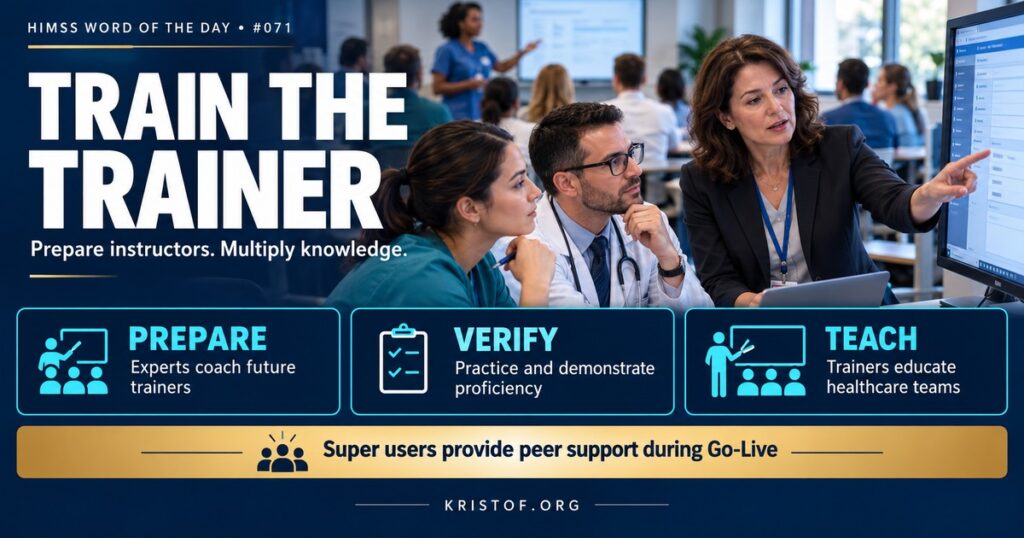
Train the trainer is an education model in which a small group of experts prepares other people to become instructors, who then teach the material to the broader audience. Instead of one team teaching everyone, knowledge cascades outward through trained teachers.
The HIMSS Dictionary describes train the trainer as a model for preparing prospective or less experienced instructors in the most effective ways to deliver training materials to others.
In healthcare IT, the model typically has several layers:
| Role | Who It Is | What They Do |
|---|---|---|
| Master or Principal Trainer | Vendor or core project education staff | Develops curriculum and prepares trainers |
| Credentialed Trainer | Organization staff who pass a proficiency process | Teaches end-user classes and runs proficiency assessments |
| Super User | Frontline clinicians and staff with extra training | Supports peers on their unit, especially during Go-Live |
| End User | Everyone who uses the system | Completes training and demonstrates proficiency |
⚠️ Exam Alert: Train the trainer describes how instructors are prepared, not the training content itself. Super users are peer supporters, not necessarily formal classroom instructors. Credentialed trainers usually must demonstrate proficiency before teaching. Questions may ask which approach best scales training across a large organization with limited education staff; train the trainer is the classic answer.
🌐 Why It Matters: Real-World Healthcare IT Context
Large implementations require training thousands of people in a short time. A hospital system replacing its EHR may need to train nurses, physicians, pharmacists, therapists, registration staff, and many others, each on role-specific workflows, often within a few weeks before Go-Live. A central education team cannot do that alone.
Train the trainer solves the scale problem and adds a second benefit: trainers drawn from within the organization understand local workflows, culture, and terminology. A nurse trainer who has worked on a medical-surgical unit can connect system steps to real situations in ways an outside instructor may not.
Evidence on the model is generally positive but uneven. A 2012 systematic review in the Journal of Continuing Education in the Health Professions by Pearce and colleagues identified 18 studies of train-the-trainer programs. Most found improvements in knowledge, clinical behavior, or patient outcomes, though study quality varied and the authors noted moderate risk of bias. The review suggested that blended approaches, combining interactive methods with supporting materials, were the most effective way to deliver these programs.
Quality control is the main risk of cascading training. Each layer of teaching can drift a little from the original message, especially when curriculum changes late in a project. Programs reduce that drift with standardized lesson plans, practice exercises built in a training environment that matches the final build, observation of trainers by master trainers, and proficiency checks for end users that confirm they can perform key tasks, not just that they attended class. Some organizations also require learners to pass a proficiency assessment before receiving access to the live system.
The model is used widely in healthcare beyond EHRs. AHRQ’s TeamSTEPPS program, for example, prepares master trainers who then teach teamwork and communication skills within their own organizations.
Timing matters as much as content. Training delivered too far before Go-Live fades from memory, while training squeezed into the last few days leaves no time for practice. Many implementations schedule end-user training in the final weeks before Go-Live and offer open practice labs and refresher sessions so staff can rehearse their most common tasks.
Common train-the-trainer pitfalls:
- Trainers selected for availability rather than teaching ability
- Too little time for trainers to master the system before teaching
- Curriculum that changes late, leaving trainers teaching outdated steps
- Inconsistent messages when trainers improvise
- Super users pulled back to full patient assignments during Go-Live
- No feedback loop from classrooms to the build team
Characteristics of strong programs:
- Clear criteria for selecting trainers and super users
- Proficiency testing before trainers teach
- Standardized curriculum, scripts, and practice exercises
- Training environments that match the build as closely as possible
- Protected time for super users during Go-Live and stabilization
- Regular trainer huddles to share issues and updates
🏥 The Nurse’s Perspective: Clinical, Bedside, & Workflow
Nurses frequently serve as trainers and super users, and their credibility with peers makes them especially effective.
At the Bedside
Super users are often bedside nurses chosen by their units. During Go-Live, they help colleagues find screens, complete documentation, and solve common problems, while also caring for patients or working with reduced assignments. Because they know the unit’s patients and routines, they can show colleagues how the system fits real work, not just where to click.
Nurses also learn differently than classroom schedules sometimes assume. Short, scenario-based sessions that mirror a real shift, such as admitting a patient, administering medications, and completing handoff, tend to be more meaningful than long feature tours.
Respected peers make powerful trainers. When a nurse whom colleagues trust explains why a new step matters, such as scanning before every administration, the message often lands better than the same explanation from someone outside the unit.
In Clinical Workflow
Trainers and super users become a feedback channel. They hear confusion and frustration first, notice where the build does not match workflow, and can pass that information to educators and analysts. Organizations that formally collect this feedback can use it to improve both training and the system itself.
Training continues after Go-Live. New hires, travel nurses, students, and float staff all need onboarding, and super users often support them for months. Keeping super users engaged, recognized, and current with system changes helps sustain that support.
In EHR Implementation (Go-Live Perspective)
During an Epic implementation, credentialed trainers typically complete vendor training and proficiency assessments before teaching end-user classes. Super users receive additional training so they can support their units through Go-Live.
At-the-elbow support analysts work alongside super users on the floor. The partnership works best when roles are clear: super users provide peer support and unit knowledge, while analysts bring deeper system expertise and escalate issues. Together, they turn classroom learning into confident practice.
🎓 CAHIMS / CPHIMS & HIMSS Perspective
CAHIMS Exam Domain Mapping
Train the trainer appears in implementation, change management, and education questions:
| CAHIMS Domain | How Train the Trainer Appears |
|---|---|
| Healthcare & Technology Environments | Workforce readiness for new technology; organizational change |
| Clinical Informatics | Clinical trainers and super users; scenario-based training; adoption |
| Healthcare Information & Systems Management | Training environments, proficiency testing, curriculum version control |
| Management & Leadership | Training strategy, resource planning, change management, sustaining support |
Key Terms to Know Alongside Train the Trainer
- Super User — an end user with extra training who supports peers and gathers feedback
- Credentialed Trainer — an instructor who has demonstrated proficiency and is authorized to teach end users
- Proficiency Assessment — an evaluation confirming that a user can complete required tasks in the system
- Training Environment — a separate copy of the system used for practice without affecting real patient data
- Adult Learning Principles — approaches that emphasize relevance, experience, and problem-centered learning
- Elbow Support — hands-on help provided at the user’s side during Go-Live
HIMSS Organizational Position
HIMSS addresses training and workforce development as essential parts of successful implementation and digital maturity, and its Nursing Informatics Community highlights the role of nurse educators and super users. Members can find related education and research through the HIMSS Resource Center.
🔗 Explore Further: External References
- Pearce et al. (2012), Journal of Continuing Education in the Health Professions — The Most Effective Way of Delivering a Train-the-Trainers Program https://pubmed.ncbi.nlm.nih.gov/23173243/
- AHRQ — TeamSTEPPS https://www.ahrq.gov/teamstepps-program/index.html
- ONC — SAFER Guides https://healthit.gov/clinical-quality-and-safety/safer-guides/
- ANA — Informatics Nursing Certification (NI-BC) https://www.nursingworld.org/our-certifications/informatics-nurse/
- HIMSS — Nursing Informatics Community https://www.himss.org/networking/communities/nursing-informatics/
- HIMSS — Certifications (CAHIMS and CPHIMS) https://www.himss.org/certifications
Term source: HIMSS Dictionary of Health Information and Technology Terms, Acronyms, and Organizations, 6th Edition (2025). All definitions in this series are paraphrased for editorial purposes. Readers are encouraged to consult the primary source for exact language.
Eric Andrew Kristof, RN, CAHIMS is a Healthcare IT professional and HIMSS Arkansas Chapter member based in Hot Springs Village, AR, with hands-on Epic Go-Live experience and a diverse healthcare and IT background. He writes at kristof.org at the intersection of clinical care and healthcare technology.
Leave a Reply