By Eric Andrew Kristof, RN, CAHIMS | Healthcare IT Professional | HIMSS Arkansas Chapter Member
About This Series: The HIMSS Word of The Day is a running blog series drawing from the HIMSS Dictionary of Health Information and Technology Terms, Acronyms, and Organizations, 6th Edition (2025) — the authoritative reference for healthcare IT professionals and the primary study resource for CAHIMS and CPHIMS certification. Each post paraphrases the term in plain language, grounds it in real-world healthcare IT context, and adds a bedside nursing perspective you won’t find in a textbook.
📖 The Term: HealthKit
Source: HIMSS Dictionary of Health Information and Technology Terms, Acronyms, and Organizations, 6th Edition (2025)
🔍 Plain-Language Definition
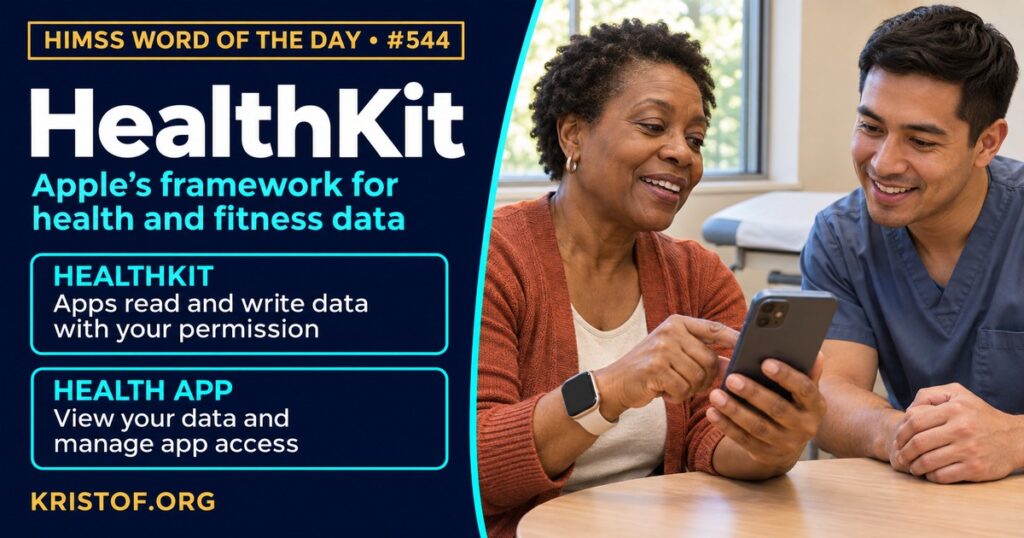
The HIMSS Dictionary describes HealthKit as Apple’s software platform for gathering data from health and fitness apps and making it available to users through a single Health app. The Dictionary’s wording dates from the platform’s early days. It was written when the Health app was new, and it does not capture how widely the framework is used today.
Apple’s developer documentation calls HealthKit a central repository for health and fitness data on iPhone and Apple Watch. With the user’s permission, apps read data from and write data to this store. Apple’s listing shows the framework available from iOS 8 and watchOS 2 onward. The documentation says HealthKit is designed to manage and merge data from multiple sources, so a person can run a favorite step counter, weight tracker, and exercise app and have their data meet in one place. Users can view, add, and delete data and change app permissions in the Health app, and apps must handle changes that occur outside the app.
Several privacy rules are built into the design, according to Apple’s documentation. Users grant or deny access separately for each type of data, for example allowing step counts but not blood glucose. If a user denies permission to read a type of data, the app cannot tell, and from its point of view no data of that type exists. HealthKit data is stored on the device and encrypted when the device is locked. Apple’s rules say apps may not use HealthKit information for advertising, may not disclose it to a third party without the user’s express permission, and may not sell it to advertising platforms, data brokers, or information resellers. With the user’s consent, the data may be shared with a third party for medical research. Every HealthKit app must also have a privacy policy, and Apple points developers to two ONC model privacy notices, one for non-HIPAA apps and one for HIPAA-covered apps.
For health IT, the main point is that HealthKit is a bridge between the consumer’s phone and the clinical record, not a clinical system. The next question is always who connects it to the EHR, who reviews the data, and what the clinical team does with it.
| Item | What it is | Who controls it |
|---|---|---|
| HealthKit | Framework and data store on iPhone and Apple Watch | The user, through per-data-type permissions |
| Health app | The place where users view and manage their data | The user |
| Apps using HealthKit | Fitness, monitoring, and patient-facing apps that read or write data | The app developer, within Apple’s rules |
| EHR or portal connection | A patient-facing platform that moves selected data into the record | The health system, with patient consent |
⚠️ Exam Alert: HealthKit is a developer framework and on-device data store. The Health app is the user interface for that data. Patient-generated health data (PGHD) is the type of data HealthKit often holds, and an EHR is the clinical record that may or may not receive it. Do not confuse HealthKit with a personal health record (PHR), a patient portal, or remote patient monitoring (RPM), which are different tools or programs that may use the data.
🌐 Why It Matters: Real-World Healthcare IT Context
Patient-generated data is only useful in care when it reaches the right people in a form they can use. The studies below look at uptake, integration, clinician reaction, and the value of the data itself. Each was checked against its published abstract, and the type of study is noted. Several are small or from a single site.
Uptake in primary care. North and Chaudhry, in Telemedicine and e-Health (2016), looked at patients in the Mayo Clinic primary care practice in Rochester, Minnesota, who had registered to connect to their medical record with Apple HealthKit. Of 98,151 patients, 503 had registered. Among those registrants, 95 (19 percent) had hypertension, 37 (7.4 percent) had diabetes, 125 (25 percent) had depression, and 56 (11 percent) had asthma, and 245 (49 percent) had conditions the authors considered readily telemonitorable. They concluded that the platform could support telemonitoring for a sizable number of primary care patients, but that provider and informatics barriers remain. This is a 2016 count from one practice, so it shows the situation early in the platform’s life, not today.
Putting glucose data in the EHR. Lewinski and colleagues, in the Journal of the American Medical Informatics Association (2019), examined two patient-facing platforms, Epic MyChart and Apple HealthKit, that moved blood glucose data into the EHR as part of a diabetes telemedicine intervention. The study invited a purposive sample of five patients who had used MyChart effectively to also use HealthKit. Patients said both platforms helped with self-management, and providers liked the convenience. Providers found the way HealthKit data appeared in the EHR hard to interpret, but valued its perceived accuracy. This is a very small qualitative study, and its authors conclude that integration is feasible.
Few users connect their data. Jung and colleagues, in JMIR mHealth and uHealth (2019), built an EMR-tethered personal health record called Health4U that could take data from the Samsung S-Health and Apple Health apps. Among 17,624 users, 215 (1.22 percent) integrated daily steps data, 175 (0.99 percent) integrated weight, 51 (0.29 percent) integrated blood sugar, and 90 (0.51 percent) integrated blood pressure. Of those who connected steps data, 48.3 percent used the Apple Health app and 43.3 percent used S-Health. This is a retrospective study of one system, and it describes the Apple Health app rather than the HealthKit framework alone.
Does the data add information? Wu and colleagues, in The Journal of Arthroplasty (2025), followed 152 patients having unilateral total knee replacement. They compared patient-reported outcome scores with objective HealthKit metrics, including gait speed, step count, standing duration, steadiness, and an estimated six-minute walk, before surgery and at one, six, and 12 months afterward. Correlations between the patient-reported scores and the HealthKit metrics were consistently low (mean r of 0.2 to 0.3) and not significant after adjustment for multiple comparisons. The HealthKit metrics were highly correlated with one another. The authors suggest that clinicians consider adding objective measures like these to routine assessment, because patient-reported scores may not fully reflect function. It is a single prospective cohort, and low correlation does not show which measure is more accurate.
Taken together, the sources suggest that HealthKit can carry useful data, that few patients connect it, that clinicians need workable displays, and that the data should be understood as a complement to, not a replacement for, other measures.
Common HealthKit problems:
- Assuming that data on a patient’s phone is automatically in the chart
- Low connection rates, so only a small, self-selected group of patients share data
- Data in the EHR that is hard to read or find
- Unclear responsibility for reviewing incoming data and responding to it
- Mixing data from different devices and apps without knowing the source
- Patients unsure what they have allowed each app to see
What supports effective use of patient-generated data:
- Patient consent that is clear, specific to each type of data, and easy to change
- A named clinical owner for reviewing the data and acting on it
- Display formats that fit clinicians’ routines
- Clear policies on what to import, what to ignore, and how often to look
- Patient education about what is shared and with whom
- Privacy notices that match whether the app is HIPAA-covered or not
🏥 The Nurse’s Perspective: Clinical, Bedside, & Workflow
Patients now arrive with years of phone and watch data, and nurses are often the first to hear about it.
At the Bedside
Patients mention step counts, heart rate readings, and glucose or blood pressure logs from their devices. Nurses decide what to ask for, what to record, and what to treat as a prompt for a clinical conversation. A reading from a patient’s own device is not the same as a measurement taken by a validated unit device, so documentation notes the source.
In Clinical Workflow
Nurse informaticists help define who looks at incoming patient-generated data and what happens next. The small glucose study found that providers valued the data but struggled with how it was displayed, which points to a workflow and design problem as well as a technical one. Nurses in clinics and care management teams are frequently the people who watch trends, call patients, and escalate concerns, so their needs shape what a useful display looks like.
In EHR Implementation (Go-Live Perspective)
During an Epic Go-Live, analysts at the elbow field questions such as where a patient’s connected data appears, who reviews it, and what to do when it looks abnormal. They also hear patient questions about what they have allowed the app to share. Capturing those questions during the early weeks helps the project team write clear instructions for staff and patients.
🎓 CAHIMS / CPHIMS & HIMSS Perspective
CAHIMS Exam Domain Mapping
HealthKit connects consumer technology, privacy, and clinical data:
| CAHIMS Domain | How HealthKit Appears |
|---|---|
| Healthcare & Technology Environments | Consumer devices, mobile platforms, and patient-facing technology |
| Clinical Informatics | Patient-generated data, remote monitoring, and clinical use of device data |
| Healthcare Information & Systems Management | EHR integration, data flow, consent management, and privacy notices |
| Management & Leadership | Policy on patient-generated data, ownership of review, and patient communication |
Key Terms to Know Alongside HealthKit
- Patient-Generated Health Data (PGHD) — health data created and recorded by or for patients outside clinical settings
- Personal Health Record (PHR) — tool that lets individuals manage their own health information
- Remote Patient Monitoring (RPM) — use of technology to collect patient data outside the clinic and send it to clinicians
- mHealth — health services and information delivered through mobile devices
- Wearable Technology — body-worn devices that track activity and physiological signals
- Patient Consent — a patient’s permission for data to be accessed or shared
HIMSS Organizational Position
HIMSS offers education and research on health information and technology topics through its Resource Center. Members can find related information on the HIMSS Resource Center page.
🧭 More HIMSS Word of The Day Terms
Related terms in the Connected Health series:
Browse all Connected Health terms or the A–Z glossary.
🔗 Explore Further: External References
- Apple Developer Documentation — HealthKit https://developer.apple.com/documentation/healthkit
- Apple Developer Documentation — Protecting user privacy (HealthKit) https://developer.apple.com/documentation/healthkit/protecting-user-privacy
- North and Chaudhry (2016), Telemedicine journal and e-health : the official journal of the American Telemedicine Association — Apple HealthKit and Health App: Patient Uptake and Barriers in Primary Care https://pubmed.ncbi.nlm.nih.gov/27172297/
- Lewinski et al. (2019), Journal of the American Medical Informatics Association : JAMIA — Bridging the integration gap between patient-generated blood glucose data and electronic health records https://pubmed.ncbi.nlm.nih.gov/31192360/
- Jung et al. (2019), JMIR mHealth and uHealth — Development of Comprehensive Personal Health Records Integrating Patient-Generated Health Data Directly From Samsung S-Health and Apple Health Apps: Retrospective Cross-Sectional Observational Study https://pubmed.ncbi.nlm.nih.gov/31140446/
- Wu et al. (2025), The Journal of arthroplasty — How Do Patient-Reported Outcomes Correlate With Real-Time Objective Measures of Function After Total Knee Arthroplasty? A Prospective Study Using Daily Gait Metrics https://pubmed.ncbi.nlm.nih.gov/39667590/
- HIMSS — Resource Center https://www.himss.org/resource-center
Term source: HIMSS Dictionary of Health Information and Technology Terms, Acronyms, and Organizations, 6th Edition (2025). All definitions in this series are paraphrased for editorial purposes. Readers are encouraged to consult the primary source for exact language.
Eric Andrew Kristof, RN, CAHIMS is a Healthcare IT professional and HIMSS Arkansas Chapter member based in Hot Springs Village, AR, with hands-on Epic Go-Live experience and a diverse healthcare and IT background. He writes at kristof.org at the intersection of clinical care and healthcare technology.
Leave a Reply