By Eric Andrew Kristof, RN, CAHIMS | Healthcare IT Professional | HIMSS Arkansas Chapter Member
About This Series: The HIMSS Word of The Day is a running blog series drawing from the HIMSS Dictionary of Health Information and Technology Terms, Acronyms, and Organizations, 6th Edition (2025) — the authoritative reference for healthcare IT professionals and the primary study resource for CAHIMS and CPHIMS certification. Each post paraphrases the term in plain language, grounds it in real-world healthcare IT context, and adds a bedside nursing perspective you won’t find in a textbook.
📖 The Term: CIS (Clinical Information System)
Source: HIMSS Dictionary of Health Information and Technology Terms, Acronyms, and Organizations, 6th Edition (2025)
🔍 Plain-Language Definition
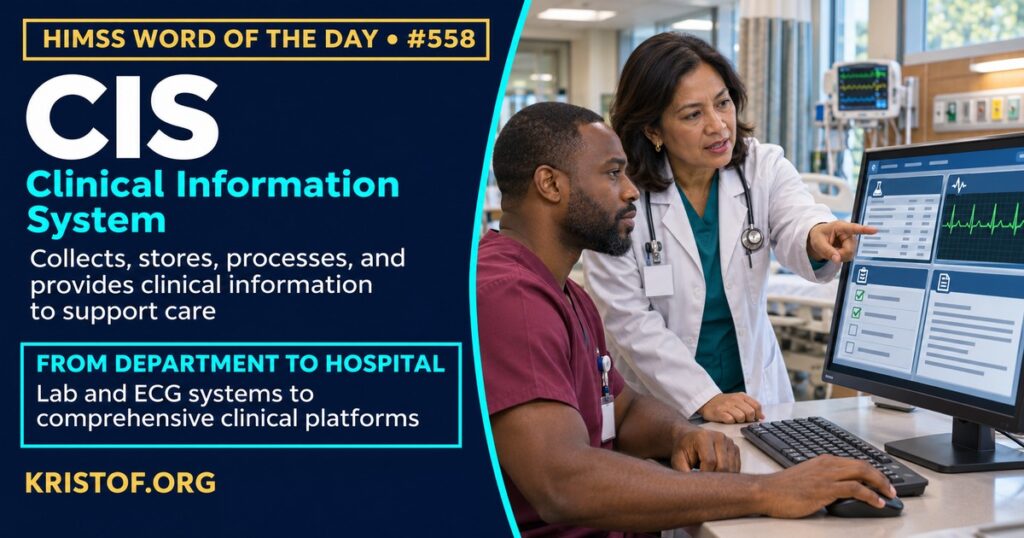
The HIMSS Dictionary defines a clinical information system (CIS) as a system built to collect, store, work with, and make available the clinical information that matters for delivering health care. The Dictionary notes that a CIS may be limited to one area, such as a laboratory system or an ECG management system, or may be comprehensive and cover nearly every part of clinical information.
That range is the key idea. In everyday use, “CIS” can refer to a single departmental tool or to the main system a hospital relies on for charting, orders, and results. The scope depends on the organization, so it is worth asking which meaning a speaker has in mind.
| Scope | Examples of a CIS |
|---|---|
| Single area | Laboratory system, ECG management system, bedside monitoring data system |
| Department group | Pharmacy, radiology, or intensive care systems that share data |
| Comprehensive | A system that covers documentation, orders, results, and care planning across a hospital or province |
The table is a teaching sketch and not an official taxonomy.
⚠️ Exam Alert: A CIS is defined by what it does with clinical information, not by its size. An EHR is a comprehensive record shared across settings, and a CIS may be only one department’s system. An ancillary system is a supporting department system that often feeds a larger CIS. CIS can also mean other things outside health IT, so the context matters. HIMSS offers CAHIMS and CPHIMS.
🌐 Why It Matters: Real-World Healthcare IT Context
The studies below involve clinical information systems of different sizes, from a province-wide system to an intensive care data system. Each was checked against its published abstract, and the type of study is noted. Most come from Canada or Spain, so findings may differ elsewhere.
Checking configuration for safety. Sutton and colleagues, in Applied Clinical Informatics (2023), applied a safety checklist to a province-wide CIS in Alberta, Canada. The abstract cites Digital Health Canada’s 2013 eSafety guidelines, which estimate that about one-third of patient safety incidents after CIS implementation are technology-related. The team applied a shortened version of the checklist to 13 modules, with two evaluators reviewing recorded demonstrations. All modules scored above 72 percent compliance, averaging 84 percent, and 273 opportunities for improvement were identified. Four themes emerged: inconsistent date and time, unclear patient identification, an ineffective alert system, and insufficient decision support. The method reviewed recordings, not live use, so it shows configuration gaps and not actual harm.
Improving work after implementation. Eberhardt and colleagues, in the Canadian Journal of Hospital Pharmacy (2026), describe a quality improvement group at a tertiary hospital that formed after a CIS went live. Process mapping found two areas of wasted time: knowing which information sources pharmacists could use for problem-solving, and finding the right clinical pharmacist to contact. After four action plans, the time to resolve medication orders needing clarification fell by 81 percent, and surveyed pharmacists were generally satisfied, except with the standard sign-in method for the care team. It is a single-site improvement project, so the result shows what can be done locally and not what to expect everywhere.
Using a CIS to support infection control. Leal and colleagues, in the American Journal of Infection Control (2026), studied an admission screening tool for antimicrobial-resistant organisms inside Alberta’s provincial CIS, using data from January 2020 to March 2024 from 92 percent of eligible facilities. Adherence ranged from 43 to 65 percent, and it declined with more months of CIS use. Higher adherence was associated with lower MRSA infection rates, though the authors describe the effect size as small and say more work is needed to clarify whether screening reduces transmission. It is an observational study, so it cannot show cause.
Replacing manual records. Munoz-Bonet and colleagues, in Scientific Reports (2023), studied a high-density-data CIS in a pediatric intensive care unit, using patients with severe diabetic ketoacidosis. The system collects one data point per parameter every 3 to 5 seconds and calculates hourly statistics. Compared with manual hourly nursing records for heart rate, respiratory rate, and oxygen saturation, the central-tendency calculations were identical or very similar and strongly correlated, while the measures of spread differed and correlated more weakly. The authors conclude that central-tendency calculations can replace manual records, but that automatic measurements need supervision by staff. It is a prospective observational study in one setting.
Open-source options. Magdub and colleagues, in Studies in Health Technology and Informatics (2024), examine GNU Health, an open-source CIS, for use in European countries. Using one case study and expert interviews, they describe benefits such as customization, integration, and scalability, and barriers such as regulation, interoperability issues, and resistance to change from established proprietary systems. They conclude that the obstacles can hardly be overcome. This is a small qualitative paper, and it covers one product.
Together, the sources show that a CIS is more than software: its configuration, support after go-live, and fit with workflow determine whether it helps.
Common clinical information system problems:
- Inconsistent date and time display across modules
- Unclear patient identification on screens
- Alerts that are ineffective or poorly targeted
- Decision support that is missing where it is needed
- Support structures that are unclear after go-live
- Adherence to built-in tools that fades over time
What supports a safe, useful CIS:
- Safety review of configuration before and after go-live
- Quality improvement teams that include pharmacy, nursing, and medicine
- Clear roles and contacts for problem-solving
- Built-in tools that fit the actual workflow
- Supervised automation of data capture, such as device data
- Ongoing measurement of use and results
🏥 The Nurse’s Perspective: Clinical, Bedside, & Workflow
Nurses interact with the clinical information system more than almost any other group, so its design shows up in every shift.
At the Bedside
Identification is the first safety step, so unclear patient identification on a screen is a concern at the point of care. Consistent date and time displays matter just as much, because a medication or assessment recorded with the wrong time can mislead the next nurse. Automation helps when it removes repeated manual entry, as in the vital signs study, but nurses still review the data for meaning.
In Clinical Workflow
The CIS ties together orders, results, documentation, and communication. When tools such as an admission screening form are built into it, adherence depends on how well they fit the real order of work. Nurse informaticists can look for places where use drops off and ask nurses what slows them down.
In EHR Implementation (Go-Live Perspective)
During an Epic Go-Live, analysts at the elbow see how a CIS settles in: first questions about logging in and finding patients, then questions about who to call for a medication order or a build issue. The quality improvement example shows that clarifying roles and contacts after go-live can save time. Writing down which questions repeat gives teams a starting list for fixes.
🎓 CAHIMS / CPHIMS & HIMSS Perspective
CAHIMS Exam Domain Mapping
The CIS sits at the center of care delivery and systems management:
| CAHIMS Domain | How the CIS Appears |
|---|---|
| Healthcare & Technology Environments | Types and scope of clinical systems in a health system |
| Clinical Informatics | Documentation, orders, results, and decision support in care |
| Healthcare Information & Systems Management | Configuration, safety review, support, and optimization after go-live |
| Management & Leadership | Governance, quality improvement, and measuring the value of systems |
Key Terms to Know Alongside the CIS
- EHR (Electronic Health Record) — electronic version of a patient’s health record
- Nursing information system — system that supports nursing documentation and care management
- Pharmacy Information System (PIS) — system that supports medication ordering, verification, and dispensing
- Implementation — process of putting a system into use in an organization
- Alert — notification that draws attention to a condition or action
- Clinical Data Repository (CDR) — database that stores clinical data from multiple sources
HIMSS Organizational Position
HIMSS offers education and research on health information and technology topics through its Resource Center. Members can find related information on the HIMSS Resource Center page.
🧭 More HIMSS Word of The Day Terms
Related terms in the Clinical Informatics series:
- Data Governance
- VistA (Veterans Health Information Systems and Technology Architecture)
- Advance Directive
- Anesthesia Information Management System (AIMS)
Browse all Clinical Informatics terms or the A–Z glossary.
🔗 Explore Further: External References
- Sutton et al. (2023), Applied clinical informatics — System Configuration Evaluation for a Province-Wide Clinical Information System Using the eSafety Checklist https://pubmed.ncbi.nlm.nih.gov/37704029/
- Eberhardt et al. (2026), The Canadian journal of hospital pharmacy — Establishing a Quality Improvement Working Group to Improve Pharmacist Communication at a Tertiary Hospital after Implementation of a Clinical Information System https://pubmed.ncbi.nlm.nih.gov/42964940/
- Leal et al. (2026), American journal of infection control — Antimicrobial-resistant organism admission screening adherence using a clinical information system and its impact on methicillin-resistant Staphylococcus aureus rates in a provincial healthcare system https://pubmed.ncbi.nlm.nih.gov/41547515/
- Munoz-Bonet et al. (2023), Scientific reports — Exploring the clinical relevance of vital signs statistical calculations from a new-generation clinical information system https://pubmed.ncbi.nlm.nih.gov/37699960/
- Magdub et al. (2024), Studies in health technology and informatics — Utilizing Open Source Clinical Information Systems in European Countries: Potential and Barriers https://pubmed.ncbi.nlm.nih.gov/39575790/
- HIMSS — Resource Center https://www.himss.org/resource-center
Term source: HIMSS Dictionary of Health Information and Technology Terms, Acronyms, and Organizations, 6th Edition (2025). All definitions in this series are paraphrased for editorial purposes. Readers are encouraged to consult the primary source for exact language.
Eric Andrew Kristof, RN, CAHIMS is a Healthcare IT professional and HIMSS Arkansas Chapter member based in Hot Springs Village, AR, with hands-on Epic Go-Live experience and a diverse healthcare and IT background. He writes at kristof.org at the intersection of clinical care and healthcare technology.
Leave a Reply