By Eric Andrew Kristof, RN, CAHIMS | Healthcare IT Professional | HIMSS Arkansas Chapter Member
About This Series: The HIMSS Word of The Day is a running blog series drawing from the HIMSS Dictionary of Health Information and Technology Terms, Acronyms, and Organizations, 6th Edition (2025) — the authoritative reference for healthcare IT professionals and the primary study resource for CAHIMS and CPHIMS certification. Each post paraphrases the term in plain language, grounds it in real-world healthcare IT context, and adds a bedside nursing perspective you won’t find in a textbook.
📖 The Term: HUD (Heads-Up Display)
Source: HIMSS Dictionary of Health Information and Technology Terms, Acronyms, and Organizations, 6th Edition (2025)
🔍 Plain-Language Definition
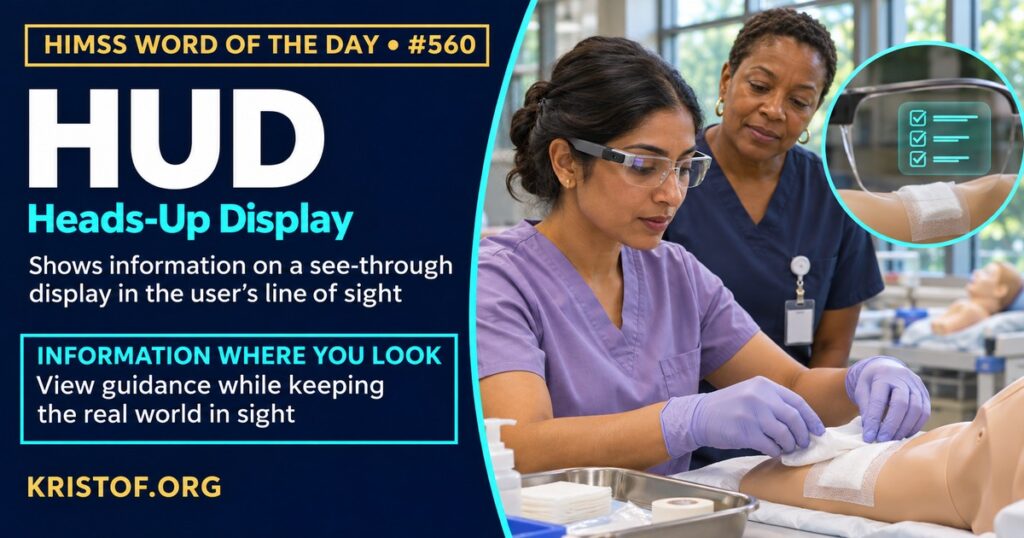
The HIMSS Dictionary describes a heads-up display (HUD) as a display that places information, data, or other graphics directly in front of the user’s eyes. The imaging runs on a see-through glass screen, so the person can read what is shown without tilting the head, moving the neck, or scrolling to find it. The Dictionary lists “Heads-Up Display” as the spelled-out name of the abbreviation.
In health care, the idea is easiest to see in two settings. In the operating room, a surgeon may see imaging or navigation guidance overlaid on the field. In teaching and care delivery, a student or clinician may wear smart glasses or a headset that shows instructions or video. Both depend on the same principle: information appears where the user is already looking.
| Related term | How it relates to a HUD |
|---|---|
| Augmented reality (AR) | Superimposes layers of virtual content on real physical objects, often shown through a HUD |
| Head-mounted display (HMD) | A wearable display; Google Glass and Microsoft HoloLens are examples of optical HMDs |
| Smart glasses | Eyeglass-style wearable displays, for example Google Glass |
| Virtual reality (VR) | Replaces the real view with a fully computer-generated one |
The table is a teaching sketch and not an official taxonomy. Products and terms overlap.
⚠️ Exam Alert: A HUD is a display method: information shown in the user’s line of sight. Augmented reality is the technique of overlaying content on the real world, and a HUD is one way to show that content. Virtual reality replaces the real view instead of adding to it. A HUD is also not a dashboard, which is a summary screen that a person turns to look at, and not a wearable sensor, which collects data instead of displaying it.
🌐 Why It Matters: Real-World Healthcare IT Context
The reviews below cover wearable displays and augmented reality in health care. Each was checked against its published abstract, and the type of study is noted. Most are narrative or scoping reviews, which summarize literature without testing a single device against a control, and several note that evidence is early.
Smart glasses and headsets compared. Baashar and colleagues, in the International Journal of Environmental Research and Public Health (2023), surveyed wearable augmented reality in health care with a focus on head-mounted displays. They considered 37 studies from 2017 to 2022, of which about 41 percent focused on smart glasses such as Google Glass and about 59 percent on Microsoft HoloLens. Google Glass appeared in surgical specialties, preoperative settings, dermatology visits, and nursing skill training, while HoloLens appeared in telepresence and holographic navigation. Limits included low battery life, limited memory, and possible ocular pain. The authors report promising feasibility, usability, and acceptability results but call for more rigorous research on efficacy and cost-effectiveness.
Nursing education. Romare and Skär, in Nurse Education in Practice (2023), did a scoping review of smart glasses in nursing education and analyzed 14 references. Smart glasses were used in different learning situations and were generally evaluated positively by nursing students, who found them beneficial, motivating, and engaging. The authors also note drawbacks that could negatively affect learning, say the results depended on both the user and the situation, and report that technical issues could make students lose focus and that technical support is needed.
Independent learning. Quqandi and colleagues, in CIN: Computers, Informatics, Nursing (2023), reviewed augmented reality in supporting independent learning in health care and nursing education. They note strengths and challenges and find few studies that link augmented reality with independent learning theory, then propose a new learning approach to fill the gap. It is a narrative review that ends in a proposal, not a test.
In orthopaedic surgery. Lex and colleagues, in International Orthopaedics (2023), wrote a narrative review of augmented reality in orthopaedic surgery. They describe a system with a camera, image processing, tracking tools, and an output screen, and say the user sees a transparent heads-up display that shows both the natural view and computer-generated images. The authors state that high-quality evidence for clinical use in the orthopaedic operating room is lacking. They add that a growing in vitro literature points to possible gains in operative accuracy, alignment parameters, and operative time, and they describe AR in surgery as being in its infancy.
In neurosurgery. Contreras López and colleagues, in Clinical Neurology and Neurosurgery (2019), systematically reviewed intraoperative augmented reality in neurosurgery. They searched PubMed for studies from the preceding five years and included 12 articles. Neurovascular use was the most frequent (47.3 percent), followed by neuro-oncological use (46.7 percent). The authors write that AR lets a surgeon keep the view on the operative site and is useful for locating structures and planning, but they state that comparative studies are still required to determine its effectiveness. This review is older than the others, and its search was limited to one database.
Together, the reviews show wide interest, some promising early results, practical hardware limits, and a clear call for stronger comparative studies.
Common heads-up display problems:
- Low battery life and limited memory size, as listed in the 2023 survey of head-mounted displays
- Possible ocular pain
- Technical issues that can pull a student’s attention away from the lesson
- Drawbacks that could negatively affect learning, noted in the nursing education review
- Little high-quality clinical evidence, especially in orthopaedic surgery
- A shortage of comparative studies, which the neurosurgery review says are still required
What supports a useful heads-up display:
- A task where information in the line of sight replaces glances at several screens
- Technical support to ease the learning curve, which the nursing education review calls for
- Promising feasibility, usability, and acceptability results reported in the 2023 survey
- Study designs that test efficacy and cost-effectiveness, which that survey requests
- Matching the device to the setting, since results depended on both user and situation
🏥 The Nurse’s Perspective: Clinical, Bedside, & Workflow
A heads-up display changes where information appears, and that matters most when a nurse’s hands are busy.
At the Bedside
For procedures with sterile fields, a display in the line of sight could mean fewer trips to a screen. The 2023 survey notes that head-mounted displays may help maintain sterile conditions in the surgical field. In nursing education, students generally evaluate smart glasses positively, though the same review notes drawbacks. A device with a camera also raises a practical question for nurses about what is captured and who can see it, and that is a local policy matter outside these reviews.
In Clinical Workflow
Any wearable display adds a new device to charge, clean, and manage. Nurse informaticists can ask early questions: where the device is stored, how it is cleaned, who may record with it, and what happens when the battery fades mid-shift. The survey lists low battery life, limited memory, and possible ocular pain as limits, so these questions belong in planning.
In EHR Implementation (Go-Live Perspective)
During an Epic Go-Live, analysts at the elbow already see how hardware shapes work: workstation placement, handheld scanners, and screen glare. A wearable display would add questions about how information reaches the device and who controls what it shows. A pilot with a small group of nurses, with notes on comfort and usefulness, is a sensible first step.
🎓 CAHIMS / CPHIMS & HIMSS Perspective
CAHIMS Exam Domain Mapping
The heads-up display connects hardware, workflow, and emerging technology:
| CAHIMS Domain | How a HUD Appears |
|---|---|
| Healthcare & Technology Environments | Wearable and emerging display technologies in surgery, education, and care |
| Clinical Informatics | Information delivered in the clinician’s line of sight at the point of care |
| Healthcare Information & Systems Management | Device management, privacy, integration, and support |
| Management & Leadership | Pilot design, evaluating value, and change management |
Key Terms to Know Alongside a HUD
- Virtual reality — computer-generated environment that replaces the user’s real view
- Wearable technology — devices worn on the body that collect or display information
- Usability testing — evaluating a system by watching users try real tasks
- Dashboard — screen that summarizes key measures for monitoring
- Point-of-care system — system used where care is delivered
- Digital health — broad label that covers mobile, wearable, and connected tools
HIMSS Organizational Position
HIMSS offers education and research on health information and technology topics through its Resource Center. Members can find related information on the HIMSS Resource Center page.
🧭 More HIMSS Word of The Day Terms
Related terms in the Connected Health series:
Browse all Connected Health terms or the A–Z glossary.
🔗 Explore Further: External References
- Baashar et al. (2023), International journal of environmental research and public health — Towards Wearable Augmented Reality in Healthcare: A Comparative Survey and Analysis of Head-Mounted Displays https://pubmed.ncbi.nlm.nih.gov/36900951/
- Romare and Skär (2023), Nurse education in practice — The use of smart glasses in nursing education: A scoping review https://pubmed.ncbi.nlm.nih.gov/37924651/
- Quqandi et al. (2023), Computers, informatics, nursing : CIN — Augmented Reality in Supporting Healthcare and Nursing Independent Learning: Narrative Review https://pubmed.ncbi.nlm.nih.gov/35470310/
- Lex et al. (2023), International orthopaedics — Clinical applications of augmented reality in orthopaedic surgery: a comprehensive narrative review https://pubmed.ncbi.nlm.nih.gov/35852653/
- Contreras López et al. (2019), Clinical neurology and neurosurgery — Intraoperative clinical application of augmented reality in neurosurgery: A systematic review https://pubmed.ncbi.nlm.nih.gov/30579049/
- HIMSS — Resource Center https://www.himss.org/resource-center
Term source: HIMSS Dictionary of Health Information and Technology Terms, Acronyms, and Organizations, 6th Edition (2025). All definitions in this series are paraphrased for editorial purposes. Readers are encouraged to consult the primary source for exact language.
Eric Andrew Kristof, RN, CAHIMS is a Healthcare IT professional and HIMSS Arkansas Chapter member based in Hot Springs Village, AR, with hands-on Epic Go-Live experience and a diverse healthcare and IT background. He writes at kristof.org at the intersection of clinical care and healthcare technology.
Leave a Reply