By Eric Andrew Kristof, RN, CAHIMS | Healthcare IT Professional | HIMSS Arkansas Chapter Member
About This Series: The HIMSS Word of The Day is a running blog series drawing from the HIMSS Dictionary of Health Information and Technology Terms, Acronyms, and Organizations, 6th Edition (2025) — the authoritative reference for healthcare IT professionals and the primary study resource for CAHIMS and CPHIMS certification. Each post paraphrases the term in plain language, grounds it in real-world healthcare IT context, and adds a bedside nursing perspective you won’t find in a textbook.
📖 The Term: NCPDP Telecommunication Standard
Source: HIMSS Dictionary of Health Information and Technology Terms, Acronyms, and Organizations, 6th Edition (2025)
🔍 Plain-Language Definition
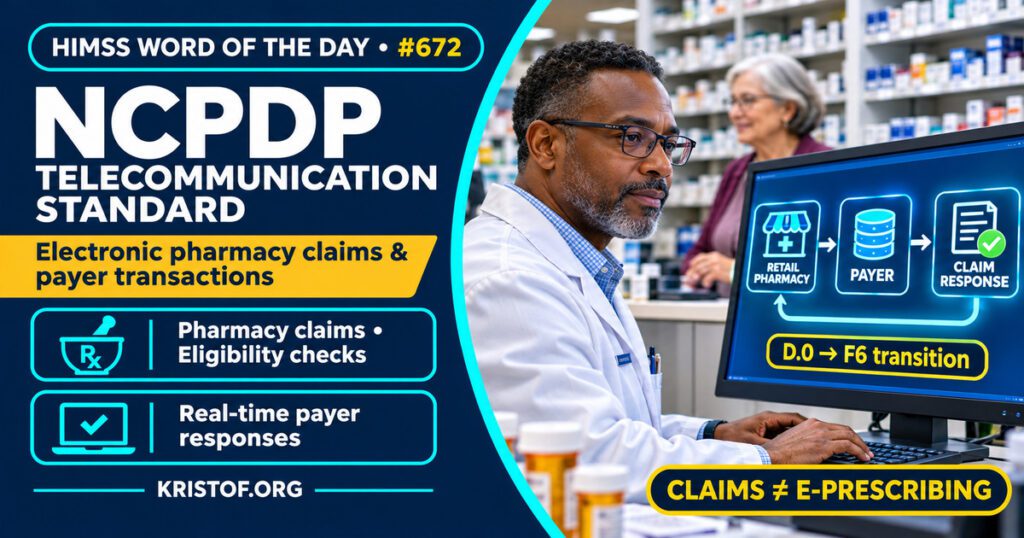
The HIMSS Dictionary describes the NCPDP Telecommunication Standard in two senses. First, it is a National Council for Prescription Drug Programs standard designed for high-volume dispensers such as retail pharmacies, and the dictionary says Version 5.1 is mandated under HIPAA. Second, it is a standard format for electronic submission of third-party drug claims, built to support eligibility checks at the point of sale and consistent claims processing.
The reference to Version 5.1 is out of date. A 2020 letter from the National Committee on Vital and Health Statistics (NCVHS), an advisory body to the HHS Secretary, says Version D.0 is the NCPDP Telecommunication Standard named in HIPAA, adopted in 2009 and required for use starting in 2012. I did not find a source in this session that discusses Version 5.1, so I cannot say when it was replaced.
According to a 2024 federal final rule, the standard covers retail pharmacy transactions for health care claims or equivalent encounter information, eligibility, referral certification and authorization, and coordination of benefits.
| Version | Status in the sources below | Source |
|---|---|---|
| 5.1 | Named in the dictionary, no longer the HIPAA-named version | Dictionary, NCVHS letter |
| D.0 | Adopted in 2009 and required from 2012, currently named in HIPAA | NCVHS letter |
| F6 | Adopted by a December 2024 final rule to replace D.0 | Federal Register |
| Batch Standard | Version 1.2 replaced by Version 15 in the same rule | Federal Register |
⚠️ Exam Alert: The NCPDP Telecommunication Standard is the format for pharmacy claims and related payer transactions. NCPDP SCRIPT is a different NCPDP standard, used for electronic prescribing. Do not use the dictionary’s Version 5.1 as the current answer on an exam, and learn that the named version has moved from D.0 toward F6.
🌐 Why It Matters: Real-World Healthcare IT Context
The regulatory timeline. The NCVHS letter of April 22, 2020 recommended that HHS adopt Version F6 to replace Version D.0, and notes that D.0 has been in effect since its 2009 adoption and required since 2012. A final rule published in the Federal Register on December 13, 2024 then replaced the NCPDP Telecommunication Standard Version D.0 with Version F6, and replaced the equivalent Batch Standard Version 1.2 with Version 15. For Medicaid pharmacy subrogation, it replaced Version 3.0 with Version 10, but only for State Medicaid agencies. The proposed requirement for all health plans was not finalized.
The dates changed, and sources disagree. The December 2024 rule originally set an effective date of February 11, 2025, with compliance by February 11, 2028 and an optional transition period starting August 11, 2027. NCPDP’s own HIPAA page, revised January 9, 2026, says the effective date was delayed to April 14, 2025 under a January 20, 2025 presidential memorandum on a regulatory freeze. An interim final rule published August 21, 2025, effective August 20, 2025, states that covered entities must comply with Version F6 and Version 15 by April 14, 2028, rather than February 11, 2028, and that the 8-month transition period now runs from August 14, 2027 through April 14, 2028. It says the earlier text allowed only six months because of a calculation error, and that it changes dates, not the substance of the standards. NCPDP’s page still lists February 11, 2028 as the required date in one place, and also mentions April 14, 2028, without explaining the difference. HIPAA Journal’s article reports the earlier dates. I would treat the August 2025 interim final rule as the most recent primary source I found, and verify the current dates before any planning.
Who is affected. The Federal Register summary says covered entities must comply, and State Medicaid agencies must comply with the subrogation version. I did not read the sections that define covered entities in detail, so I give no further list.
What I could not confirm. I could not read the eCFR text of 45 CFR 162.1102 because that site blocked my fetch, so I did not confirm the current regulation text. I did not find a source discussing Version 5.1. I did not review the technical content of Version F6 or D.0, such as data fields or the changes between them, and I did not verify any cost or impact estimates. I read federal summary and date sections and NCPDP’s HIPAA page, not full technical specifications, which NCPDP distributes to members.
Common NCPDP Telecommunication Standard problems:
- Using an out-of-date version number as the current one
- Mixing it up with NCPDP SCRIPT, which is for e-prescribing
- Planning around a compliance date from a superseded document
- Assuming trading partners will switch on the same day during the transition period
- Treating a federal summary as the technical specification
What supports a smooth transition:
- Checking the current compliance dates in the Federal Register and CMS guidance
- Confirming with trading partners when each will use F6
- Reviewing payer sheets and software vendor plans
- Testing before the transition period begins
- Tracking later corrections and delays, as this rule has had several
🏥 The Nurse’s Perspective: Clinical, Bedside, & Workflow
Most nurses never see this standard, because it moves claims between pharmacy systems and health plans.
At the Bedside
A bedside nurse does not use the standard directly. Its transactions are retail pharmacy claims, eligibility checks, referral certification and authorization, and coordination of benefits, which are payer-facing steps, as described in the federal rule. A patient who cannot get a prescription filled at a pharmacy because of a claim problem may call the clinic, which is a plausible downstream effect that none of the sources measure.
In Clinical Workflow
Nurses in clinics and care coordination roles sometimes handle calls about medication access. Understanding that pharmacy claims follow a standard format with versions helps explain why a change by a payer or pharmacy can disrupt routine fills. This is a workflow observation, not a finding from the rule.
In EHR Implementation (Go-Live Perspective)
During an Epic Go-Live, analysts and at-the-elbow support staff work mostly with prescribing and pharmacy interfaces. The Telecommunication Standard sits between pharmacies and payers, so a go-live team is less likely to configure it, but may field questions when a claim issue is blamed on “the system.” This is general workflow context, and the sources reviewed do not address EHR go-lives.
🎓 CAHIMS / CPHIMS & HIMSS Perspective
CAHIMS Exam Domain Mapping
The standard appears in questions about transactions, HIPAA, and standards adoption:
| CAHIMS Domain | How the NCPDP Telecommunication Standard Appears |
|---|---|
| Healthcare & Technology Environments | Standards, transaction formats, and versions |
| Clinical Informatics | Medication access and pharmacy claims data |
| Healthcare Information & Systems Management | Compliance dates, trading partner coordination, and testing |
| Management & Leadership | Regulatory change management and vendor oversight |
Key Terms to Know Alongside the NCPDP Telecommunication Standard
- HIPAA transaction standards — the standard formats HIPAA requires covered entities to use for certain electronic transactions
- Covered entity — a health plan, clearinghouse, or provider that is subject to HIPAA
- NCPDP SCRIPT — an NCPDP standard for electronic prescribing
- Eligibility verification — checking whether a patient has active coverage
- Coordination of benefits — determining which payer pays first when more than one plan applies
- Trading partner — an entity with which another entity exchanges standard transactions
HIMSS Organizational Position
HIMSS offers education and research on health information and technology topics through its Resource Center. Members can find related information on the HIMSS Resource Center page.
🧭 More HIMSS Word of The Day Terms
Related terms in the Interoperability and Standards series:
- Application Programming Interface (API)
- Electronic Data Interchange (EDI)
- Standards Development Organization (SDO)
- Unicode
Browse all Interoperability and Standards terms or the A–Z glossary.
🔗 Explore Further: External References
- HHS — Administrative Simplification: Modifications of HIPAA NCPDP Retail Pharmacy Standards; and Modification of the Medicaid Pharmacy Subrogation Standard, final rule, Federal Register, December 13, 2024 https://www.govinfo.gov/content/pkg/FR-2024-12-13/pdf/2024-29138.pdf
- HHS — Interim final rule updating the dates in the December 2024 NCPDP final rule, Federal Register, August 21, 2025 https://public-inspection.federalregister.gov/2025-15958.pdf
- NCPDP — HIPAA information (revised January 9, 2026) https://ncpdp.org/NCPDP/media/pdf/Resources/HIPAA.pdf
- NCVHS — Recommendation letter on adoption of a new pharmacy standard under HIPAA, April 22, 2020 https://ncvhs.hhs.gov/wp-content/uploads/2020/04/Recommendation-Letter-Adoption-of-New-Pharmacy-Standard-Under-HIPAA-April-22-2020-508.pdf
- HIPAA Journal — HHS Publishes Final Rule Modifying HIPAA NCPDP Retail Pharmacy and Medicaid Pharmacy Subrogation Standards https://www.hipaajournal.com/hipaa-final-rule-ncpdp-retail-pharmacy-medicaid-pharmacy-subrogation-standards/
- HIMSS — Resource Center https://www.himss.org/resource-center
Term source: HIMSS Dictionary of Health Information and Technology Terms, Acronyms, and Organizations, 6th Edition (2025). All definitions in this series are paraphrased for editorial purposes. Readers are encouraged to consult the primary source for exact language.
Eric Andrew Kristof, RN, CAHIMS is a Healthcare IT professional and HIMSS Arkansas Chapter member based in Hot Springs Village, AR, with hands-on Epic Go-Live experience and a diverse healthcare and IT background. He writes at kristof.org at the intersection of clinical care and healthcare technology.
Leave a Reply