By Eric Andrew Kristof, RN, CAHIMS | Healthcare IT Professional | HIMSS Arkansas Chapter Member
About This Series: The HIMSS Word of The Day is a running blog series drawing from the HIMSS Dictionary of Health Information and Technology Terms, Acronyms, and Organizations, 6th Edition (2025) — the authoritative reference for healthcare IT professionals and the primary study resource for CAHIMS and CPHIMS certification. Each post paraphrases the term in plain language, grounds it in real-world healthcare IT context, and adds a bedside nursing perspective you won’t find in a textbook.
📖 The Term: EMI (Electromagnetic Interference)
Source: HIMSS Dictionary of Health Information and Technology Terms, Acronyms, and Organizations, 6th Edition (2025)
🔍 Plain-Language Definition
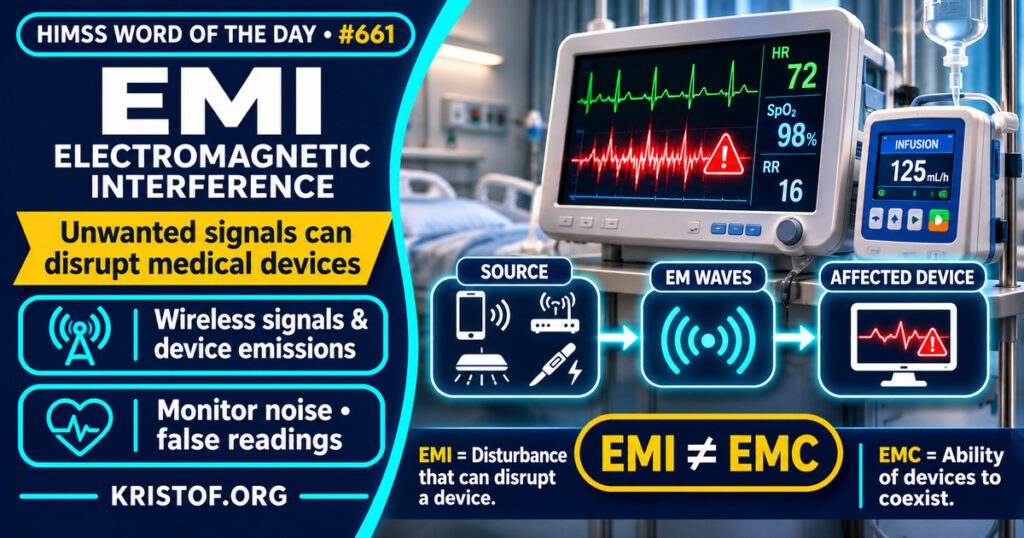
The HIMSS Dictionary describes EMI (electromagnetic interference) as a disturbance in how an electronic device operates that is caused by electromagnetic waves. In a healthcare setting the source can be another device, a wireless system, a light fixture, or surgical equipment, and the affected device can be a bedside monitor, an infusion pump, a telemetry transmitter, or an implanted cardiac device.
EMI is one side of electromagnetic compatibility (EMC), which asks whether devices can work together in the same environment without disrupting each other.
| Element | Role | Example from the sources below |
|---|---|---|
| Source | Emits electromagnetic energy | Mobile phone, WLAN adapter, LED light power supply, electrosurgery unit |
| Path | How the energy reaches the device | Radiated through the air, usually at a short distance |
| Victim device | The equipment that malfunctions | Infusion pump, monitor, pacemaker, wireless telemetry |
| Effect | The disruption | Noise, false signals, loss of function, inappropriate therapy |
⚠️ Exam Alert: EMI is about unwanted energy disrupting a device. It is not the same as a network outage, a cyberattack, or a software fault, although all of these can make a device misbehave. Keep EMI (the disturbance) distinct from EMC (the ability to coexist).
🌐 Why It Matters: Real-World Healthcare IT Context
EMI research covers a wide range of devices and decades of technology. Several of the sources below describe testing of equipment that has since changed, so the numbers show what was found at the time, not what hospitals should expect now.
Mobile phones. Lawrentschuk and Bolton (2004) systematically reviewed studies of digital mobile phone interference with monitoring and treatment equipment, not including implantable devices, covering 1966 to 2004. Clinically relevant EMI that could endanger patients occurred in 45 of 479 devices tested at 900 MHz and 14 of 457 at 1800 MHz. In the largest studies the prevalence was low, and most clinically relevant interference occurred within 1 meter. The authors note testing was not standardized and that at least 4 percent of devices tested in any study were susceptible. All studies recommended some restriction of phone use, most often keeping phones farther than 1 meter from equipment and restricting use in clinical areas. The phones and devices tested were from the era before smartphones, so current risk may differ.
Wireless networks. Calcagnini and colleagues (2011) tested 45 critical care devices, including infusion pumps, defibrillators, monitors, ventilators, anesthesia machines, and external pacemakers, with wireless local area network adapters (IEEE 802.11 b/g, 2.45 GHz, 100 mW) under the ANSI C63.18 recommended practice. Interference occurred in three of 45 devices at a maximum distance of 5 centimeters, and in two cases the malfunction could have clinical consequences. The authors consider these adapters reasonably safe, though interference may occur at very close range, under 10 centimeters. This is a bench test of the devices and adapters of that time.
Telemetry and lighting. Ishida and colleagues (2020) studied wireless medical telemetry in Japan, which uses 400 MHz bands shared with other radio systems. They tested interference from radiation noise emitted by switched-mode power supplies in LED lights and suggested countermeasures and a simple way to manage the electromagnetic environment. The abstract does not give numeric results, and the setting is Japan, whose radio rules may differ from those elsewhere.
Surgery and implanted devices. Misiri and colleagues (2012) reviewed EMI from medical equipment and implanted cardiac devices. They report that the most commonly observed interaction is in the operating room with electrosurgery, that risk can often be reduced by communication between the cardiac device specialist and the anesthesia and surgical team, and that MRI should generally not be used in patients with these devices. Gordon and colleagues (2021) reviewed cases of EMI between continuous-flow left ventricular assist devices and other implanted cardiac devices, finding interference with telemetry or signal sensing, inappropriate shocks in some cases, and fixes such as shielding, increasing distance, or exchanging a device. That review draws on case reports, which can overstate how often problems occur.
What I could not confirm. I did not find a current, hospital-wide estimate of how often EMI affects patient care, and I did not review modern smartphone and Wi-Fi 6 era testing. I did not verify the full text of any source, so details beyond the abstracts, such as the tested models, are not covered.
Common EMI problems:
- Assuming old test results describe current phones and networks
- Placing a transmitter or charger close to sensitive equipment
- New equipment or lighting added without electromagnetic review
- Shared radio bands with several systems in one area
- Implanted device interactions that the care team does not plan for
What supports managing EMI:
- Testing devices with recognized methods, such as ANSI C63.18
- Distance and use policies for phones and wireless adapters near critical equipment
- Reviewing the electromagnetic environment when adding lighting or radio systems
- Communication among device specialists, surgeons, and anesthesia teams
- Reporting suspected interference so it can be investigated
🏥 The Nurse’s Perspective: Clinical, Bedside, & Workflow
Nurses are often the first to notice when a device behaves oddly near other equipment.
At the Bedside
A monitor tracing that suddenly shows noise, or a pump that alarms near a transmitter, may be EMI, though many other causes exist. The reviews above do not tell a nurse how to diagnose it. A practical step is to treat the patient first, check the patient and device connections, move or remove the suspected source if it is safe to do so, and report the event to biomedical engineering.
In Clinical Workflow
Mobile phone and wireless device policies on units are shaped by studies like the systematic review above, which reported most clinically relevant interference within 1 meter. Nurses who carry phones and wireless devices follow those policies, and they can report events that suggest a source or location problem. For patients with implanted cardiac devices, the review of the medical environment points to planning with the device team before surgery or MRI.
In EHR Implementation (Go-Live Perspective)
During an Epic Go-Live, wireless computers on wheels, handheld devices, and badges join the environment. Analysts and biomedical staff can test device performance with the new equipment in place, as the WLAN adapter study did on a bench. This is a workflow suggestion, not a finding from the studies.
🎓 CAHIMS / CPHIMS & HIMSS Perspective
CAHIMS Exam Domain Mapping
EMI appears wherever devices and wireless systems share an environment:
| CAHIMS Domain | How EMI Appears |
|---|---|
| Healthcare & Technology Environments | Wireless systems, medical devices, and the physical environment |
| Clinical Informatics | Device data quality and patient safety |
| Healthcare Information & Systems Management | Network planning, device testing, and incident review |
| Management & Leadership | Policy on wireless devices and technology risk |
Key Terms to Know Alongside EMI
- Electromagnetic compatibility (EMC) — the ability of equipment to operate in an electromagnetic environment without causing or suffering unacceptable interference
- Wireless medical telemetry (WMT) — wireless transmission of patient monitoring data
- Wireless local area network (WLAN) — a local network that uses radio links instead of cables
- Radio frequency identification (RFID) — use of radio signals to identify tagged items
- Cardiac implantable electronic device (CIED) — an implanted device such as a pacemaker or defibrillator
- Medical device integration — the flow of device data into clinical information systems
HIMSS Organizational Position
HIMSS offers education and research on health information and technology topics through its Resource Center. Members can find related information on the HIMSS Resource Center page.
🧭 More HIMSS Word of The Day Terms
Related terms in the IT Infrastructure series:
Browse all IT Infrastructure terms or the A–Z glossary.
🔗 Explore Further: External References
- Lawrentschuk and Bolton (2004), Medical Journal of Australia — Mobile phone interference with medical equipment and its clinical relevance: a systematic review https://pubmed.ncbi.nlm.nih.gov/15287832/
- Calcagnini et al. (2011), Health Physics — Electromagnetic compatibility of WLAN adapters with life-supporting medical devices https://pubmed.ncbi.nlm.nih.gov/21451319/
- Ishida et al. (2020), Journal of Medical Systems — Electromagnetic Compatibility of 400 MHz Radio Communications in Hospitals: Safety Management of Wireless Medical Telemetry https://pubmed.ncbi.nlm.nih.gov/32737672/
- Misiri et al. (2012), Clinical Cardiology — Electromagnetic interference and implanted cardiac devices: the medical environment (part II) https://pubmed.ncbi.nlm.nih.gov/22539263/
- Gordon et al. (2021), Journal of Interventional Cardiac Electrophysiology — Electromagnetic interference between implantable cardiac devices and continuous-flow left ventricular assist devices: a review https://pubmed.ncbi.nlm.nih.gov/33433742/
- HIMSS — Resource Center https://www.himss.org/resource-center
Term source: HIMSS Dictionary of Health Information and Technology Terms, Acronyms, and Organizations, 6th Edition (2025). All definitions in this series are paraphrased for editorial purposes. Readers are encouraged to consult the primary source for exact language.
Eric Andrew Kristof, RN, CAHIMS is a Healthcare IT professional and HIMSS Arkansas Chapter member based in Hot Springs Village, AR, with hands-on Epic Go-Live experience and a diverse healthcare and IT background. He writes at kristof.org at the intersection of clinical care and healthcare technology.
Leave a Reply