By Eric Andrew Kristof, RN, CAHIMS | Healthcare IT Professional | HIMSS Arkansas Chapter Member
About This Series: The HIMSS Word of The Day is a running blog series drawing from the HIMSS Dictionary of Health Information and Technology Terms, Acronyms, and Organizations, 6th Edition (2025) — the authoritative reference for healthcare IT professionals and the primary study resource for CAHIMS and CPHIMS certification. Each post paraphrases the term in plain language, grounds it in real-world healthcare IT context, and adds a bedside nursing perspective you won’t find in a textbook.
📖 The Term: EOB (Explanation of Benefits)
Source: HIMSS Dictionary of Health Information and Technology Terms, Acronyms, and Organizations, 6th Edition (2025)
🔍 Plain-Language Definition
The HIMSS Dictionary describes an EOB (Explanation of Benefits) as a document that explains how a health claim was handled under the insured person’s benefits. The entry is short, so it helps to see how other sources describe it.
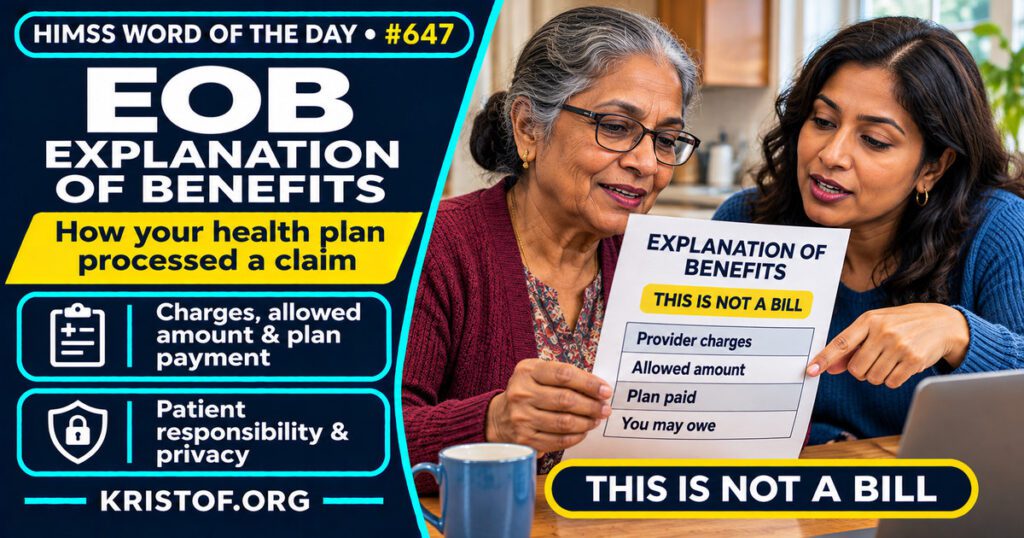
CMS, in its guide to reading an explanation of benefits, says an EOB shows the total charges for a visit and how much the health plan covers, and it stresses that an EOB is not a bill. The page says it helps a person see what they are likely to owe when the provider sends a bill. According to the page, an EOB lists a claim number, a payee, the provider’s charges, the allowed charges (what the provider will be paid, which may differ from the charges), the amount the insurer pays, and what the patient owes, along with remark codes that explain charges or payments.
Olson and colleagues (2025) describe EOBs as claims documents that health insurers send to policyholders to notify them of the charges for their own care and for the care of their covered dependents. That detail matters for health IT, because the person who receives the document may not be the person who received the care.
| Item | Detail |
|---|---|
| Sent by | The health plan or insurer |
| Sent to | The policyholder, who may differ from the patient (Olson and colleagues, 2025) |
| Not | A bill (CMS) |
| Typically shows | Provider charges, allowed charges, plan payment, amount owed, claim number, remark codes (CMS) |
| Common concern | Disclosure of sensitive services to a policyholder other than the patient |
⚠️ Exam Alert: An EOB is a summary of how a claim was handled, not a request for payment. A bill comes from the provider. Provider charges and allowed charges are different numbers on the same document. A related term, remittance advice, is commonly the provider-facing counterpart, but this post did not verify its details from the sources read.
🌐 Why It Matters: Real-World Healthcare IT Context
EOBs matter in health IT because they are a patient-facing output of claims data, and the way they are addressed and worded can affect privacy and access to care.
What studies show. Sedlander and colleagues (2015), in the Journal of Adolescent Health, wrote a commentary based on interviews with 31 health care administrators, policy experts, clinicians, and health plan representatives. They say the Affordable Care Act‘s expansion of coverage for young people may expose more people to confidentiality breaches through EOBs sent to the policyholder, typically a parent. The study identified five policy options for reconciling confidentiality protections with EOBs. No single solution emerged, but approaches built on automatic system changes, which need no action from the patient or provider, were considered most effective. The authors say more is needed to understand how these approaches are put into practice and enforced. This is a small qualitative study and a commentary, so it reflects expert opinion, not measured results.
Andrasfay (2018), in the same journal, analyzed 2015 National Health Interview Survey data on 2,108 young adults aged 18 to 25. In unadjusted analyses, dependents had lower HIV testing than privately insured or Medicaid policyholders. After controls, dependents did not have significantly lower odds than privately insured policyholders, though dependent young men had marginally lower odds of ever having an HIV test and dependent young women had marginally lower odds of ever having a Pap test than comparable Medicaid policyholders. The author concludes that dependents’ use of several reproductive health services was similar to that of comparable policyholders. This is a cross-sectional survey, and the abstract does not report measuring EOB exposure directly.
Loosier and colleagues (2018) analyzed commercial claims for young women aged 18 to 25 from 2007 to 2014. Parentally insured young women were less likely to receive a reproductive health service (adjusted odds ratio 0.66) or chlamydia testing (0.75) using their parent’s insurance. The authors say this could suggest that confidentiality concerns lead to missed care. It is an observational claims analysis, so it cannot show that EOBs caused the difference, and services paid for outside the plan would presumably not appear in the data.
Olson and colleagues (2025) surveyed 66 adolescents and young adults in Pennsylvania in 2021 as a pilot, using a convenience sample. Themes included avoiding care because of fear of adult disapproval and a desire for educational resources, and the team built a digital toolkit from the results. This is a very small pilot and does not describe the whole population.
On the rules, an HHS page, last reviewed July 26, 2013, says a health plan must accommodate a reasonable request for confidential communications only if the individual clearly states that not doing so could endanger them, citing 45 CFR 164.522(b), and that a health care provider must accommodate reasonable requests. That guidance is more than a decade old, and this post did not review current federal or state rules.
What I could not find. I did not find national figures on how many EOBs are sent or how often they disclose sensitive care, or evidence that any specific technical change works in practice. I also did not review state laws, which Sedlander and colleagues say the policy options are meant to inform.
Common EOB problems:
- Patients mistaking an EOB for a bill, although CMS says it is not one
- EOBs revealing sensitive services to a policyholder who is not the patient
- Young people possibly avoiding care out of fear of disclosure, as pilot and observational studies suggest but do not prove
- Confusion between provider charges and allowed charges
- Protections that depend on the patient knowing to ask for them
- Codes and terms that patients find hard to read
What supports sound EOB practice:
- Plain-language explanations of the document, as in the CMS guide
- Clear routes for patients to request confidential communications
- Automatic protections that do not require the patient to act, which interviewees in the Sedlander study favored
- Patient education, such as the toolkit that Olson and colleagues describe
- Staff who know where to send questions about claims and privacy
- Regular review of federal, state, and plan rules
🏥 The Nurse’s Perspective: Clinical, Bedside, & Workflow
Nurses do not produce EOBs, but patients often bring them questions about charges, and sensitive care raises privacy questions.
At the Bedside
Patients may ask what an EOB means, especially when they have just received one. CMS says an EOB is not a bill and lists a plan phone number for questions, so nurses can point patients to the plan or the billing office instead of interpreting coverage. In adolescent and sexual health care, the studies above show that worry about who sees an EOB can be a real concern, and nurses can route those questions to registration, billing, or privacy staff.
In Clinical Workflow
Nurse informaticists often work with registration and billing teams on who receives patient communications. Questions about alternate contact methods or addresses for confidential communications usually involve more than one department. This post did not verify how any specific system handles those requests, so the point is to know who owns them locally.
In EHR Implementation (Go-Live Perspective)
During an Epic Go-Live, analysts at the elbow hear patient-account and privacy questions alongside clinical ones. This post does not claim that any specific go-live had EOB problems. It shows why teams benefit from knowing, before launch, where billing and confidential-communication questions are routed.
🎓 CAHIMS / CPHIMS & HIMSS Perspective
CAHIMS Exam Domain Mapping
EOBs connect claims data, privacy, and patient communication:
| CAHIMS Domain | How EOB Appears |
|---|---|
| Healthcare & Technology Environments | Payers, claims, and patient financial communications |
| Clinical Informatics | Patient access to confidential care and patient-facing information |
| Healthcare Information & Systems Management | Claims data flows, patient account systems, and privacy controls |
| Management & Leadership | Privacy policy, patient education, and monitoring of rule changes |
Key Terms to Know Alongside EOB
- Claim — a request for payment sent to a health plan for care provided
- Payer — the organization that pays for care, such as a health plan
- Policyholder — the person who holds the insurance policy and receives plan notices
- Allowed charges — the amount a provider will be paid, which may differ from the provider’s charges per CMS
- Confidential communications — a HIPAA right to request that information be sent by alternative means or to an alternative location, per HHS
- Protected Health Information (PHI) — individually identifiable health information covered by HIPAA
HIMSS Organizational Position
HIMSS offers education and research on health information and technology topics through its Resource Center. Members can find related information on the HIMSS Resource Center page.
🧭 More HIMSS Word of The Day Terms
Related terms in the Healthcare Policy series:
- Covered Entity (HIPAA)
- Amendments and Corrections
- Universal Health Coverage (UHC)
- QAPI (Quality Assurance and Performance Improvement)
Browse all Healthcare Policy terms or the A–Z glossary.
🔗 Explore Further: External References
- CMS — How to read a health insurance explanation of benefits https://www.cms.gov/initiatives/your-patient-rights/medical-bill-rights/get-help/guides-resources/read-explanation-benefits
- HHS — Uses and Disclosures for Treatment, Payment, and Health Care Operations https://www.hhs.gov/hipaa/for-professionals/privacy/guidance/disclosures-treatment-payment-health-care-operations/index.html
- Sedlander et al. (2015), Journal of Adolescent Health — Options for assuring access to confidential care for adolescents and young adults in an explanation of benefits environment https://pubmed.ncbi.nlm.nih.gov/25530602/
- Andrasfay (2018), Journal of Adolescent Health — Reproductive Health-Care Utilization of Young Adults Insured as Dependents https://pubmed.ncbi.nlm.nih.gov/29415821/
- Loosier et al. (2018), Journal of Adolescent Health — Young Adults’ Access to Insurance Through Parents: Relationship to Receipt of Reproductive Health Services and Chlamydia Testing, 2007-2014 https://pubmed.ncbi.nlm.nih.gov/30115507/
- Olson et al. (2025), Health Promotion Practice — The Use of Community Advocacy Educational Toolkits: Explaining “Explanation of Benefits” to Support Adolescent and Young Adult Health in Pennsylvania https://pubmed.ncbi.nlm.nih.gov/41307172/
- HIMSS — Resource Center https://www.himss.org/resource-center
Term source: HIMSS Dictionary of Health Information and Technology Terms, Acronyms, and Organizations, 6th Edition (2025). All definitions in this series are paraphrased for editorial purposes. Readers are encouraged to consult the primary source for exact language.
Eric Andrew Kristof, RN, CAHIMS is a Healthcare IT professional and HIMSS Arkansas Chapter member based in Hot Springs Village, AR, with hands-on Epic Go-Live experience and a diverse healthcare and IT background. He writes at kristof.org at the intersection of clinical care and healthcare technology.
Leave a Reply