By Eric Andrew Kristof, RN, CAHIMS | Healthcare IT Professional | HIMSS Arkansas Chapter Member
About This Series: The HIMSS Word of the Day is a running blog series drawing from the HIMSS Dictionary of Health Information and Technology Terms, Acronyms, and Organizations, 6th Edition (2025) — the authoritative reference for healthcare IT professionals and the primary study resource for CAHIMS and CPHIMS certification. Each post paraphrases the term in plain language, grounds it in real-world healthcare IT context, and adds a bedside nursing perspective you won’t find in a textbook.
📖 The Term: Universal Health Coverage (UHC)
Source: HIMSS Dictionary of Health Information and Technology Terms, Acronyms, and Organizations, 6th Edition (2025)
🔍 Plain-Language Definition
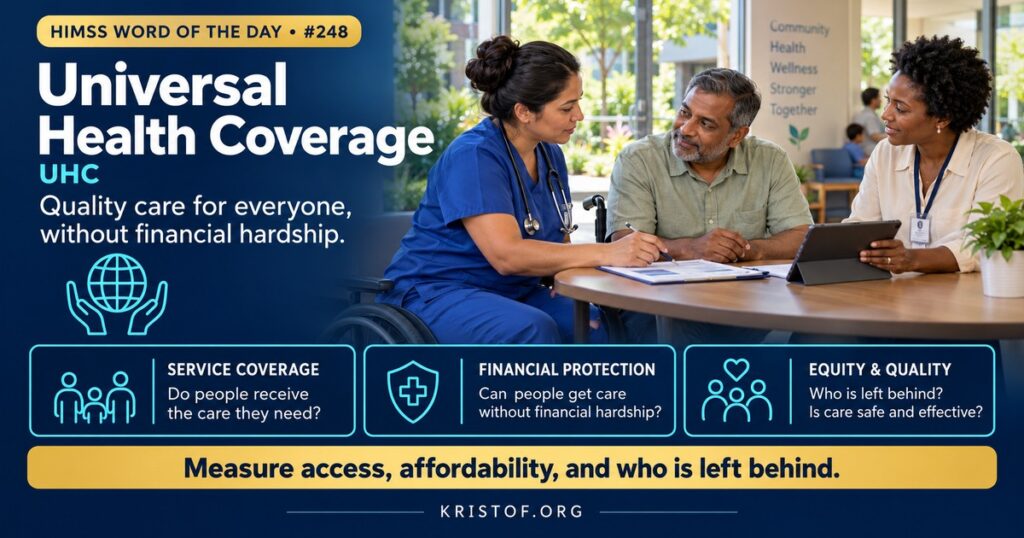
Universal health coverage (UHC) is the principle that every person and community can obtain needed health care without being financially harmed by paying for it. The HIMSS Dictionary adds that this covers the full range of essential, quality services, spanning health promotion, prevention, treatment, rehabilitation, and end-of-life comfort care at every stage of life. The World Health Organization describes the goal in similar terms: access to the full range of quality services a person needs, when and where they need them, without financial hardship.
Two ideas sit inside the definition: service coverage (do people actually receive the care they need?) and financial protection (does paying for care push them into hardship?). UHC is one of the targets nations adopted within the 2030 Sustainable Development Goals in 2015. WHO notes that the global monitoring framework uses two indicators, the UHC service coverage index (SDG indicator 3.8.1) and the proportion of the population facing financial hardship in health (SDG indicator 3.8.2).
| UHC Dimension | Question | Indicator |
|---|---|---|
| Service coverage | Do people get essential services? | UHC service coverage index (0 to 100) |
| Financial protection | Does paying for care cause hardship? | Share of population facing financial hardship |
| Equity | Who is left behind? | Coverage by income, sex, place, and other groups |
| Quality | Are services safe and effective? | Quality-of-care measures |
⚠️ Exam Alert: UHC is about access without financial hardship, not about a single payer model. Countries reach it through different financing systems. It rests on two indicators: service coverage and financial hardship. It is a goal within the SDGs, not a program of one government.
🌐 Why It Matters: Real-World Healthcare IT Context
Health information professionals meet UHC in two ways: as a policy goal that shapes health systems around the world, and as a data problem that requires reliable information systems.
The latest WHO fact sheet reports slowing progress. The UHC service coverage index rose from 54 to 71 between 2000 and 2023, but progress after 2015 ran at one-third of the annualized rate before 2015. About 4.6 billion people were not fully covered by essential health services in 2023. In 2022, 2.1 billion people faced financial hardship from health spending, including 1.6 billion who were living in poverty or pushed deeper into it by out-of-pocket costs, equal to 26 percent of the population, down from 34 percent in 2000. On the current trajectory, WHO projects that the world will not achieve UHC by 2030, with the index reaching 74 and 24 percent of people still facing financial hardship. Gains in service coverage have been driven mostly by infectious disease control, which accounts for 52 percent of the increase since 2000, while care for noncommunicable diseases lags at 61 index points in 2023.
Country-level studies show the detail behind the averages. A narrative review from Somalia found out-of-pocket payments account for 44.9 percent of total health expenditure, compared with a global average of 18.6 percent and a sub-Saharan Africa average of 35.7 percent, and about 24 percent of households experience catastrophic health spending, often borrowing, selling assets, or forgoing care. The review credits examples from Rwanda, Ghana, and Ethiopia for showing that reducing reliance on out-of-pocket payments needs more public financing, pooled prepayment, and subsidies for the poor, not insurance laws alone. A panel study of 166 countries from 2001 to 2023 found that a higher out-of-pocket share was associated with a lower service coverage index, while the association of a general connectivity measure with the index weakened or disappeared in alternative analyses. The authors noted that general internet access does not capture the adoption or quality of digital health services. That is a useful caution for informaticists: technology access is not the same as better coverage.
Data are central. Tracking UHC requires facility reporting, household surveys, civil registration, and health management information systems that count services such as immunization, antenatal care, and treatment of chronic disease. Weak or fragmented systems make it hard to see who is left behind. Digital tools can help by capturing routine service data, linking records across facilities, and supporting community health workers, but only when they are interoperable, secure, locally owned, and designed for the workforce that uses them. Privacy and consent protections matter as much in low-resource settings as anywhere.
For US readers, UHC is a reminder that coverage, access, and affordability are measured and compared worldwide, and that the same questions apply at home: who gets which services, who delays care because of cost, and what data would show it. The terminology also appears in global health work, humanitarian response, and international informatics partnerships.
Common UHC data problems:
- Services delivered but not recorded in facility systems
- Paper registers that cannot be aggregated quickly
- Duplicate or incompatible digital tools introduced by separate projects
- Data that do not show who is excluded by income, place, or sex
- Financial hardship measured only through periodic surveys
- Lack of privacy and data protection rules for digital systems
What supports UHC monitoring and delivery:
- Routine health information systems with consistent indicators
- Interoperable standards so tools share data
- Equity breakdowns in every dashboard
- Training for health workers on data entry and use
- Strong primary health care as the base of coverage
- Public financing and pooled funds that reduce out-of-pocket burden
🏥 The Nurse’s Perspective: Clinical, Bedside, & Workflow
Nurses and midwives make up a large share of the health workforce in many countries and carry much of the work of delivering UHC.
At the Bedside
In clinics and communities, nurses provide the vaccinations, prenatal visits, chronic disease checks, and health teaching that make up the service coverage index. Recording each service accurately lets the system see what was done. Nurses also see financial barriers directly, such as a patient who skips medication to save money, and can refer to available assistance.
In Clinical Workflow
Nurse managers in primary care and public health use registers and dashboards to track immunization, screening, and follow-up. Community health nurses use outreach lists to find people who missed visits. Those tasks depend on simple, reliable data tools.
Nurse informaticists contribute to the design of mobile and paper-to-digital tools, set indicator definitions, and train staff. In global health programs, they also help teams adapt systems to limited connectivity and local languages.
In EHR Implementation (Go-Live Perspective)
Implementations in low-resource settings differ from a large hospital Epic Go-Live, but the lessons carry over: train in the workflow, offer support at the point of care, and listen to frontline feedback. At-the-elbow support equivalents, such as peer champions in clinics, help staff trust the tool, and early reports on missing data show where entry or design needs correction.
🎓 CAHIMS / CPHIMS & HIMSS Perspective
CAHIMS Exam Domain Mapping
UHC appears in global health, policy, and public health informatics questions:
| CAHIMS Domain | How UHC Appears |
|---|---|
| Healthcare & Technology Environments | Health systems worldwide, financing models, policy goals |
| Clinical Informatics | Population health indicators, primary care data, equity measurement |
| Healthcare Information & Systems Management | Health management information systems, interoperability, data quality |
| Management & Leadership | Policy analysis, resource allocation, global partnerships |
Key Terms to Know Alongside UHC
- UHC Service Coverage Index — composite measure of coverage of essential health services
- Financial Hardship — health spending that causes poverty or deprives people of other needs
- Out-of-Pocket Spending — payments made directly by patients at the point of care
- Primary Health Care — first-contact, community-based care that anchors a health system
- Health Management Information System (HMIS) — system for routine collection and use of health service data
- Sustainable Development Goals (SDGs) — global goals adopted in 2015, including health
HIMSS Organizational Position
HIMSS supports health system strengthening and digital health around the world through its global programs, research, and community work. Members can find related resources through the HIMSS Resource Center.
🔗 Explore Further: External References
- WHO — Universal Health Coverage (UHC) Fact Sheet https://www.who.int/news-room/fact-sheets/detail/universal-health-coverage-(uhc)
- WHO — Universal Health Coverage https://www.who.int/health-topics/universal-health-coverage
- World Bank — Universal Health Coverage https://www.worldbank.org/ext/en/topic/health/universal-health-coverage
- Bashir (2026), Frontiers in Public Health — Out-of-Pocket Health Expenditures as a Barrier to Healthcare Access, Financial Protection, and Progress Toward Universal Health Coverage: A Narrative Review From Somalia https://pubmed.ncbi.nlm.nih.gov/42948335/
- Lu et al. (2026), Frontiers in Public Health — Health Financing, Digital Connectivity, and Universal Health Coverage: A Country-Year Panel Study https://pubmed.ncbi.nlm.nih.gov/42920684/
Term source: HIMSS Dictionary of Health Information and Technology Terms, Acronyms, and Organizations, 6th Edition (2025). All definitions in this series are paraphrased for editorial purposes. Readers are encouraged to consult the primary source for exact language.
Eric Andrew Kristof, RN, CAHIMS is a Healthcare IT professional and HIMSS Arkansas Chapter member based in Hot Springs Village, AR, with hands-on Epic Go-Live experience and a diverse healthcare and IT background. He writes at kristof.org at the intersection of clinical care and healthcare technology.
Leave a Reply