By Eric Andrew Kristof, RN, CAHIMS | Healthcare IT Professional | HIMSS Arkansas Chapter Member
About This Series: The HIMSS Word of the Day is a running blog series drawing from the HIMSS Dictionary of Health Information and Technology Terms, Acronyms, and Organizations, 6th Edition (2025) — the authoritative reference for healthcare IT professionals and the primary study resource for CAHIMS and CPHIMS certification. Each post paraphrases the term in plain language, grounds it in real-world healthcare IT context, and adds a bedside nursing perspective you won’t find in a textbook.
📖 The Term: Affordable Care Act (ACA)
Source: HIMSS Dictionary of Health Information and Technology Terms, Acronyms, and Organizations, 6th Edition (2025)
🔍 Plain-Language Definition
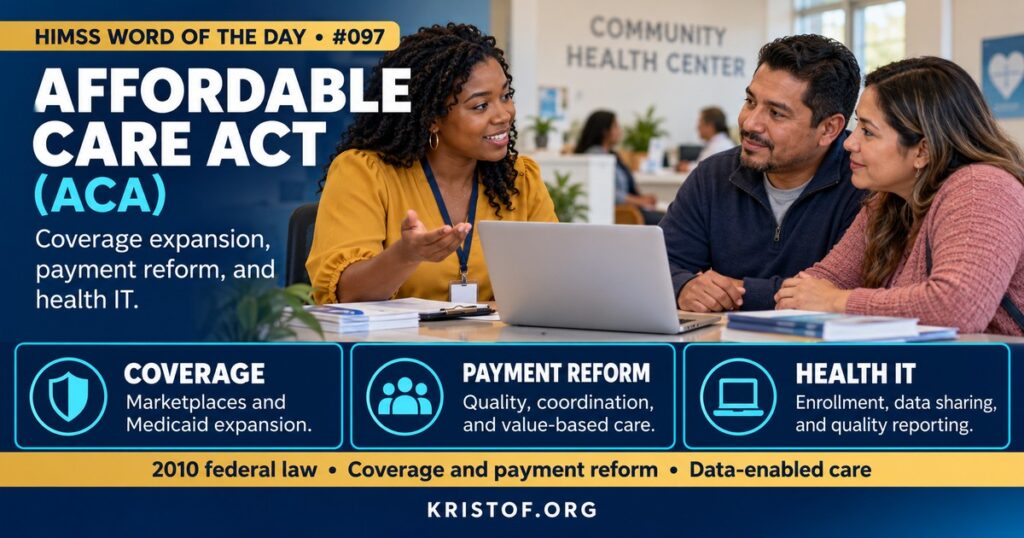
The Affordable Care Act (ACA), formally the Patient Protection and Affordable Care Act, is a 2010 federal law that expanded health insurance coverage and introduced major reforms to how Medicare pays for care.
The HIMSS Dictionary notes that the law was signed by President Obama on March 23, 2010, with the goals of extending coverage to more people and making it more affordable. It highlights a health IT provision: Section 1561 asked HHS, working with its health IT advisory committees, to develop interoperable, secure standards and protocols so people could enroll electronically in government health and social service programs at both the federal and state levels.
The ACA touched nearly every part of the health system:
| Area | Key Provisions | Health IT Connection |
|---|---|---|
| Coverage | Health insurance marketplaces, Medicaid expansion, protections for preexisting conditions, dependent coverage to age 26 | Online eligibility and enrollment systems |
| Medicare Payment Reform | Medicare Shared Savings Program for ACOs, Hospital Readmissions Reduction Program, Hospital Value-Based Purchasing | Quality measurement and data sharing |
| Innovation | Creation of the CMS Innovation Center to test new payment and care models | Data infrastructure for model participation and evaluation |
| Administrative Simplification | Operating rules and standards for electronic administrative transactions | Electronic eligibility, claims status, and payment transactions |
| Equity and Nondiscrimination | Section 1557 nondiscrimination protections | Language access and accessible technology |
⚠️ Exam Alert: The ACA (2010) focused on coverage and payment reform. HITECH (2009) focused on EHR adoption and HIPAA enforcement. MACRA (2015) reformed Medicare clinician payment. The 21st Century Cures Act (2016) addressed information blocking and API access. Know which law created which program, such as the ACA creating the Medicare Shared Savings Program and the CMS Innovation Center.
🌐 Why It Matters: Real-World Healthcare IT Context
The ACA expanded coverage to millions of people through marketplaces and Medicaid expansion, which changed who hospitals and clinics serve and how they are paid. Online eligibility and enrollment systems became essential infrastructure for states and the federal government.
Its payment reforms reshaped hospital priorities. The Medicare Shared Savings Program created Accountable Care Organizations that share savings when they improve quality and reduce spending. The Hospital Readmissions Reduction Program reduced payments to hospitals with excess readmissions. Hospital Value-Based Purchasing tied part of Medicare payment to quality performance. Each of these programs relies on accurate data, quality measurement, and information sharing across care settings.
The CMS Innovation Center, created by the ACA, tests new models of care and payment, such as bundled payments and advanced primary care models. Successful models can be expanded, and many have influenced value-based care across the industry.
The ACA also strengthened administrative simplification by requiring operating rules for electronic transactions such as eligibility checks and claim status, building on HIPAA‘s transaction standards to reduce administrative cost and burden.
Prevention and public health also received attention. The ACA required many health plans to cover recommended preventive services without cost sharing and created programs to support prevention and community health. Those provisions increased the importance of tracking preventive care, immunizations, and screenings in EHRs and registries, data that nurses frequently collect and document during intake and care management.
Parts of the ACA have been changed by later legislation and court decisions, including a Supreme Court ruling that made Medicaid expansion optional for states, so its effects vary by state. Its payment and quality programs remain central to Medicare policy.
Health IT implications of the ACA:
- Eligibility and enrollment systems connecting individuals, states, and plans
- Quality measurement infrastructure for value-based programs
- Data sharing to support ACOs and care coordination
- Readmission tracking and transition-of-care tools
- Electronic administrative transactions with operating rules
- Analytics for population health and model evaluation
Common challenges:
- Complex data requirements across multiple programs
- Variation in Medicaid policy by state
- Limited interoperability between hospitals and community providers
- Measurement burden for clinicians and organizations
- Rapid policy changes affecting program design
- Translating payment incentives into practical workflow changes
🏥 The Nurse’s Perspective: Clinical, Bedside, & Workflow
The ACA’s effects reach nurses through coverage changes, payment programs, and new care models.
At the Bedside
Insurance coverage affects what happens after discharge. Patients with coverage may have better access to follow-up appointments, medications, and home services. Nurses involved in discharge planning often work with case managers and social workers to connect patients with coverage options and community resources.
Readmission penalties placed new emphasis on discharge teaching, medication reconciliation, and follow-up scheduling. Many of the transition-of-care practices nurses use today gained attention because of the ACA’s payment incentives.
Preventive care documentation matters here as well. Screenings, immunizations, and counseling that nurses record in structured fields support both patient care and the quality measures many ACA-related programs use.
In Clinical Workflow
Accountable Care Organizations and Innovation Center models often employ nurses as care managers and navigators. They follow up with patients after hospital stays, coordinate chronic disease care, and use registries and analytics to identify patients who need outreach.
Quality measures tied to value-based purchasing depend on nursing documentation, including assessments, education, and patient experience. Nurses’ accurate documentation helps organizations demonstrate performance in these programs.
Coverage changes also affect registration and financial counseling. Nurses in clinics and emergency departments often work alongside financial counselors who help uninsured patients apply for Medicaid or marketplace coverage, and accurate registration data supports those applications.
In EHR Implementation (Go-Live Perspective)
During an Epic Go-Live, transition-of-care tools, care management workflows, and quality reporting are configured to support value-based programs that trace back to the ACA. Nurses may see new discharge navigators, follow-up call workflows, and registries designed to reduce readmissions.
At-the-elbow support analysts can help care managers and nurses find these tools and understand which documentation feeds program reporting. Early monitoring after Go-Live helps confirm that readmission and quality data continue to flow correctly.
🎓 CAHIMS / CPHIMS & HIMSS Perspective
CAHIMS Exam Domain Mapping
The ACA appears in policy and value-based care questions:
| CAHIMS Domain | How the ACA Appears |
|---|---|
| Healthcare & Technology Environments | Coverage expansion; Medicare payment reform; CMS Innovation Center; relationship to HITECH, MACRA, and Cures |
| Clinical Informatics | Transition-of-care workflows; care management; quality documentation |
| Healthcare Information & Systems Management | Enrollment systems, administrative transactions, quality reporting, data sharing |
| Management & Leadership | Value-based strategy, ACO participation, readmission reduction, financial planning |
Key Terms to Know Alongside ACA
- Medicare Shared Savings Program (MSSP) — the ACA-created program for Accountable Care Organizations in Medicare
- CMS Innovation Center — the CMS center created by the ACA to test new payment and service delivery models
- Hospital Readmissions Reduction Program (HRRP) — a program that reduces payments to hospitals with excess readmissions
- Hospital Value-Based Purchasing — a program that adjusts Medicare hospital payments based on quality performance
- Health Insurance Marketplace — the online exchange for purchasing individual health coverage
- Administrative Simplification — standards and operating rules for electronic administrative transactions
HIMSS Organizational Position
HIMSS engages on federal health policy, including value-based payment, quality measurement, and administrative simplification, through its public policy and advocacy work. Members can find related education and research through the HIMSS Resource Center.
🔗 Explore Further: External References
- HHS — About the Affordable Care Act https://www.hhs.gov/healthcare/about-the-aca/index.html
- HealthCare.gov — Where Can I Read the Affordable Care Act? https://www.healthcare.gov/where-can-i-read-the-affordable-care-act/
- CMS — Medicare Shared Savings Program https://www.cms.gov/medicare/payment/shared-savings-program
- CMS — Hospital Readmissions Reduction Program https://www.cms.gov/medicare/payment/prospective-payment-systems/acute-inpatient-pps/hospital-readmissions-reduction-program-hrrp
- CMS Innovation Center — Value-Based Care https://www.cms.gov/priorities/innovation/key-concepts/value-based-care
- HIMSS — Public Policy and Advocacy https://www.himss.org/public-policy-advocacy-overview
Term source: HIMSS Dictionary of Health Information and Technology Terms, Acronyms, and Organizations, 6th Edition (2025). All definitions in this series are paraphrased for editorial purposes. Readers are encouraged to consult the primary source for exact language.
Eric Andrew Kristof, RN, CAHIMS is a Healthcare IT professional and HIMSS Arkansas Chapter member based in Hot Springs Village, AR, with hands-on Epic Go-Live experience and a diverse healthcare and IT background. He writes at kristof.org at the intersection of clinical care and healthcare technology.
Leave a Reply