By Eric Andrew Kristof, RN, CAHIMS | Healthcare IT Professional | HIMSS Arkansas Chapter Member
About This Series: The HIMSS Word of the Day is a running blog series drawing from the HIMSS Dictionary of Health Information and Technology Terms, Acronyms, and Organizations, 6th Edition (2025) — the authoritative reference for healthcare IT professionals and the primary study resource for CAHIMS and CPHIMS certification. Each post paraphrases the term in plain language, grounds it in real-world healthcare IT context, and adds a bedside nursing perspective you won’t find in a textbook.
📖 The Term: Amendments and Corrections
Source: HIMSS Dictionary of Health Information and Technology Terms, Acronyms, and Organizations, 6th Edition (2025)
🔍 Plain-Language Definition
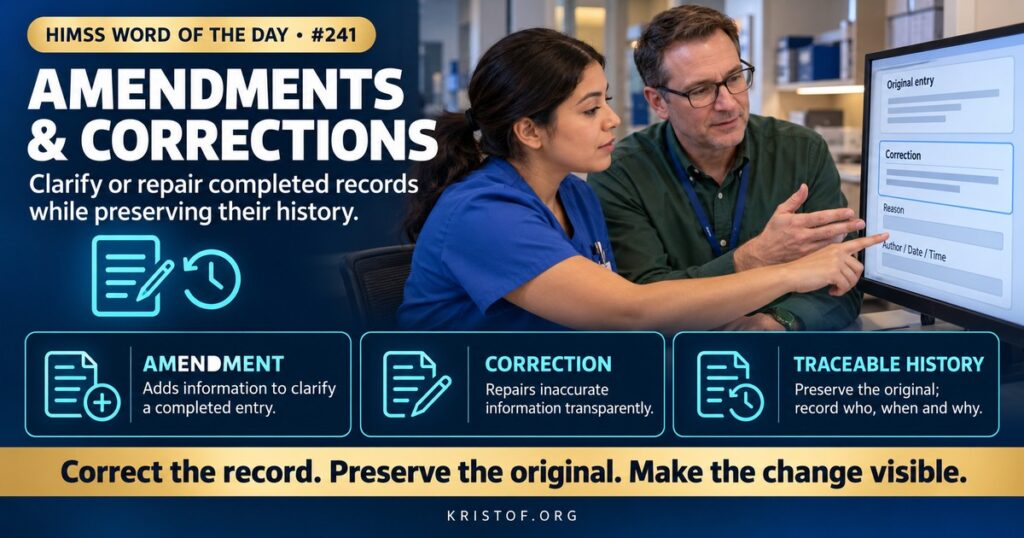
Amendments and corrections are the sanctioned ways to clarify or repair information in a health record once the original entry is done. The HIMSS Dictionary explains that an amendment is documentation added after the provider completed the original entry to clarify the record, and that amendments should be timely and carry the current date. A correction changes information to clarify an inaccuracy after the electronic document has been signed or declared complete.
The core principle is that the original entry is not erased. A reader should be able to see what was originally written, what changed, who changed it, when, and why. Electronic systems support this through version history, audit trails, and visible addenda.
| Action | When Used | Key Rule |
|---|---|---|
| Amendment | Clarify or add to a completed entry | Dated at the time it is written |
| Correction | Fix an inaccuracy in a signed entry | Original remains visible, with author, date, and reason |
| Late entry | Add documentation omitted earlier | Labeled as late, with current date and time |
| Patient-requested amendment | Patient asks to change their record | Governed by HIPAA timelines and procedures |
| Deletion or overwriting | Not acceptable | Hides history and undermines trust |
⚠️ Exam Alert: A correction repairs an error in a signed entry, while an amendment adds clarifying information. Neither erases the original. Under HIPAA, a patient may request an amendment, and the covered entity may deny it in specific cases, such as when the information is accurate and complete.
🌐 Why It Matters: Real-World Healthcare IT Context
Records are used to make clinical decisions, support billing, defend care in legal disputes, and inform patients. If staff can quietly change them, none of these uses can be trusted. If errors cannot be fixed, the record becomes less accurate over time. Amendments and corrections solve this by allowing change with transparency.
HIPAA gives patients a formal route. Under 45 CFR 164.526, an individual has the right to have a covered entity amend protected health information in a designated record set for as long as it is maintained. A covered entity may deny the request in four situations: it did not create the information, unless the originator is no longer available; the information is not part of the designated record set; it would not be available for inspection under the access rule; or it is accurate and complete. The entity may require requests in writing with a reason, if it tells individuals in advance. It must act no later than 60 days after receipt, with at most one 30-day extension if it gives a written statement of reasons and a completion date. If it accepts, it must identify affected records and append the amendment or provide a link to it, inform the individual, and make reasonable efforts to notify others who received the information and may have relied on it. If it denies, it must provide a written denial, and the individual may submit a statement of disagreement.
EHR certification criteria reflect these expectations. The ONC criterion at 45 CFR 170.315(d)(4) requires certified technology to let a user select the record affected by a patient’s amendment request and, for an accepted amendment, append it to the record or link to its location. For a denied amendment, the system must append the request and denial, or link to where they are kept.
Research shows both how often patients see problems and how rarely they use the formal process. A study at one institution analyzed 818 patient-initiated amendment requests from 181 patients over seven years. Most requests, 636 or 77.8 percent, sought to fix incorrect information, and 49.7 percent of all requests were approved. In 6.6 percent, patients wanted valid information removed, and 27.8 percent of those were approved. Only about 0.2 percent of patients who requested a copy of their chart submitted an amendment request, which the authors thought might reflect low awareness of the right. A large survey of patients reading open ambulatory notes at three US health care organizations found that of 22,889 patients who read notes and answered error questions, 4,830 or 21.1 percent reported a perceived mistake, and 2,043 of those, or 42.3 percent, rated the mistake as serious. Among very serious mistakes, the most common were errors about diagnosis, medical history, and medications or allergies, and 6.5 percent reportedly involved notes written on the wrong patient. These are patient perceptions, not chart audits, but they show that record access surfaces real documentation problems.
Good organizations make correction easy and visible. They publish how patients can request amendments, route requests quickly to the right clinician and health information management staff, and track timelines. They train staff on how to correct without erasing, including how to handle wrong-patient charting, which needs both a correction and notification of affected parties. And they audit for patterns, such as copy-forward text that spreads an error.
Common problems with amendments and corrections:
- Overwriting or deleting entries rather than correcting them transparently
- Late entries without labels or accurate dates
- Patients unaware of how to request changes
- Requests that miss the 60-day timeline
- Corrections that do not reach downstream systems or recipients of the information
- Copy-forward errors that repeat after correction
What supports trustworthy corrections:
- Clear policies on late entries, amendments, and corrections
- EHR workflows that preserve the original and show the change
- A visible patient request process and tracking against deadlines
- Training on wrong-patient documentation events
- Notification paths for recipients of corrected information
- Audits for repeated errors and copy-forward
🏥 The Nurse’s Perspective: Clinical, Bedside, & Workflow
Nurses document constantly, so knowing how to fix the record properly protects patients and the nurse.
At the Bedside
When a nurse notices that a documented vital sign, allergy, or assessment is wrong, the right move is to correct it through the system’s function so that the original is preserved and the reason is recorded. Charting in the wrong patient’s record needs immediate action: correcting the chart and notifying the right people, since a wrong entry may have driven care decisions.
Patients who read their notes may ask nurses about something that looks wrong. Listening, checking the record, and directing the patient to the formal request process respects their right and protects accuracy.
In Clinical Workflow
Nurse managers and educators teach staff when to use a late entry, an addendum, or a correction, and what makes each acceptable. They review wrong-patient events, support the nurse who made the error, and follow policy for notification and reporting.
Nurse informaticists help design correction tools that are quick to use and clear in the display, so that a corrected entry does not leave a confusing trail. They also check that corrected data update downstream views, such as flowsheet graphs and handoff reports.
In EHR Implementation (Go-Live Perspective)
An Epic Go-Live is when users learn how to correct entries in a new system, and early errors are common. Training that shows exactly how to correct flowsheet values, notes, and orders prevents workarounds such as duplicate entries. At-the-elbow support analysts help nurses fix mistakes on the spot and report patterns, such as a confusing correction button, so that build and training can be improved.
🎓 CAHIMS / CPHIMS & HIMSS Perspective
CAHIMS Exam Domain Mapping
Amendments and corrections appear in health record integrity, privacy, and legal questions:
| CAHIMS Domain | How Amendments and Corrections Appear |
|---|---|
| Healthcare & Technology Environments | HIPAA right to amend, legal health record, certification criteria |
| Clinical Informatics | Documentation practices, patient access, workflow |
| Healthcare Information & Systems Management | Audit trails, version history, record management |
| Management & Leadership | Policies, request tracking, compliance, training |
Key Terms to Know Alongside Amendments and Corrections
- Designated Record Set — records used to make decisions about individuals, which are subject to access and amendment rights
- Late Entry — documentation added after the fact and labeled as such
- Addendum — additional information appended to a completed note
- Audit Trail — record of who created, viewed, or changed information
- Legal Health Record — the records an organization defines as its official business record
- Statement of Disagreement — patient’s written disagreement when an amendment is denied
HIMSS Organizational Position
HIMSS supports accurate and trustworthy health information through its education, research, and public policy work. Members can find related resources through the HIMSS Resource Center and Public Policy and Advocacy pages.
🔗 Explore Further: External References
- eCFR — 45 CFR 164.526, Amendment of Protected Health Information https://www.ecfr.gov/current/title-45/subtitle-A/subchapter-C/part-164/subpart-E/section-164.526
- eCFR — 45 CFR 170.315, Health IT Certification Criteria (Amendments, (d)(4)) https://www.ecfr.gov/current/title-45/subtitle-A/subchapter-D/part-170/subpart-C/section-170.315
- HHS — HIPAA Privacy Rule Summary https://www.hhs.gov/hipaa/for-professionals/privacy/laws-regulations/index.html
- Hanauer et al. (2014), Journal of the American Medical Informatics Association — Patient-Initiated Electronic Health Record Amendment Requests https://pubmed.ncbi.nlm.nih.gov/24863430/
- Bell et al. (2020), JAMA Network Open — Frequency and Types of Patient-Reported Errors in Electronic Health Record Ambulatory Care Notes https://pubmed.ncbi.nlm.nih.gov/32515797/
Term source: HIMSS Dictionary of Health Information and Technology Terms, Acronyms, and Organizations, 6th Edition (2025). All definitions in this series are paraphrased for editorial purposes. Readers are encouraged to consult the primary source for exact language.
Eric Andrew Kristof, RN, CAHIMS is a Healthcare IT professional and HIMSS Arkansas Chapter member based in Hot Springs Village, AR, with hands-on Epic Go-Live experience and a diverse healthcare and IT background. He writes at kristof.org at the intersection of clinical care and healthcare technology.
Leave a Reply