By Eric Andrew Kristof, RN, CAHIMS | Healthcare IT Professional | HIMSS Arkansas Chapter Member
About This Series: The HIMSS Word of The Day is a running blog series drawing from the HIMSS Dictionary of Health Information and Technology Terms, Acronyms, and Organizations, 6th Edition (2025) — the authoritative reference for healthcare IT professionals and the primary study resource for CAHIMS and CPHIMS certification. Each post paraphrases the term in plain language, grounds it in real-world healthcare IT context, and adds a bedside nursing perspective you won’t find in a textbook.
📖 The Term: Disease Staging
Source: HIMSS Dictionary of Health Information and Technology Terms, Acronyms, and Organizations, 6th Edition (2025)
🔍 Plain-Language Definition
The HIMSS Dictionary describes disease staging as a scheme for classifying patients, built on diagnostic findings, into groups defined by the cause of the disease, its effects on the body, and its severity. The dictionary says the groups can serve as a basis for comparing similar patients when assessing quality of care, outcomes, resource use, and the effectiveness of alternative treatments, and it notes a role in hospital privileging. It also says staging was designed to help judge ambulatory care by comparing severity at the time of hospitalization among patients covered by different insurers, and it points readers to the entry on severity systems.
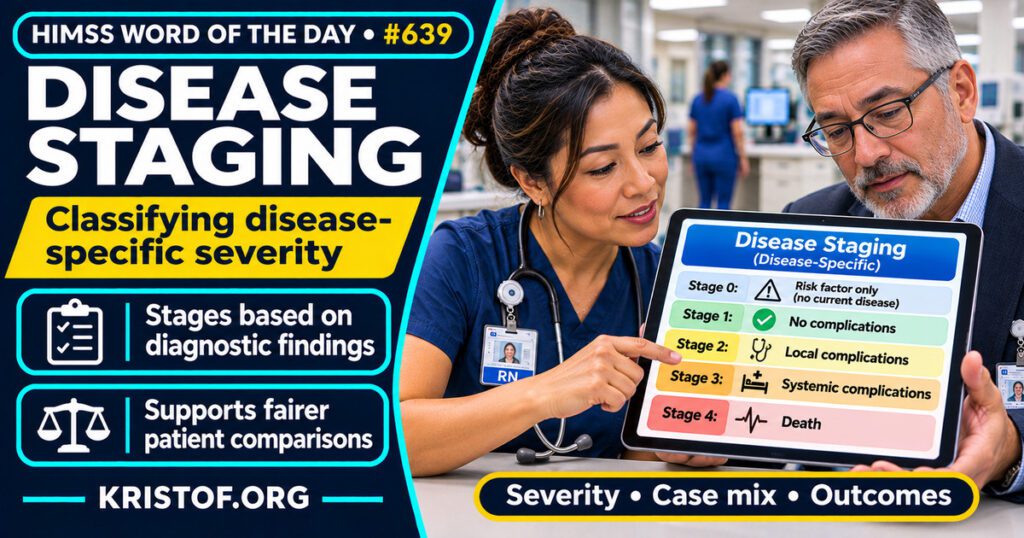
An AHRQ-hosted copy of the Fifth Edition clinical criteria and a page from the Asano-Gonnella Center at Thomas Jefferson University give the same stage logic. Severity here means the risk of organ failure or death, judged from how the disease shows itself in the body. Stage 1 is a disease without complications, Stage 2 is a disease with local complications, Stage 3 involves multiple sites or systemic complications, and Stage 4 is death. The Jefferson page adds that some diseases skip stages and that Stage 0 marks a significant risk factor with no current disease.
| Feature | What the sources describe |
|---|---|
| Basis | Diagnostic findings, with criteria written disease by disease |
| Severity meaning | Risk of organ failure or death, based on the disease’s own course |
| Stages | 1 (no complications), 2 (local complications), 3 (multiple sites or systemic complications), 4 (death) |
| Scope of criteria | Hundreds of diagnoses, described as roughly 400 in the Fifth Edition document and 420 in a 1984 article |
| Application | Software applies the criteria to coded hospital discharge data |
| What it leaves out | Treatment and quality of life are not part of the staging, per the Jefferson page |
The table is a simplified summary of sources written between 1984 and 2006 plus one current university page.
⚠️ Exam Alert: Disease staging is a specific named classification system. A severity system is the broader category, and disease staging is one example. Cancer staging such as TNM is a different, cancer-specific staging approach. A diagnosis-related group is a payment classification built on diagnoses and procedures, not on disease-specific stage criteria. Also remember that stages are ordinal within each disease, so Stage 2 of one disease and Stage 2 of another are not equivalent.
🌐 Why It Matters: Real-World Healthcare IT Context
Disease staging matters as a clear example of how severity is added to diagnosis data. A diagnosis code says what a patient has. A severity classification adds how advanced it is, which can change how fairly hospitals, physicians, and populations are compared.
What studies show. Gonnella and colleagues (1984), in JAMA, described staging as a method for measuring severity of specific, well-defined diseases. They reported that staging criteria had been developed for 420 diagnoses and converted into coded criteria that can be applied to computerized hospital discharge abstracts to produce a case-mix classification system. The authors illustrated its uses with diabetes mellitus. This is a description of the method, and its figures reflect the system as it stood in 1984.
Markson and colleagues (1991), in Evaluation and the Health Professions, reviewed applications of disease staging in outcomes assessment and management. They argued that severity measures such as disease staging help because they classify diseases along dimensions that matter for prognosis. This is a review, so it summarizes uses and does not test them.
Iezzoni (1997), in JAMA, compared commercial severity measures using one database of adult admissions for acute myocardial infarction (11,880 patients), coronary artery bypass graft surgery (7,765), pneumonia (18,016), and stroke (9,407). Disease Staging had the highest c statistic for acute myocardial infarction, 0.86, while other measures led for other conditions. The measures often disagreed about which hospitals looked unusually good or bad, and the author concluded that severity-adjusted mortality rates alone are unlikely to isolate quality differences across hospitals. The data are from the 1990s, and the criteria and coding systems have been updated since then.
Taroni and colleagues (1997), in the Journal of Health Services Research and Policy, used the Disease Staging classification to identify advanced-stage admissions for six conditions across 80 Local Health Units in Lombardy, Italy. Areas with low overall hospitalization rates had higher rates of advanced-stage admission, 55.9 versus 43.0 per 100,000, and their residents were about 30 percent more likely to be admitted with advanced disease. The study treated advanced-stage admission as a sign of untimely admission, which is a presumption, and it is an observational analysis of one region.
What I could not find. I did not find studies from the past decade that evaluate disease staging in current EHR or claims environments. I also could not confirm who currently publishes or sells the staging software or what its latest version is. The AHRQ-hosted document is the Fifth Edition from 2006, and the Jefferson page gives no version number. The count of covered diagnoses differs between sources, about 400 versus 420, and I did not trace why.
Common disease staging problems:
- Treating stage numbers as comparable across different diseases
- Relying on coded data that may be incomplete or inaccurate
- Using one severity measure alone to judge hospital quality
- Mixing up disease staging with cancer staging or payment groupers
- Using a method that was validated in older data without checking it against current coding practice
- Leaving out treatment, quality of life, and social factors that the staging itself does not capture
What supports sound use of disease staging:
- Disease-specific criteria written with clinical input
- Software that applies criteria to coded discharge data consistently
- Criteria updated to match coding conventions, as the Fifth Edition document says
- Using staging as one input to risk adjustment, alongside other measures
- Comparing results across more than one severity method, as Iezzoni’s study shows is worthwhile
- Clinical review of unusual results before drawing conclusions about a hospital
🏥 The Nurse’s Perspective: Clinical, Bedside, & Workflow
Nurses do not assign disease stages, but their documentation sits upstream of the data that staging software reads.
At the Bedside
Staging criteria rely on diagnostic findings such as exam, imaging, laboratory, pathology, and operative results, according to the Jefferson page. Nurses record observations, assessments, and events that help the care team see how a patient’s disease is progressing. Whether that documentation affects the final coded diagnoses depends on provider documentation and coding practices at each organization.
In Clinical Workflow
Quality, case management, and clinical documentation improvement teams are the usual consumers of severity data. A nurse in one of those roles may see severity-adjusted results used to compare units or hospitals, and may be asked why two reports of the same hospital differ. The Iezzoni findings are a useful reminder that different severity tools can give different answers.
In EHR Implementation (Go-Live Perspective)
During an Epic Go-Live, nurse analysts help confirm that documentation fields and problem lists capture information in a form that downstream coding and reporting can use. This post does not claim that any specific go-live affected severity reports. It does show why reporting and analytics requirements belong in readiness work, since severity measures depend on the quality of the coded data feeding them.
🎓 CAHIMS / CPHIMS & HIMSS Perspective
CAHIMS Exam Domain Mapping
Disease staging connects classification, data quality, and quality measurement:
| CAHIMS Domain | How Disease Staging Appears |
|---|---|
| Healthcare & Technology Environments | Coded hospital discharge data and classification systems used in payment and quality analysis |
| Clinical Informatics | Diagnostic findings, severity concepts, and how documentation supports coded data |
| Healthcare Information & Systems Management | Applying classification software to administrative data and checking data quality |
| Management & Leadership | Using severity-adjusted measures fairly in quality, utilization, and reimbursement decisions |
Key Terms to Know Alongside Disease Staging
- Severity system — a method for measuring how ill patients are so they can be compared fairly
- Case mix — the mix of patient types and severity a provider treats
- Diagnosis Related Group — a payment classification that groups hospital stays
- International Classification of Diseases — the coding system whose codes are the input to staging software
- Patient classification — a system for grouping patients by shared characteristics
- Risk adjustment — statistical correction for patient differences when comparing outcomes
HIMSS Organizational Position
HIMSS offers education and research on health information and technology topics through its Resource Center. Members can find related information on the HIMSS Resource Center page.
🧭 More HIMSS Word of The Day Terms
Related terms in the Data and Analytics series:
Browse all Data and Analytics terms or the A–Z glossary.
🔗 Explore Further: External References
- Asano-Gonnella Center, Thomas Jefferson University — Disease Staging https://jefferson.edu/academics/colleges-schools-institutes/skmc/research/research-medical-education/disease-staging.html
- AHRQ HCUP — Disease Staging Version 5.24 Clinical Criteria (Fifth Edition, 2006) https://hcup-us.ahrq.gov/db/nation/nis/Disease%20Staging%20V5.24%20Clinical%20Criteria.pdf
- Gonnella et al. (1984), JAMA — Staging of disease. A case-mix measurement. https://pubmed.ncbi.nlm.nih.gov/6418903/
- Markson et al. (1991), Evaluation and the Health Professions — Clinical outcomes management and disease staging. https://pubmed.ncbi.nlm.nih.gov/10111357/
- Iezzoni (1997), JAMA — The risks of risk adjustment. https://pubmed.ncbi.nlm.nih.gov/9370507/
- Taroni et al. (1997), Journal of Health Services Research and Policy — Variation in hospital use and avoidable patient morbidity. https://pubmed.ncbi.nlm.nih.gov/10182250/
- HIMSS — Resource Center https://www.himss.org/resource-center
Term source: HIMSS Dictionary of Health Information and Technology Terms, Acronyms, and Organizations, 6th Edition (2025). All definitions in this series are paraphrased for editorial purposes. Readers are encouraged to consult the primary source for exact language.
Eric Andrew Kristof, RN, CAHIMS is a Healthcare IT professional and HIMSS Arkansas Chapter member based in Hot Springs Village, AR, with hands-on Epic Go-Live experience and a diverse healthcare and IT background. He writes at kristof.org at the intersection of clinical care and healthcare technology.
Leave a Reply