By Eric Andrew Kristof, RN, CAHIMS | Healthcare IT Professional | HIMSS Arkansas Chapter Member
About This Series: The HIMSS Word of The Day is a running blog series drawing from the HIMSS Dictionary of Health Information and Technology Terms, Acronyms, and Organizations, 6th Edition (2025) — the authoritative reference for healthcare IT professionals and the primary study resource for CAHIMS and CPHIMS certification. Each post paraphrases the term in plain language, grounds it in real-world healthcare IT context, and adds a bedside nursing perspective you won’t find in a textbook.
📖 The Term: Patient Classification (PCS)
Source: HIMSS Dictionary of Health Information and Technology Terms, Acronyms, and Organizations, 6th Edition (2025)
🔍 Plain-Language Definition
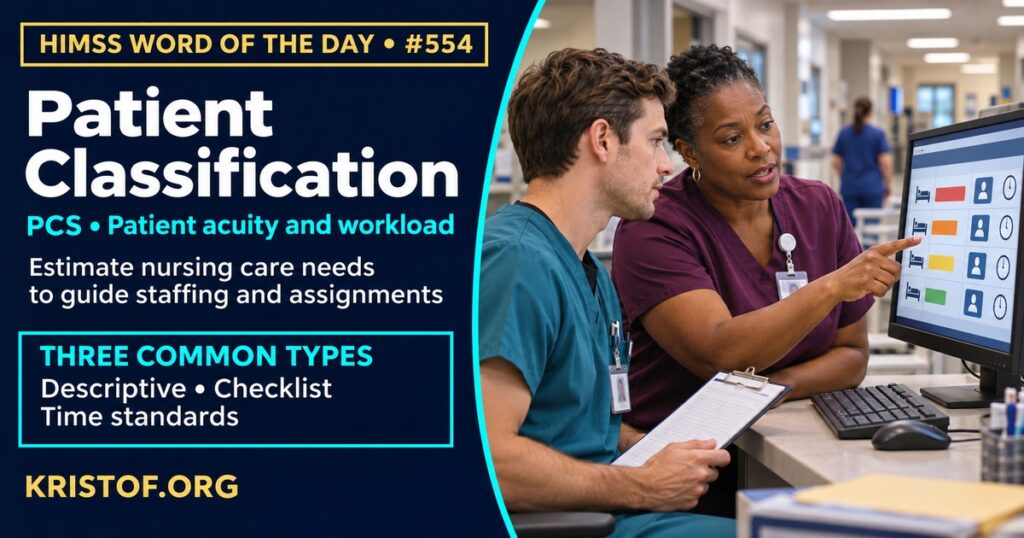
The HIMSS Dictionary treats patient classification (PCS) and the patient acuity system as the same thing: a nursing management method for scheduling and assigning staff around the care patients need. By estimating workload, it supports decisions about how many nurses a unit requires. The Dictionary names three types as the most common: descriptive, checklist, and time standards.
A useful way to picture the three types is to ask how each one reaches a score. The summaries below are general teaching descriptions and not definitions from any one product.
| PCS type | How it works, in brief |
|---|---|
| Descriptive | Nurses match a patient to a written description of a care level |
| Checklist | Nurses mark which care activities or patient characteristics apply, and the marks produce a score |
| Time standards | Care activities are tied to estimated minutes, and the total estimates care time |
Whichever type is used, a PCS turns a bedside judgment into a number or a category. That number feeds staffing plans, unit comparisons, and sometimes budgeting. Many hospitals build the tool into the EHR so nurses can enter or confirm a classification during a shift, which makes PCS a clinical informatics topic as well as a staffing one.
⚠️ Exam Alert: Patient classification (PCS) here means the nursing acuity and workload tool. It does not mean the ICD-10-PCS procedure coding system, and it is not the same as triage, which sorts patients by urgency. A patient acuity system and a nurse-to-patient ratio are related but different: one measures need, the other sets a number. HIMSS offers CAHIMS and CPHIMS.
🌐 Why It Matters: Real-World Healthcare IT Context
Staffing decisions affect safety, cost, and nurse well-being, so the question is whether classification tools measure workload well and whether using them helps. The sources below were checked against their published abstracts, and the type of study is noted. Several are very recent, and some come from single hospitals or countries.
Does a score track real workload? Zaboli and colleagues, in Applied Nursing Research (2026), studied the PERROCA patient classification system across 12 wards in five hospitals. They enrolled 472 adult inpatients and measured the total time nurses spent on activities over 24 hours. The median PERROCA score was 17, and median nursing care time was 155 minutes. Each one-point increase in PERROCA was associated with about 12.8 additional minutes in a simple model and 7.45 minutes in a model that accounted for ward clustering. High workload occurred in 112 patients, or 23.7 percent, and the score was independently associated with it. The authors conclude the tool may be a practical way to estimate workload. This is a cross-sectional study of association in adults.
Combining observation with a score. Biyik and colleagues, in the Journal of Nursing Management (2026), observed 20 nurses on chest diseases and urology wards at one Turkish teaching hospital over five weeks and combined time-motion analysis with a patient classification system to calculate an optimal number of nurses. The result was consistent with current staffing in both wards. Nurses spent about 23 to 27 percent of working time on direct care, 31 to 33 percent on indirect care, and 35 to 42 percent on personal tasks. The authors suggest redesigning workflow to increase direct care time. It is a small observational study at one site.
Does using a PCS improve outcomes? Artuso and colleagues, in the Western Journal of Nursing Research (2025), did a scoping review of studies that assessed outcomes linked to nursing patient classification systems in hospitals. From 964 abstracts, only 4 studies met the criteria. They looked at outcomes such as satisfaction, job attitude, and morale, and none addressed pediatric patients, caregivers, or hospital organizations. The authors call for standardized evaluation of outcomes after implementation. The honest summary is that the evidence on outcomes is limited.
A gap in pediatrics. Da Rin Della Mora and colleagues, in Healthcare (2025), searched for validated tools that assess the nursing complexity of pediatric patients. After screening 498 papers and reading 7 in full, none met the inclusion criteria, which the authors call an empty review. They point to the lack of a shared definition of patient nursing complexity as the main barrier.
Data-driven classification. Ren and colleagues, in the Journal of Nursing Management (2026), used machine learning to build a patient classification system for a gastroenterology ward. They extracted nursing activity data from the hospital information system, built a decision tree, and validated the tool prospectively in 357 patients. The final tool had two main categories and five subcategories linked to estimated nursing hours per 24 hours, ranging from 0.96 to 4.15. The model was developed in one ward at one hospital, so it should be treated as a proof of concept.
Taken together, the studies suggest that classification tools can track workload, that they work best when combined with direct observation, and that evidence on patient and staff outcomes is still thin.
Common patient classification problems:
- Scores entered late, in bulk, or from habit and not from current patient need
- A tool built for adult medical-surgical units used unchanged in other settings
- Different definitions of acuity or complexity between units and vendors
- Classification treated as the full answer, with no observation of indirect work
- Little or no follow-up on whether staffing decisions improve outcomes
- Nurses who do not see how their entries affect staffing
What supports effective patient classification:
- A tool validated for the unit’s patient population
- Clear definitions and training for nurses who classify patients
- Entry built into the nursing workflow, not added on top of it
- Regular comparison of scores with observed workload
- Review of results by nurse leaders and staff together
- Tracking of outcomes after staffing changes
🏥 The Nurse’s Perspective: Clinical, Bedside, & Workflow
Patient classification looks like a staffing topic, but its data starts with what nurses see at the bedside.
At the Bedside
A classification is a nurse’s summary of how heavy a patient’s care is right now: mobility, monitoring, teaching, wound care, and psychosocial needs. A thoughtful entry makes the workload visible. A rushed one hides it, and the next shift may plan around the wrong picture.
In Clinical Workflow
Charge nurses and managers use classification results to balance assignments and plan staffing. The time-motion findings are a reminder that direct care is only part of the day, so indirect work such as documentation, coordination, and searching for supplies also belongs in the conversation. Nurse informaticists can help by checking whether the EHR makes classification quick enough to be accurate.
In EHR Implementation (Go-Live Perspective)
During an Epic Go-Live, analysts at the elbow see how classification fits into the shift: when it is entered, who confirms it, and whether the screen shows enough information to decide. Questions such as “where do I score this?” are early signs that a workflow needs adjustment. Recording those questions helps teams refine both the build and the training.
🎓 CAHIMS / CPHIMS & HIMSS Perspective
CAHIMS Exam Domain Mapping
Patient classification links clinical documentation, staffing, and data use:
| CAHIMS Domain | How Patient Classification Appears |
|---|---|
| Healthcare & Technology Environments | Nursing workforce planning and the role of acuity tools |
| Clinical Informatics | Nursing assessment data feeding a score or category |
| Healthcare Information & Systems Management | Building and maintaining classification in the EHR, reporting, and data quality |
| Management & Leadership | Staffing decisions, workload measurement, and evaluating outcomes |
Key Terms to Know Alongside Patient Classification
- Nursing information system — system that supports nursing documentation and care management
- Workflow — sequence of tasks and handoffs involved in completing work
- Plan of care — documented plan for a patient’s treatment and nursing care
- Dashboard — visual display of key measures for monitoring
- Predictive modeling — use of data and statistics to estimate likely outcomes
- QI (Quality Improvement) — structured effort to improve care processes and results
HIMSS Organizational Position
HIMSS offers education and research on health information and technology topics through its Resource Center. Members can find related information on the HIMSS Resource Center page.
🧭 More HIMSS Word of The Day Terms
Related terms in the Clinical Informatics series:
Browse all Clinical Informatics terms or the A–Z glossary.
🔗 Explore Further: External References
- Zaboli et al. (2026), Applied nursing research : ANR — Association between the PERROCA patient classification system and nursing workload: A multicentre cross-sectional study https://pubmed.ncbi.nlm.nih.gov/42547141/
- Biyik et al. (2026), Journal of nursing management — Nursing Workload and Optimal Staffing in Medical and Surgical Wards: A Time-Motion Study Using a Patient Classification System https://pubmed.ncbi.nlm.nih.gov/42661409/
- Artuso et al. (2025), Western journal of nursing research — Do Nursing Patient Classification Systems to Classify Inpatients Impact Outcomes? A Scoping Review https://pubmed.ncbi.nlm.nih.gov/41045199/
- Da Rin Della Mora et al. (2025), Healthcare (Basel, Switzerland) — Nursing Patient Classification Systems to Assess Pediatric Patients’ Nursing Complexity: An Empty Narrative Literature Review https://pubmed.ncbi.nlm.nih.gov/41302311/
- Ren et al. (2026), Journal of nursing management — Development of a Machine Learning-Based Patient Classification System for a Gastroenterology Ward https://pubmed.ncbi.nlm.nih.gov/42528328/
- HIMSS — Resource Center https://www.himss.org/resource-center
Term source: HIMSS Dictionary of Health Information and Technology Terms, Acronyms, and Organizations, 6th Edition (2025). All definitions in this series are paraphrased for editorial purposes. Readers are encouraged to consult the primary source for exact language.
Eric Andrew Kristof, RN, CAHIMS is a Healthcare IT professional and HIMSS Arkansas Chapter member based in Hot Springs Village, AR, with hands-on Epic Go-Live experience and a diverse healthcare and IT background. He writes at kristof.org at the intersection of clinical care and healthcare technology.
Leave a Reply