By Eric Andrew Kristof, RN, CAHIMS | Healthcare IT Professional | HIMSS Arkansas Chapter Member
About This Series: The HIMSS Word of The Day is a running blog series drawing from the HIMSS Dictionary of Health Information and Technology Terms, Acronyms, and Organizations, 6th Edition (2025) — the authoritative reference for healthcare IT professionals and the primary study resource for CAHIMS and CPHIMS certification. Each post paraphrases the term in plain language, grounds it in real-world healthcare IT context, and adds a bedside nursing perspective you won’t find in a textbook.
📖 The Term: EED (Early Event Detection)
Source: HIMSS Dictionary of Health Information and Technology Terms, Acronyms, and Organizations, 6th Edition (2025)
🔍 Plain-Language Definition
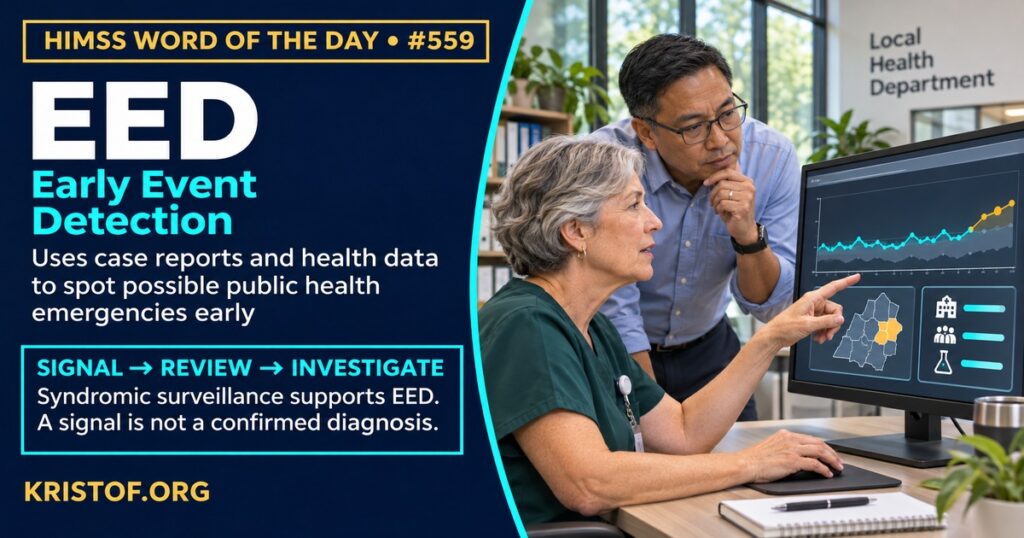
The HIMSS Dictionary describes early event detection (EED) as a component of preparedness work in the Centers for Disease Control and Prevention’s Public Health Information Network (PHIN). It combines reports of cases and suspected cases with statistical monitoring of health-related data, with the goal of finding events that might signal a public health emergency as early as possible.
The most common method behind EED is syndromic surveillance. A systematic review by Hughes and colleagues (cited below) explains that syndromic surveillance draws on information collected during routine patient care, such as signs, symptoms, and preliminary diagnoses. That makes it much timelier than surveillance that waits for laboratory confirmation. The Dictionary’s definition does not use the term syndromic surveillance, so it is best read as the method most often linked to the goal.
CDC’s National Syndromic Surveillance Program (NSSP) page, dated January 2026, offers a working example. It describes NSSP as an early warning system for health threats that runs on the BioSense Platform. Emergency department visits are a main data source, patient information is de-identified, and data can be available within about 24 hours of a visit. The page says health care facilities send data through state and local health departments or health information exchanges. It states that over 6,900 facilities contribute daily and that 84 percent of U.S. emergency departments send data. These figures are CDC’s own and may have changed, so check the current page.
| Piece of EED | What it does |
|---|---|
| Case and suspect case reporting | Flags individual reports that clinicians or labs send to public health |
| Statistical monitoring | Looks for unusual increases or patterns in routine data |
| Data sources | Emergency department visits are a main source; others can include lab results, air quality, and weather |
| Response | Public health staff review signals and decide whether to investigate |
⚠️ Exam Alert: EED is the goal and function: noticing possible events early. Syndromic surveillance is a method that supports it. NEDSS supports disease reporting, HAN is a communication system for health alerts, and PHIN is the broader CDC network of standards and systems. EED does not confirm a diagnosis, it raises a signal for follow-up. HIMSS offers CAHIMS and CPHIMS.
🌐 Why It Matters: Real-World Healthcare IT Context
Early detection sounds simple, but the studies below show how much depends on data quality, setting, and workforce skills. Each was checked against its published abstract or page, and the type of study is noted.
A worldwide scan. Hughes and colleagues, in BMC Public Health (2020), systematically reviewed emergency department syndromic surveillance systems, searching literature through 2017. They found 559 eligible items, including 136 journal articles and 423 conference abstracts or papers, and identified 115 systems in 15 countries and territories across North America, Europe, Asia, and Australasia. The authors point out that emergency departments exist worldwide, which makes them a potentially valuable source. The review covers published descriptions of systems, not their accuracy.
During disasters. Alkhattabi and colleagues, in Disaster Medicine and Public Health Preparedness (2023), reviewed syndromic surveillance used during natural and man-made disasters. From 5,059 studies they included 16. Most considered the approach usable in a disaster, and simplicity and timeliness were the attributes most often highlighted. The authors say the data are sensitive to incomplete and erroneous reporting and call for a standardized approach. It is a narrative review of a small set of studies.
At mass gatherings. Spector and colleagues, in the International Journal of Environmental Research and Public Health (2022), did a scoping review of syndromic surveillance for mass gatherings and included 19 publications. Emergency departments were the most common data source, with first aid stations and event clinics also used, and data were often collected on custom forms. The authors say syndromic surveillance can inform policy about the profile of syndromes seen, but the review does not show that it is a reliable way to detect critical public health events at mass gatherings.
Workforce skills. DeVore and colleagues, in the Journal of Public Health Management and Practice (2016), analyzed a 2015 survey of U.S. local health departments. In 2013, more than half of departments reported using syndromic surveillance. Among workers with access to it, fewer than 50 percent showed proficiency in any of the five task areas: communication, data use, data analysis, quality monitoring and assurance, and system design and development. Users were strongest in data use, and proficiency rose with years of experience and the size of the jurisdiction. The data are self-reported and come from 2015.
Together with CDC’s description, these sources suggest EED depends on timely data from routine care, careful quality control, and trained staff, and that detection signals still need human follow-up.
Common early event detection problems:
- Incomplete or inconsistent reporting from data sources
- Signals that are hard to interpret without local context
- Different custom forms or definitions across sites
- Limited staff proficiency in analysis and quality monitoring
- Too much reliance on a single data source
- Signals that arrive without a clear plan for follow-up
What supports effective early event detection:
- Timely data from emergency departments and other routine care sources
- Standardized definitions and reporting approaches
- Quality monitoring and assurance
- Trained public health and clinical staff
- Links between clinicians, health information exchanges, and health departments
- Clear processes for reviewing and acting on signals
🏥 The Nurse’s Perspective: Clinical, Bedside, & Workflow
Early event detection depends on information that nurses help create during routine care.
At the Bedside
At triage and during assessment, nurses record symptoms, reasons for visit, and other details. These entries support care first, but data collected during routine care is also the basis of syndromic surveillance, according to the review. Complete and consistent documentation makes the signal clearer for the public health staff who monitor it.
In Clinical Workflow
Infection prevention, emergency, and public health nurses often notice unusual patterns before a report is filed. Reporting what they see through the proper channels adds a human signal alongside the statistical one. Nurse informaticists can help by making sure the data sent to public health reflects how nurses actually document.
In EHR Implementation (Go-Live Perspective)
During an Epic Go-Live, analysts at the elbow see how fields are used and where staff skip them. Those patterns matter for surveillance as well as care, because a required field used inconsistently weakens the data leaving the hospital. Analysts can help by checking that public health reporting feeds come from fields that nurses fill out reliably.
🎓 CAHIMS / CPHIMS & HIMSS Perspective
CAHIMS Exam Domain Mapping
Early event detection links clinical documentation to public health use of data:
| CAHIMS Domain | How EED Appears |
|---|---|
| Healthcare & Technology Environments | Public health networks and the role of health care data |
| Clinical Informatics | Documentation that supports surveillance and care |
| Healthcare Information & Systems Management | Data feeds, quality monitoring, and reporting to health departments |
| Management & Leadership | Preparedness planning, staff training, and response processes |
Key Terms to Know Alongside EED
- Biosurveillance — monitoring of health data to detect and track disease threats
- BioSense Platform — CDC platform that supports syndromic surveillance data sharing
- PHIN (Public Health Information Network) — CDC initiative for public health information systems and standards
- NEDSS (National Electronic Disease Surveillance System) — CDC-supported system for reporting notifiable diseases
- HAN (Health Alert Network) — communication system for health alerts to public health partners
- OM (Outbreak Management) — activities and systems used to investigate and control outbreaks
HIMSS Organizational Position
HIMSS offers education and research on health information and technology topics through its Resource Center. Members can find related information on the HIMSS Resource Center page.
🧭 More HIMSS Word of The Day Terms
Related terms in the Data and Analytics series:
Browse all Data and Analytics terms or the A–Z glossary.
🔗 Explore Further: External References
- CDC — National Syndromic Surveillance Program (NSSP) https://www.cdc.gov/nssp/about/index.html
- Hughes et al. (2020), BMC public health — Emergency department syndromic surveillance systems: a systematic review https://pubmed.ncbi.nlm.nih.gov/33298000/
- Alkhattabi et al. (2023), Disaster medicine and public health preparedness — Syndromic Surveillance Implementation During Disaster Events https://pubmed.ncbi.nlm.nih.gov/38031255/
- Spector et al. (2022), International journal of environmental research and public health — Syndromic Surveillance Systems for Mass Gatherings: A Scoping Review https://pubmed.ncbi.nlm.nih.gov/35457541/
- DeVore et al. (2016), Journal of public health management and practice : JPHMP — Workforce Competencies in Syndromic Surveillance Practice at Local Health Departments https://pubmed.ncbi.nlm.nih.gov/27684623/
- HIMSS — Resource Center https://www.himss.org/resource-center
Term source: HIMSS Dictionary of Health Information and Technology Terms, Acronyms, and Organizations, 6th Edition (2025). All definitions in this series are paraphrased for editorial purposes. Readers are encouraged to consult the primary source for exact language.
Eric Andrew Kristof, RN, CAHIMS is a Healthcare IT professional and HIMSS Arkansas Chapter member based in Hot Springs Village, AR, with hands-on Epic Go-Live experience and a diverse healthcare and IT background. He writes at kristof.org at the intersection of clinical care and healthcare technology.
Leave a Reply