By Eric Andrew Kristof, RN, CAHIMS | Healthcare IT Professional | HIMSS Arkansas Chapter Member
About This Series: The HIMSS Word of the Day is a running blog series drawing from the HIMSS Dictionary of Health Information and Technology Terms, Acronyms, and Organizations, 6th Edition (2025) — the authoritative reference for healthcare IT professionals and the primary study resource for CAHIMS and CPHIMS certification. Each post paraphrases the term in plain language, grounds it in real-world healthcare IT context, and adds a bedside nursing perspective you won’t find in a textbook.
📖 The Term: DS4P (Data Segmentation for Privacy)
Source: HIMSS Dictionary of Health Information and Technology Terms, Acronyms, and Organizations, 6th Edition (2025)
🔍 Plain-Language Definition
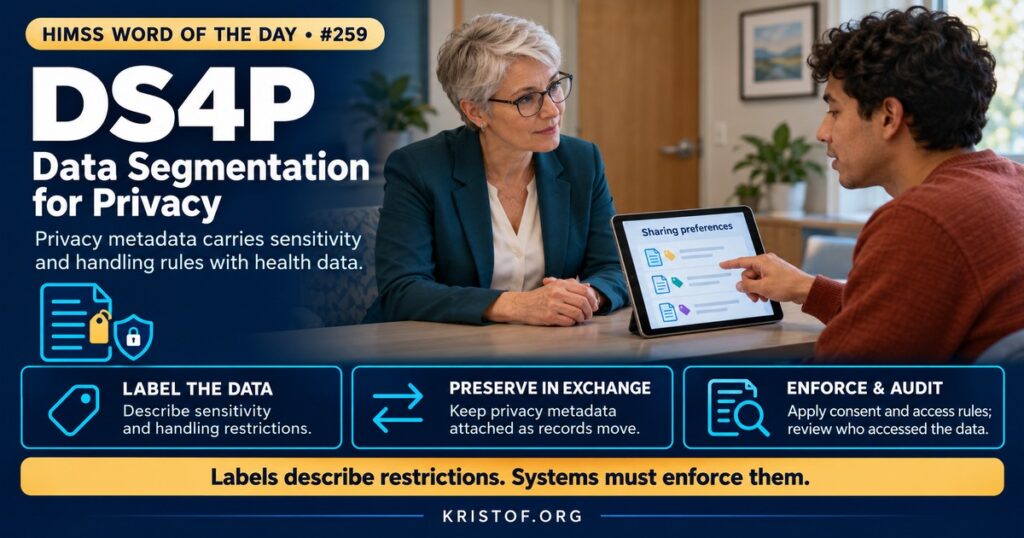
DS4P, short for Data Segmentation for Privacy, is a standard that allows a provider to attach privacy metadata to a Consolidated Clinical Document Architecture (C-CDA) document. According to the HIMSS Dictionary, the metadata expresses how the data are classified and what limits on redisclosure apply under the relevant law, which supports the electronic exchange of this kind of health information.
Some information is subject to rules stricter than the baseline for health data. Examples include substance use disorder treatment records covered by 42 CFR Part 2, and, depending on the state, certain mental health, reproductive health, HIV, or minor consent records. When these records are exchanged electronically, the receiving system needs to know about the restrictions in a form software can use. DS4P addresses this with security labels, which are tags that describe confidentiality, sensitivity, and handling instructions.
| Concept | Meaning | Example |
|---|---|---|
| Segmentation | Separating or marking sensitive data so it can be handled differently | Flagging a substance use treatment note |
| Security label | Metadata describing confidentiality and handling | Restricted, no redisclosure without consent |
| Redisclosure limit | Rule on passing data on to others | Recipient may not share without patient consent |
| Consent directive | Patient’s permission or restriction | Share with a named provider only |
| Enforcement | System behavior based on labels | Hide a section from users not entitled to see it |
⚠️ Exam Alert: DS4P is a tagging standard: it describes sensitivity and restrictions but does not itself enforce them. Systems must act on the labels through access control. 42 CFR Part 2 governs substance use disorder treatment records and includes notice requirements that accompany disclosures. DS4P originally applied to C-CDA, and similar guidance now exists for FHIR.
🌐 Why It Matters: Real-World Healthcare IT Context
Sharing health information improves coordination, but not all information may be shared in the same way. A patient in treatment for substance use disorder may fear that disclosure to employers, insurers, or courts will cause harm, and may avoid care if records cannot be protected. Federal law recognizes this. Under 42 CFR 2.32, each disclosure made with the patient’s written consent must be accompanied by a notice that the record is protected by federal confidentiality rules and that using or disclosing it in legal proceedings against the patient, or making other uses or disclosures, is prohibited unless authorized by the patient’s consent or otherwise permitted. The notice follows the data. DS4P aims to carry that kind of restriction in a computable form so the next system can honor it.
Without segmentation, organizations face a hard choice. They can withhold whole records, which hurts care, or share everything, which risks violating rules and patient trust. Segmentation allows more precise sharing: the medication list may flow while a restricted note does not, or a record may flow with a label that tells the recipient what to do with it. Manual segmentation is slow and error-prone, which is why automated approaches are being developed.
A 2026 study evaluated one such approach, SHARES, an open-source segmentation platform built on FHIR to support patient-directed, granular control of sensitive substance use information in line with 42 CFR Part 2. The team generated 11,519 synthetic FHIR patient records and had physicians classify 1,848 unique clinical terms; the classifications became rules the engine applied. The engine processed 197.6 million FHIR resources across 11 confidentiality thresholds, flagging 17 million items, or 8.64 percent, as sensitive. It achieved about 18,909 resources per second on a commodity laptop, and a full run on 11,519 patients cost under one cent. The authors concluded that automated, rule-based segmentation in a FHIR-native design is feasible and scalable and supports auditability, and noted that future versions would add clinical logic for context. The study used synthetic data, so real-world accuracy and workflow fit remain to be shown.
The standards continue to evolve. HL7 publishes a FHIR Data Segmentation for Privacy implementation guide, in continuous build as of this writing, which provides guidance for applying security labels in FHIR. The guide describes security labels as used by access control systems governing collection, access, use, and disclosure according to organizational, jurisdictional, or personal policy, and builds on the HL7 Healthcare Privacy and Security Classification System. Organizations should check the current published version and the regulations that apply in their states.
Technical labels are only part of the answer. Governance has to decide what counts as sensitive, who may see it, how patient consent is captured and honored, and how the EHR displays restricted content. Labels must be applied accurately, which depends on clinicians documenting in the right places and on coding that reflects the data’s source. Receiving systems must preserve labels and apply them, and not strip them during import. Audit logs should show who accessed restricted data. And break-the-glass and emergency access rules must be defined, since care needs can override restrictions in limited circumstances.
Common data segmentation problems:
- Sensitive information mixed into general notes where it cannot be separated
- Labels applied inconsistently or not at all
- Receiving systems that ignore or strip privacy metadata
- Consent captured on paper, so systems cannot enforce it
- All-or-nothing sharing because segmentation is too hard to do accurately
- Unclear rules for emergency access to restricted data
What supports effective segmentation:
- A clear policy defining sensitive categories and handling rules
- Structured documentation locations for sensitive information
- Security labels carried and honored in exchange
- Electronic capture of patient consent and restrictions
- Auditing of access to restricted data
- Testing of exchange scenarios with partner organizations
🏥 The Nurse’s Perspective: Clinical, Bedside, & Workflow
Nurses handle sensitive information every day, and their documentation choices can make segmentation work or fail.
At the Bedside
A patient may disclose substance use, mental health, or reproductive health information to a nurse in confidence. Knowing where and how to document it, and what the patient has agreed to share, protects both the patient and the organization. Explaining in plain language who can see what, and how to change those choices, helps patients trust the process.
Nurses also face questions from family members and outside callers. Disclosure rules apply even when the request seems well meant.
In Clinical Workflow
Behavioral health and addiction treatment nurses work under the strictest rules. Nurse managers train staff on consent, redisclosure notices, and who may receive records. Case managers coordinating with outside agencies check that consent covers the specific exchange.
Nurse informaticists help determine where sensitive information is recorded in the EHR, how it is flagged, and how it appears to users with different roles. They test scenarios that include emergency access and transfers to other facilities.
In EHR Implementation (Go-Live Perspective)
An Epic Go-Live must account for sensitive record types: restricted notes, confidential results, and consent-based sharing. Analysts configure security and test with realistic cases. At-the-elbow support analysts hear when nurses cannot find restricted information they are entitled to see, or when they see something they think they should not, and they escalate those cases to privacy and build teams at once.
🎓 CAHIMS / CPHIMS & HIMSS Perspective
CAHIMS Exam Domain Mapping
DS4P appears in privacy, standards, and consent management questions:
| CAHIMS Domain | How DS4P Appears |
|---|---|
| Healthcare & Technology Environments | Privacy laws, 42 CFR Part 2, HL7 standards |
| Clinical Informatics | Documentation of sensitive information, consent, emergency access |
| Healthcare Information & Systems Management | Security labels, access control, interfaces, auditing |
| Management & Leadership | Privacy governance, policy, patient trust, compliance |
Key Terms to Know Alongside DS4P
- Security Label — metadata describing sensitivity and handling rules
- 42 CFR Part 2 — federal rule protecting substance use disorder treatment records
- Redisclosure — passing information on to another party
- Consent Directive — patient’s recorded permission or restriction on sharing
- Sensitive Information — data with extra legal or ethical protection
- Access Control — process that grants or denies access to information
HIMSS Organizational Position
HIMSS supports privacy and security in health information through its public policy work, Healthcare Cybersecurity Community, and research. Members can find related resources through the HIMSS Resource Center and Public Policy and Advocacy pages.
🔗 Explore Further: External References
- eCFR — 42 CFR Part 2, Confidentiality of Substance Use Disorder Patient Records https://www.ecfr.gov/current/title-42/chapter-I/subchapter-A/part-2
- HL7 — FHIR Data Segmentation for Privacy (DS4P) Implementation Guide https://build.fhir.org/ig/HL7/fhir-security-label-ds4p/
- HHS — 42 CFR Part 2 Final Rule Fact Sheet https://www.hhs.gov/hipaa/for-professionals/regulatory-initiatives/fact-sheet-42-cfr-part-2-final-rule/index.html
- HHS — Health Information Technology and HIPAA https://www.hhs.gov/hipaa/for-professionals/special-topics/health-information-technology/index.html
- Lee et al. (2026), Applied Clinical Informatics — Assessing the Effectiveness and Scalability of Fast Healthcare Interoperability Resource-Based Granular Data Segmentation Technology https://pubmed.ncbi.nlm.nih.gov/42285541/
Term source: HIMSS Dictionary of Health Information and Technology Terms, Acronyms, and Organizations, 6th Edition (2025). All definitions in this series are paraphrased for editorial purposes. Readers are encouraged to consult the primary source for exact language.
Eric Andrew Kristof, RN, CAHIMS is a Healthcare IT professional and HIMSS Arkansas Chapter member based in Hot Springs Village, AR, with hands-on Epic Go-Live experience and a diverse healthcare and IT background. He writes at kristof.org at the intersection of clinical care and healthcare technology.
Leave a Reply